
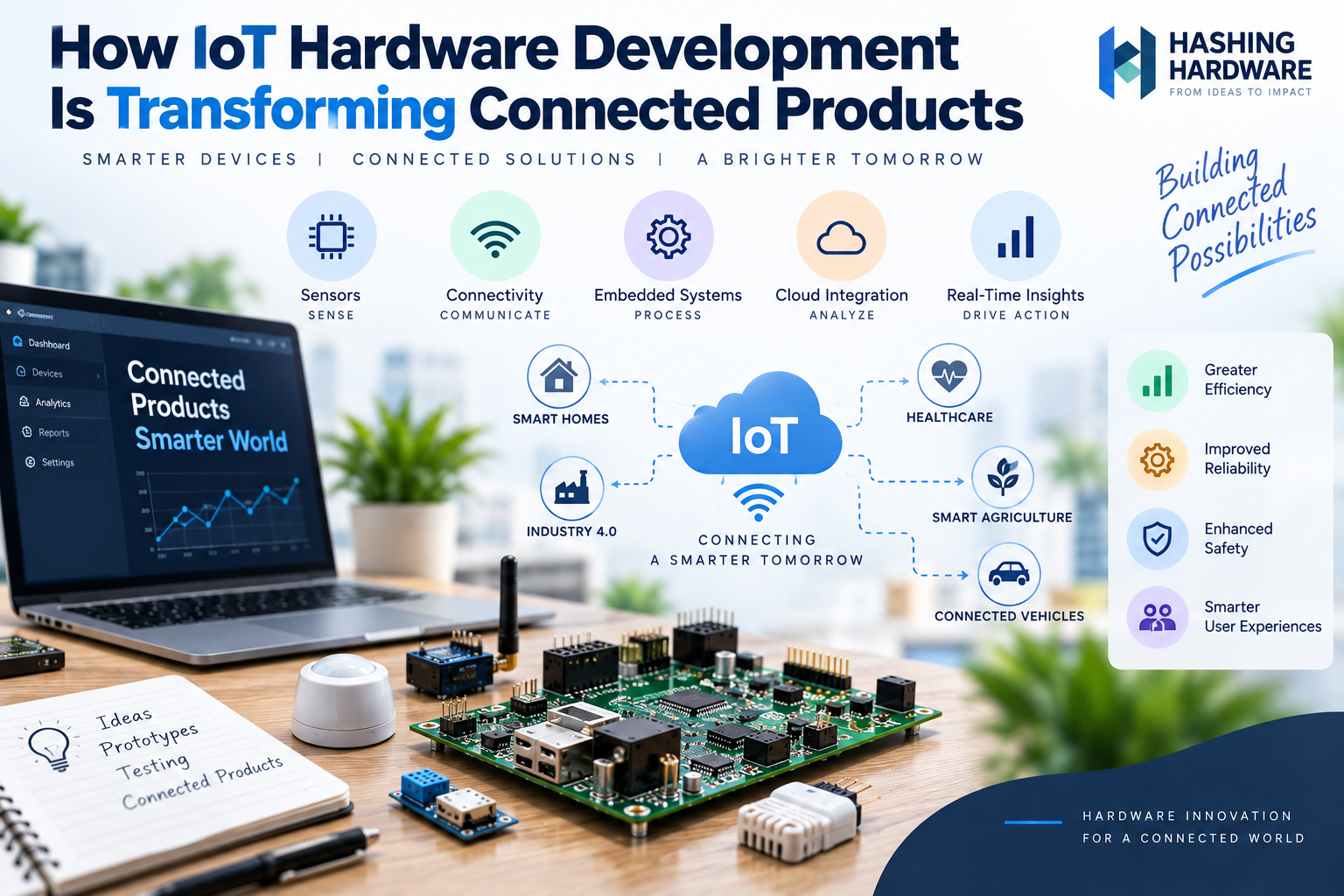
The way products are designed, used, and managed is changing rapidly. Devices that once operated independently can now collect data, communicate with other systems, and respond to changing conditions.
This transformation is being driven by the Internet of Things (IoT).
From smart home devices and industrial equipment to healthcare systems and connected vehicles, IoT is creating products that can interact with their environment and exchange information in real time.
At the center of this transformation is IoT hardware development.
IoT hardware combines physical components such as sensors, processors, communication modules, and power systems with software and cloud technologies. Together, these technologies allow physical products to become connected, intelligent, and more responsive.
What Is IoT Hardware Development?
IoT hardware development is the process of designing and building physical devices that can collect, process, transmit, and sometimes act on data.
An IoT device may include:
- Sensors for collecting information
- A microcontroller or processor
- Wireless or wired communication modules
- Power management components
- Memory and storage
- Input and output interfaces
- Security components
- A custom PCB
These components work together to connect the physical device to software platforms, mobile applications, cloud services, or other connected devices.
For example, a temperature-monitoring device can use a sensor to measure temperature, a microcontroller to process the reading, and a wireless module to send the data to a cloud platform.
The result is more than a physical product. It becomes part of a connected system.
Why Is IoT Hardware Important for Connected Products?
Traditional hardware often performs a predefined function.
A connected product can go further.
It can:
- Collect real-time data
- Communicate with other devices
- Send information to cloud platforms
- Receive remote commands
- Monitor its own operating conditions
- Support predictive maintenance
- Provide information to users
- Receive software or firmware updates
This connectivity changes how products are developed and how they create value after deployment.
Instead of ending at the point of sale, a connected product can continue generating useful data and supporting new services throughout its lifecycle.
Key Components of IoT Hardware
Successful IoT hardware development requires careful integration of several technologies.
1. Sensors
Sensors allow IoT devices to observe their surroundings.
Depending on the application, a product may use sensors for:
- Temperature
- Humidity
- Pressure
- Motion
- Light
- Proximity
- Vibration
- Position
- Air quality
- Current and voltage
Choosing the right sensor is important because sensor accuracy, power consumption, operating range, and environmental tolerance can directly affect product performance.
2. Microcontrollers and Processors
The microcontroller acts as the control center of many IoT devices.
It processes sensor information, controls connected components, manages communication, and executes embedded firmware.
Hardware engineers need to consider factors such as:
- Processing capability
- Memory
- Power consumption
- Communication interfaces
- Security features
- Package size
- Cost
- Long-term component availability
The right processor depends on the product’s requirements.
3. Connectivity Modules
Connectivity allows an IoT product to communicate with external systems.
Depending on the application, an IoT device may use:
- Wi-Fi
- Bluetooth
- Bluetooth Low Energy
- Cellular connectivity
- LoRaWAN
- Zigbee
- Ethernet
- Other wireless technologies
The choice depends on factors such as communication range, bandwidth, power consumption, network availability, and deployment environment.
4. Power Management
Power management is one of the most important aspects of IoT hardware design.
Many IoT devices operate using batteries and may need to function for months or years without frequent maintenance.
Hardware designers may therefore need to optimize:
- Sleep modes
- Power consumption
- Battery capacity
- Voltage regulation
- Charging systems
- Energy efficiency
- Power distribution
A small improvement in power consumption can significantly increase the operating life of a battery-powered product.
5. Custom PCBs
A custom printed circuit board brings the different hardware components together.
PCB design must consider:
- Signal integrity
- Power distribution
- Component placement
- Electromagnetic interference
- Thermal performance
- Manufacturing requirements
- Board size
- Reliability
A well-designed PCB provides the foundation for a reliable IoT product.
How IoT Hardware Is Transforming Connected Products
IoT hardware is changing products in several important ways.
Real-Time Monitoring
Connected devices can continuously collect information and transmit it to users or software platforms.
For example, industrial equipment can monitor temperature, vibration, pressure, and operating conditions.
Instead of discovering a problem after equipment fails, organizations can monitor changes and investigate potential issues earlier.
Remote Control
Connectivity allows users and businesses to interact with products remotely.
A connected device may allow users to:
- Turn equipment on or off
- Change settings
- Monitor status
- Configure operating parameters
- Receive notifications
This can make products more convenient and easier to manage.
Predictive Maintenance
IoT hardware can collect operational data that helps identify unusual behavior.
For example, vibration or temperature sensors can provide information about equipment performance.
When combined with suitable analytics, this data can support maintenance strategies based on actual operating conditions rather than relying only on fixed schedules.
Product Personalization
Connected products can collect usage information and support personalized experiences.
A smart device can learn how it is used and allow software platforms to adjust settings or provide relevant information.
This creates opportunities for products to become more adaptive to individual or business requirements.
Remote Software and Firmware Updates
Connected products can potentially receive firmware updates without requiring physical access to every device.
This can help manufacturers:
- Fix software issues
- Improve functionality
- Address security vulnerabilities
- Add features
- Maintain products after deployment
However, secure update mechanisms are essential to prevent unauthorized firmware changes.
IoT Hardware Development Challenges
Although IoT provides significant opportunities, developing connected hardware introduces several challenges.
Power Consumption
Battery-powered IoT devices need careful energy management.
Hardware and firmware teams must work together to determine when components should operate and when they can enter low-power states.
Connectivity Reliability
A connected product must operate in real-world network conditions.
Weak signals, interference, network interruptions, and changing environments can affect communication.
Products should therefore be designed to handle temporary connectivity failures gracefully.
Security
Connected hardware can introduce additional security risks.
IoT security should be considered from the beginning of product development.
Important areas include:
- Secure device authentication
- Data protection
- Secure communication
- Firmware security
- Secure boot
- Access control
- Secure updates
Security should not be treated as an afterthought.
Thermal Management
Processors, communication modules, power components, and other electronics generate heat.
Poor thermal design can reduce reliability and affect product performance.
Thermal behavior should therefore be evaluated during hardware development and prototype testing.
Manufacturing at Scale
An IoT prototype may work perfectly in a laboratory but still require significant engineering work before mass production.
Manufacturing considerations include:
- Component availability
- PCB fabrication
- Assembly processes
- Testing procedures
- Production cost
- Quality control
- Supply chain planning
Design decisions should consider production requirements early.
The Role of Prototyping in IoT Hardware Development
Prototyping is an important part of developing connected products.
A prototype allows engineering teams to test whether the hardware, firmware, connectivity, and sensors work together as expected.
Testing can reveal problems such as:
- Unexpected power consumption
- Communication failures
- Sensor inaccuracies
- Thermal issues
- PCB problems
- Firmware integration issues
- Mechanical constraints
The development process can then follow an iterative cycle:
Design → Prototype → Test → Analyze → Improve → Prototype Again
This approach allows teams to identify problems before committing to large-scale manufacturing.
Designing IoT Hardware for Scalability
An IoT product may begin as a small prototype but eventually need to support thousands or millions of deployed devices.
Hardware development should therefore consider scalability early.
This can include:
- Selecting components with reliable supply
- Designing efficient manufacturing processes
- Creating automated testing procedures
- Planning firmware update mechanisms
- Considering device identification
- Supporting secure provisioning
- Designing for long-term maintenance
Scalability is not only a software concern. Hardware choices can also affect the long-term success of a connected product.
IoT Hardware and Data-Driven Products
One of the biggest changes introduced by IoT is the relationship between physical products and data.
A traditional product may provide value primarily through its physical function.
A connected product can also generate valuable information.
For example, a device could provide data about:
- Usage patterns
- Performance
- Environmental conditions
- Energy consumption
- Maintenance requirements
- Device health
This information can help businesses understand how products are being used and identify opportunities for improvement.
As a result, IoT hardware development increasingly involves thinking beyond the device itself.
The hardware becomes one part of a larger ecosystem involving:
Device → Connectivity → Cloud → Data → Application → User
The Future of IoT Hardware Development
IoT hardware is continuing to evolve as processors become more capable, connectivity options expand, and devices become smaller and more energy efficient.
Future connected products are likely to place greater emphasis on:
- Edge computing
- AI-enabled devices
- Low-power operation
- Advanced sensors
- Secure connectivity
- Remote device management
- Energy-efficient designs
- Real-time data processing
Edge computing can allow certain data-processing tasks to happen directly on the device rather than sending every piece of information to a remote server.
This can reduce latency, limit unnecessary data transmission, and support applications where fast responses are important.
Best Practices for IoT Hardware Development
A strong IoT product development process should consider the entire product lifecycle.
Some important practices include:
Define Requirements Early
Clearly identify performance, connectivity, power, environmental, security, and cost requirements before starting detailed design.
Select Components Carefully
Consider not only technical specifications but also availability, lifecycle, cost, and manufacturing requirements.
Design for Power Efficiency
Optimize hardware and firmware together, particularly for battery-powered products.
Build and Test Prototypes
Use prototypes to validate electronics, connectivity, sensors, firmware, and mechanical integration.
Consider Security From the Start
Build authentication, secure communication, firmware protection, and update mechanisms into the architecture.
Design for Manufacturing
Consider production, assembly, testing, and component availability before finalizing the design.
Plan for the Product Lifecycle
Think about maintenance, firmware updates, component replacement, support, and eventual product retirement.
Conclusion
IoT hardware development is transforming connected products by combining physical devices with sensors, processors, connectivity, embedded software, and cloud-based systems.
The result is a new generation of products that can monitor conditions, communicate remotely, generate data, receive updates, and provide more responsive experiences.
However, successful IoT development requires more than adding connectivity to an existing product.
Engineers need to consider hardware architecture, PCB design, power management, connectivity, security, firmware, testing, and manufacturing as parts of one integrated development process.
The most effective approach is to build, test, measure, and improve throughout the development cycle.
As businesses continue to adopt connected technologies, well-designed IoT hardware will play an increasingly important role in turning product concepts into reliable, intelligent, and scalable solutions.