
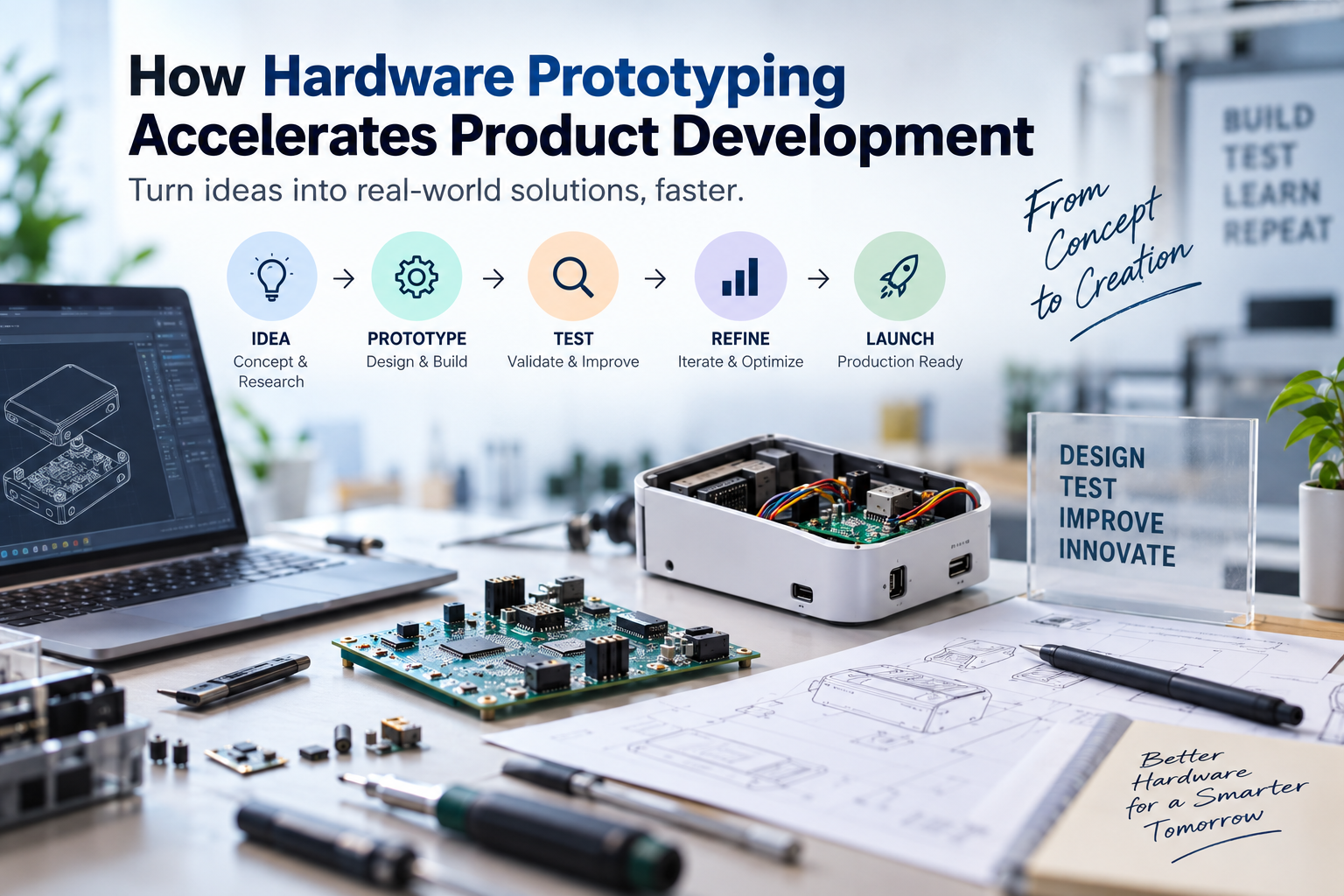
Hardware prototyping is a key step in modern product development. It helps engineering teams turn an idea into a physical product that can be tested, improved, and validated before mass production.
Building a prototype early can reveal design problems, reduce development risks, and improve product quality. It also gives teams a practical way to test how a product works in real-world conditions.
In this guide, we explore how hardware prototyping accelerates product development and why it is important for businesses developing new hardware products.
What Is Hardware Prototyping?
Hardware prototyping is the process of creating an early physical version of a product or system. The prototype represents important aspects of the final product, such as its design, functionality, electronics, or mechanical components.
A prototype does not always need to be production-ready. Its purpose is to help engineers test ideas and identify areas that need improvement.
Depending on the project, teams may create several prototype versions before reaching the final design.
Why Is Hardware Prototyping Important?
Developing hardware can involve significant time and investment. Changes made after manufacturing begins can be expensive and difficult to implement.
Prototyping allows teams to identify problems earlier in the development process.
A prototype can help teams:
- Test product functionality
- Identify design problems
- Validate engineering decisions
- Improve product usability
- Reduce development risks
- Test components and materials
- Gather feedback
- Prepare for manufacturing
Early testing can prevent costly changes later in the product development cycle.
How Hardware Prototyping Accelerates Product Development
1. Turns Ideas Into Physical Products
A concept on paper may look promising, but physical products often behave differently from initial expectations.
A prototype transforms an idea into something engineers can see, touch, and test.
This makes it easier to evaluate important factors such as size, component placement, ergonomics, connectivity, and overall functionality.
Instead of relying only on simulations or design files, teams can work with a physical representation of the product.
2. Identifies Design Problems Early
One of the biggest benefits of hardware prototyping is early problem detection.
A prototype can reveal issues that may not be obvious during the initial design stage. These issues could involve component interference, heat generation, power consumption, mechanical fit, or usability.
Finding these problems early gives engineers time to make changes before production.
This can reduce redesign costs and prevent delays later in the development process.
3. Speeds Up Testing and Validation
Testing is an essential part of hardware product development.
A working prototype allows engineers to test individual components and the complete system. They can evaluate whether the product performs according to its technical requirements.
Testing may include:
- Functional testing
- Electrical testing
- Mechanical testing
- Thermal testing
- Performance testing
- Usability testing
- Environmental testing
The results provide useful information for improving the next prototype.
4. Supports Faster Design Iterations
Hardware development is rarely a one-step process.
Teams often need to make several design changes before reaching a reliable solution.
Prototyping creates a practical feedback loop:
Design → Prototype → Test → Identify Issues → Improve → Prototype Again
This iterative process allows engineers to make informed decisions based on real test results.
Instead of spending too much time trying to create a perfect design on the first attempt, teams can gradually improve the product.
5. Reduces Development Risks
Hardware products can involve complex electronics, mechanical components, software, and manufacturing requirements.
Each element introduces potential risks.
Prototyping helps teams identify technical risks before committing to large-scale production.
For example, a prototype may reveal that a selected component does not provide the expected performance. Engineers can then evaluate alternative components before the design moves to manufacturing.
This approach helps reduce uncertainty and improves development planning.
6. Improves Product Quality
Product quality depends on more than meeting basic technical specifications.
A prototype allows teams to examine how different parts of a product work together.
Engineers can test reliability, durability, performance, and usability. They can also identify opportunities to simplify the design or improve the user experience.
Multiple prototype iterations can therefore contribute to a more refined final product.
7. Helps Control Development Costs
Prototyping requires an initial investment, but it can help reduce larger expenses later.
Manufacturing a product at scale before discovering a major design problem can result in significant costs. Correcting tooling, components, PCB designs, or mechanical structures after production begins may also require additional time.
Early prototypes provide an opportunity to identify these issues before they become expensive manufacturing problems.
8. Makes Team Collaboration Easier
Hardware projects often involve engineers, designers, developers, product managers, manufacturers, and other stakeholders.
A physical prototype gives everyone a common reference point.
Instead of discussing an idea only through drawings or specifications, teams can examine the product directly.
This can make technical discussions more productive and help stakeholders understand design decisions.
9. Helps Gather Real-World Feedback
A prototype can be used to collect feedback from users, customers, engineers, and other stakeholders.
Real-world feedback may reveal issues that internal testing does not identify.
For example, users may find that a device is difficult to operate, too large, uncomfortable to hold, or confusing to use.
Teams can use this feedback to make improvements before final production.
10. Supports Manufacturing Preparation
A prototype is also useful when preparing a product for manufacturing.
Engineers can evaluate whether components are practical to source and whether the design can be manufactured efficiently.
This stage can help identify opportunities for:
- Design for Manufacturing (DFM)
- Design for Assembly (DFA)
- Component optimization
- Cost reduction
- Manufacturing process improvements
- Supply chain planning
Addressing these factors early can make the transition from prototype to production smoother.
Common Types of Hardware Prototypes
Different development stages require different types of prototypes.
Proof-of-Concept Prototype
A proof-of-concept prototype demonstrates whether a technical idea is feasible.
It usually focuses on core functionality rather than appearance or final manufacturing requirements.
Functional Prototype
A functional prototype is designed to demonstrate how the product will operate.
It may include working electronics, firmware, sensors, communication systems, or other important components.
Engineering Prototype
An engineering prototype is closer to the final product.
It is typically used for detailed testing, validation, and engineering improvements.
Appearance Prototype
An appearance prototype focuses on the physical design of the product.
It can help teams evaluate size, shape, materials, colors, and overall appearance.
Production Prototype
A production prototype is developed with manufacturing requirements in mind.
It helps validate the final design, assembly process, components, and production methods before mass manufacturing.
The Hardware Prototyping Process
A structured prototyping process can make product development more efficient.
Step 1: Define Product Requirements
Start by identifying the product’s purpose, target users, technical requirements, and performance expectations.
Clear requirements provide a foundation for the prototype.
Step 2: Create the Initial Design
Engineers and designers develop the initial hardware architecture and design.
This may include PCB layouts, mechanical designs, component selection, enclosure concepts, and system architecture.
Step 3: Build the Prototype
The prototype is assembled using appropriate components and manufacturing methods.
The prototype should focus on the specific features or risks that need to be evaluated.
Step 4: Test the Prototype
Engineers test the prototype against defined requirements.
The results help identify technical problems and areas for improvement.
Step 5: Analyze the Results
Testing data should be reviewed carefully.
Teams can determine which design elements are working and which require changes.
Step 6: Improve the Design
Engineers make necessary modifications based on test results and feedback.
The updated design is then used to create the next prototype.
Step 7: Validate the Final Design
Once the design reaches the required level of performance, teams can conduct more comprehensive validation.
This helps confirm that the product is ready for the next stage.
Step 8: Prepare for Manufacturing
The validated design can then be optimized for manufacturing, assembly, sourcing, and production.
How Modern Technologies Improve Hardware Prototyping
Modern development technologies have made prototyping faster and more flexible.
3D Printing
3D printing allows teams to create physical components and enclosures quickly.
It is particularly useful for evaluating product dimensions, mechanical fit, and appearance.
CNC Machining
CNC machining can produce accurate prototype components from materials such as aluminum, plastics, and other engineering materials.
It is useful when prototypes require greater strength or precision.
Rapid PCB Prototyping
Rapid PCB development allows engineers to test electronic designs without waiting for the complete manufacturing process.
This can shorten development cycles and help teams identify circuit-level problems earlier.
Simulation and CAD Tools
Computer-aided design and simulation tools allow engineers to evaluate designs before building physical prototypes.
When combined with physical testing, these tools can improve development efficiency.
Embedded Development Platforms
Development boards and embedded platforms can help engineers quickly test sensors, processors, communication modules, and other electronic functions.
They are often useful during early proof-of-concept development.
Hardware Prototyping vs. Final Production
A prototype is not necessarily the final product.
The prototype is primarily used to learn, test, and improve.
The production version must meet additional requirements related to:
- Manufacturing
- Reliability
- Safety
- Cost
- Compliance
- Supply chain availability
- Scalability
- Quality control
Moving from prototype to production therefore requires additional engineering and validation.
Common Challenges in Hardware Prototyping
Although prototyping provides many benefits, teams can face several challenges.
Component Availability
Some components may have long lead times or become unavailable.
Selecting alternative components early can help reduce supply chain risks.
Prototype Costs
Multiple prototype iterations can increase costs.
Teams should focus each iteration on specific technical questions and development risks.
Design Changes
Frequent changes can affect schedules.
A structured testing and documentation process can help teams manage iterations more effectively.
Manufacturing Constraints
A prototype may work well but still be difficult or expensive to manufacture.
Manufacturing considerations should therefore be introduced early in the development process.
Best Practices for Effective Hardware Prototyping
To get the most value from prototyping, development teams should follow a structured approach.
Start Prototyping Early
Do not wait until every design detail is complete.
Early prototypes can answer important technical questions before significant resources are committed.
Define Clear Testing Goals
Each prototype should have a specific purpose.
For example, one prototype may test power consumption while another evaluates mechanical fit.
Document Every Iteration
Record design changes, test results, failures, and improvements.
Good documentation helps teams understand what changed and why.
Focus on High-Risk Areas
Prioritize the features that could create the greatest technical or manufacturing risks.
Testing these areas early can help prevent major problems later.
Consider Manufacturing From the Beginning
A design should not only work. It should also be practical to manufacture.
Considering DFM and DFA principles early can reduce production challenges.
Use Feedback to Improve the Product
Collect feedback from engineers, manufacturers, stakeholders, and potential users.
Use that feedback to guide future prototype iterations.
When Should You Use Hardware Prototyping?
Hardware prototyping is valuable across many types of product development projects.
It can be used for:
- IoT devices
- Consumer electronics
- Industrial equipment
- Wearable technology
- Embedded systems
- Smart home devices
- Robotics
- Medical devices
- Automotive electronics
- Connected hardware products
The level and type of prototyping will depend on the product’s technical requirements and development stage.
Conclusion
Hardware prototyping plays an important role in accelerating product development. It gives engineering teams a practical way to test ideas, identify problems, validate designs, and improve products before moving to large-scale production.
By using rapid prototyping, structured testing, iterative development, and early manufacturing consideration, businesses can reduce uncertainty and make better engineering decisions.
A well-planned prototyping process does more than create an early version of a product. It creates a feedback loop that helps transform an idea into a reliable, manufacturable, and market-ready hardware solution.
For companies developing new hardware products, investing in the right prototyping strategy can help create a more efficient path from concept to production.