
Artificial intelligence is changing computer hardware faster than ever. As AI models grow, they need more memory, more bandwidth, and faster access to data. However, today’s memory systems still have a major limitation: capacity and speed do not always scale together.
High Bandwidth Memory (HBM) has become a key part of modern AI accelerators. The latest HBM4 technology offers extremely high bandwidth and helps GPUs process large AI workloads. Yet, HBM remains expensive and has limited capacity compared with NAND flash.
Now, a new technology is trying to fill that gap.
High Bandwidth Flash (HBF) combines NAND flash with a high-speed interface designed for AI systems. The goal is simple: provide much more capacity than HBM while offering far more bandwidth than a traditional SSD.
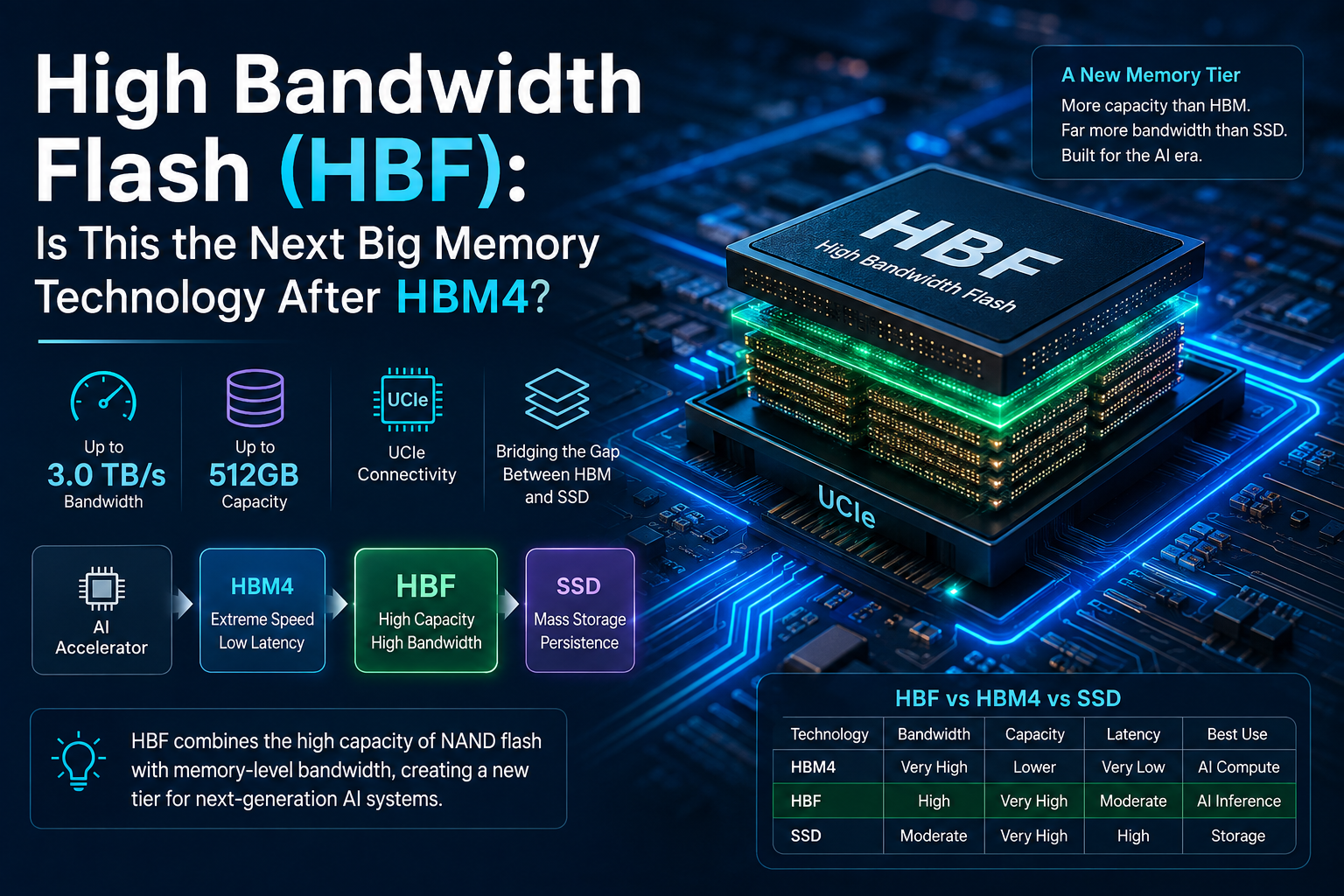
In August 2026, SK hynix and SanDisk introduced the first HBF standard specification through the Open Compute Project (OCP). The specification supports up to 512GB of capacity and bandwidth grades ranging from about 0.4TB/s to 3.0TB/s. It also uses UCIe to connect HBF with processors such as GPUs and CPUs.
So, is HBF the next big memory technology after HBM4?
It could be one of the most important new memory layers for AI, but it is more likely to complement HBM4 than replace it.
What Is High Bandwidth Flash?
High Bandwidth Flash, or HBF, is a new memory technology based on NAND flash.
At first, that may sound similar to an SSD. However, HBF targets a different part of the computer memory hierarchy.
A traditional AI system can be simplified like this:
AI Accelerator → HBM → DRAM → SSD → Long-Term Storage
HBM sits very close to the processor. It delivers extremely high bandwidth and very low latency.
An SSD offers much more storage capacity. However, its bandwidth and latency make it unsuitable for replacing HBM.
HBF aims to create a new layer between these two technologies:
AI Accelerator → HBM → HBF → SSD
This approach gives system designers another option. They can keep the most important data in HBM while moving larger data sets into HBF.
As a result, AI systems could access more data without putting everything inside expensive HBM.
Why Does AI Need More Memory?
AI models are becoming larger and more complex.
Large language models can contain billions or even trillions of parameters. In addition, AI services must handle model weights, user requests, KV caches, and other data during inference.
Therefore, memory capacity has become a major part of AI system design.
A powerful GPU can perform huge numbers of calculations. However, that performance means little if the processor has to wait for data.
This problem is often called the memory wall.
HBM helps solve the bandwidth side of this problem. However, adding more HBM also increases system cost and packaging complexity.
That creates a difficult balance:
- AI needs more memory.
- AI also needs faster memory.
- HBM provides excellent speed.
- NAND provides excellent capacity.
- Traditional SSDs cannot provide enough bandwidth for some AI workloads.
HBF tries to connect these two worlds.
HBF vs HBM4: What Is the Difference?
HBF and HBM4 are not the same technology.
HBM4 uses DRAM and focuses on extremely high performance. HBF uses NAND flash and focuses on high capacity with much higher bandwidth than normal storage.
Here is a simple comparison:
| Feature | HBM4 | High Bandwidth Flash (HBF) |
|---|---|---|
| Memory type | DRAM | NAND flash |
| Main goal | Maximum speed | High capacity + high bandwidth |
| Latency | Very low | Higher than HBM |
| Capacity | Lower | Much higher |
| Bandwidth | Extremely high | Up to 3.0TB/s in the first specification |
| Persistent storage | No | Yes, based on NAND |
| Main target | AI compute | AI inference and data-heavy workloads |
| System position | Closest to processor | Between HBM and SSD |
The difference is important.
HBM4 should handle data that the processor needs immediately. Meanwhile, HBF could hold larger amounts of data that the AI system needs to access frequently but does not need at HBM-level latency.
Therefore, the two technologies can work together.
HBF Can Reach Up to 512GB
One of the biggest advantages of HBF is capacity.
The first HBF specification supports up to 512GB using 8-high and 16-high NAND die stacks. The specification also defines three bandwidth grades, ranging from around 0.4TB/s to 3.0TB/s.
That capacity matters because AI models continue to grow.
Instead of placing every model parameter in HBM, an AI system could use different memory layers for different types of data.
For example:
HBM4
- Frequently accessed data
- Critical computation data
- High-speed cache data
HBF
- Large model weights
- Read-heavy AI data
- Large inference data sets
- Data that does not need the lowest possible latency
SSD
- Training data
- Backups
- Model checkpoints
- Long-term storage
This tiered approach could help AI systems use expensive high-speed memory more efficiently.
Up to 3TB/s of Bandwidth
Capacity is only part of the HBF story.
The technology also targets very high bandwidth.
The first HBF standard defines bandwidth levels from approximately 0.4TB/s to 3.0TB/s.
That is far beyond the bandwidth normally associated with storage devices.
However, there is an important difference between bandwidth and latency.
High bandwidth means the system can move a large amount of data quickly. Latency measures how long the system waits before receiving data.
HBF can provide impressive bandwidth, but it will not automatically match HBM4’s latency.
Therefore, HBF should not replace HBM for every task.
Instead, its value comes from combining:
Large capacity + high bandwidth + NAND economics
That combination could make HBF useful for large AI inference systems.
Why AI Inference Could Drive HBF Adoption
AI inference may become one of the biggest markets for HBF.
During inference, an AI system must load and access large model data while responding to users.
As more people use AI services, servers must process more requests at the same time. Consequently, memory capacity becomes increasingly important.
Researchers are already studying HBF for large language model inference. Recent research found that HBF could increase batch size, improve throughput, and reduce the minimum GPU requirements in some AI serving systems. However, the researchers also identified challenges around write performance and endurance.
This shows why HBF is interesting.
An AI server could keep the hottest data in HBM. At the same time, it could store larger model data in HBF.
As a result, the GPU may handle larger models without requiring an equally large amount of HBM.
HBF Uses UCIe for Processor Connectivity
Another important part of the HBF design is UCIe.
UCIe stands for Universal Chiplet Interconnect Express. It is an open standard designed to connect different chiplets inside advanced computing systems.
SK hynix and SanDisk selected UCIe as the connection interface between HBF and processors. This design could allow HBF to work with different types of CPUs and GPUs.
Why does that matter?
Modern processors increasingly use chiplet-based designs.
Instead of building everything into one huge chip, manufacturers can combine several smaller chiplets.
A future AI system could therefore include:
Compute Chiplet + HBM4 + HBF + I/O Chiplets
This modular approach could make it easier to increase memory capacity without redesigning the entire processor.
HBF Is Not Simply a Faster SSD
It is easy to describe HBF as a faster SSD.
However, that description misses the main idea.
A normal SSD focuses on persistent storage. It stores data even after the system shuts down.
HBF uses NAND as well, but its architecture targets much higher bandwidth and closer integration with processors.
In other words, HBF aims to behave more like a high-capacity memory layer than a traditional storage drive.
That difference could be especially useful in AI servers.
The system could move selected data between HBM, HBF, and SSD depending on how often that data is needed.
This creates a more flexible memory hierarchy.
Open Standards Could Help HBF Grow
HBF is also interesting because the technology is moving toward an open industry standard.
SK hynix and SanDisk released the first HBF specification through the Open Compute Project. The specification covers areas such as interfaces, electrical requirements, packaging, reliability, and software I/O.
An open standard can help different companies build products that work together.
The HBF consortium already includes companies such as Google and Tenstorrent, adding support from both AI infrastructure and processor ecosystems.
This could become important as AI hardware becomes more modular.
However, industry support does not guarantee success.
HBF still needs working products, software support, strong performance, and competitive costs.
What Are the Biggest HBF Challenges?
HBF has strong potential, but several challenges remain.
1. Higher Latency Than HBM
The biggest limitation is latency.
NAND flash does not provide the same low-latency access as DRAM-based HBM.
Therefore, software and hardware must decide which data should remain in HBM and which data can move into HBF.
2. Write Performance
AI workloads do not only read data.
Some workloads also require frequent writes.
Recent research found that limited write performance could restrict some HBF use cases.
For that reason, early HBF systems may focus more heavily on read-intensive AI workloads.
3. Endurance
NAND flash has a limited number of program and erase cycles.
Therefore, HBF designers must manage data movement carefully.
The technology needs enough endurance for demanding AI environments.
4. Software Support
Hardware alone cannot solve the memory problem.
Operating systems, AI frameworks, GPU software, and memory managers must understand the new memory tier.
The system needs to decide:
What should stay in HBM?
What should move to HBF?
What should remain on SSD?
Efficient software will be just as important as fast hardware.
5. Cost
HBF must provide a strong price-to-performance advantage.
If HBF becomes too expensive, data centers may continue using other memory and storage solutions.
On the other hand, if manufacturers can deliver large capacity at a reasonable cost, HBF could become very attractive for AI infrastructure.
Could HBF Replace HBM4?
Probably not.
Instead, HBF could make HBM4 more effective.
Think of HBM4 as the fastest working memory and HBF as a larger supporting memory layer.
The two technologies can divide the workload.
HBM4 can store data that requires extremely fast access. Meanwhile, HBF can hold larger amounts of data that do not need HBM-level latency.
Therefore, the future may look more like this:
HBM4 + HBF + SSD
rather than:
HBM4 → HBF
This distinction is important.
HBF is not simply the next generation of HBM. Instead, it could become a new part of the AI memory hierarchy.
HBF Could Change AI Data Center Design
AI data centers are already facing several hardware challenges.
They need more compute power, more memory, faster networking, better cooling, and lower power consumption.
Memory capacity adds another challenge.
HBF could help by moving some of the memory burden away from HBM.
For example, a server could use HBM for the most active data and HBF for larger pools of model data.
As a result, the same accelerator could potentially support larger models or more simultaneous inference requests.
That could improve the economics of AI infrastructure.
However, actual gains will depend on software design and workload behavior.
HBF Could Be Especially Important for Large AI Models
Large language models are only getting bigger.
At the same time, AI systems are becoming more complex. Mixture-of-Experts models, agentic AI systems, multimodal models, and other workloads can all increase memory demands.
Consequently, AI hardware needs more flexible memory architectures.
HBF could provide one answer.
Instead of forcing every piece of data into HBM, system designers could place data according to its importance and access frequency.
This approach is called tiered memory.
SK hynix has also presented HBF as part of a broader tiered-memory strategy for next-generation AI infrastructure.
The idea is simple:
Use the fastest memory for the most important data and larger memory layers for everything else.
When Could HBF Become Mainstream?
HBF is still an emerging technology.
The first standard specification appeared in August 2026. Therefore, widespread deployment will take time.
There is, however, a major development to watch.
Recent reporting says SanDisk has already taped out its first HBF product. The company reportedly expects initial samples in 2027, with mass production targeted for 2028.
That timeline makes HBF more than a theoretical concept.
The industry is now moving from standard development toward actual hardware.
Still, adoption will depend on several factors.
Manufacturers must prove performance. Data centers must see a clear economic benefit. Software companies must support the architecture. Finally, AI accelerator vendors must integrate HBF into their platforms.
HBF vs HBM4 vs SSD: Which One Wins?
The answer depends on the workload.
HBM4 wins on speed and low latency.
HBF wins on the balance between capacity and bandwidth.
SSDs win on large-scale persistent storage.
Therefore, there may not be a single winner.
Instead, the future AI server could use all three.
| Technology | Best Use |
|---|---|
| HBM4 | Fast AI computation |
| HBF | Large AI memory pools |
| SSD | Persistent storage |
| HDD/Cloud | Long-term and large-scale data |
This layered design could become more important as AI models continue to grow.
The Future of HBF
High Bandwidth Flash represents a different way of thinking about memory.
For years, the industry focused on making processors faster.
Today, the bigger challenge is often moving enough data to those processors.
HBM4 solves part of that problem by delivering enormous bandwidth.
HBF takes another approach. It combines NAND’s capacity advantages with a much faster processor-facing connection.
As a result, HBF could create a new middle layer between HBM and SSDs.
The technology still faces challenges. Latency, endurance, write performance, software support, and cost will all determine its success.
Nevertheless, the early momentum is significant.
SK hynix and SanDisk have already released an open specification. Google and Tenstorrent have joined the HBF ecosystem. SanDisk is reportedly targeting product samples in 2027.
These developments suggest that HBF is moving quickly from an idea toward real AI hardware.
Final Verdict: Is HBF the Next Big Memory Technology After HBM4?
High Bandwidth Flash may not replace HBM4, but it could become one of the most important memory technologies around it.
The AI industry needs more than faster GPUs.
It needs larger memory pools, higher bandwidth, efficient data movement, and better system economics.
HBM4 can provide extreme speed. Meanwhile, HBF could provide much more capacity without relying entirely on expensive high-speed DRAM.
That combination could be powerful.
The most likely future is not an HBM4 versus HBF battle.
Instead, AI servers could use:
HBM4 for speed → HBF for capacity → SSD for storage
If manufacturers solve the latency, endurance, software, and cost challenges, HBF could become an important part of next-generation AI infrastructure.
The technology is still young. However, 2026 has already produced a major milestone with the first open HBF specification.
The next big AI hardware battle may not be only about GPUs. It may be about the memory architecture that keeps those GPUs fed with data.
And HBF could be one of the technologies that changes the game.
Frequently Asked Questions
What is High Bandwidth Flash?
High Bandwidth Flash (HBF) is a NAND-based memory technology designed to provide much higher bandwidth than traditional storage while offering greater capacity than HBM.
How much capacity can HBF support?
The first HBF specification supports up to 512GB using 8-high and 16-high NAND die stacks.
How fast is HBF?
The first specification defines bandwidth levels from approximately 0.4TB/s to 3.0TB/s.
Is HBF faster than HBM4?
HBF can deliver very high bandwidth, but HBM4 still has major advantages in latency and processor-level performance. HBF targets a different role in the memory hierarchy.
Will HBF replace HBM4?
Probably not. HBF is better viewed as a complementary technology that can provide additional capacity alongside HBM4.
Why is HBF important for AI?
AI models continue to grow, and memory capacity has become a major system limitation. HBF could provide a larger memory layer for AI inference without requiring all data to reside in HBM.
Who is developing HBF?
SK hynix and SanDisk are leading the current HBF standardization effort. Google and Tenstorrent are also participating in the HBF consortium.
When will HBF products arrive?
SanDisk has reportedly taped out an HBF product and is targeting initial samples in 2027, with mass production expected in 2028.
Conclusion
AI hardware is entering a new phase.
The industry no longer needs only faster processors. It also needs smarter ways to store and move the enormous amount of data those processors consume.
High Bandwidth Flash could become an important part of that solution.
It brings together the capacity of NAND and the high-bandwidth approach needed by modern AI systems. More importantly, it could create a new memory layer between HBM4 and traditional SSD storage.
The technology still has challenges, but the direction is clear.
HBM4 may provide the speed. HBF could provide the scale. SSDs will provide the storage.
Together, these technologies could form the memory architecture behind the next generation of AI systems.