Artificial intelligence is pushing data centers to move more data than ever. Modern AI servers connect thousands of GPUs, switches, and memory systems. As a result, traditional electrical connections are facing new limits in speed, power, and signal quality.
This is where Co-Packaged Optics (CPO) could make a major difference.
What Is Co-Packaged Optics?
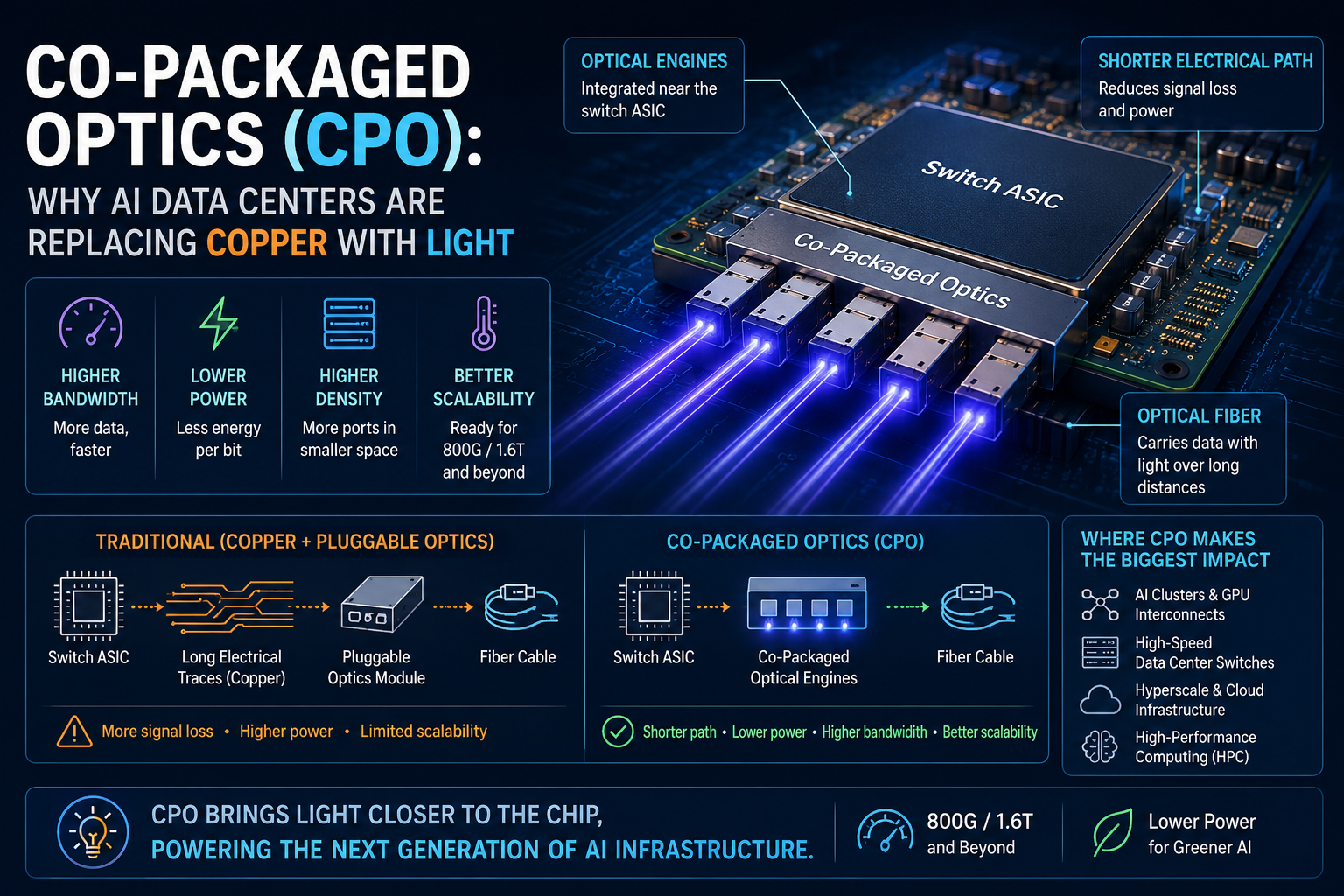
CPO places optical components much closer to the main switch or computing chip. Instead of sending high-speed electrical signals across longer copper traces before converting them into light, CPO moves the optical conversion closer to the silicon.
The basic idea is:
Chip → Optical Engine → Fiber → Optical Engine → Chip
This shorter electrical path can help reduce signal loss and power consumption.
Why Is AI Driving CPO?
AI workloads create huge amounts of data traffic. GPUs constantly exchange information while training and running large AI models.
As network speeds move toward 800G and 1.6T, electrical connections become harder to scale efficiently. Therefore, optical networking is becoming increasingly important for AI infrastructure.
CPO can help provide:
- Higher bandwidth density
- Better energy efficiency
- Shorter electrical connections
- Improved scalability
- Faster communication between AI systems
CPO vs Copper
Copper is still useful for short connections because it is affordable and easy to service.
However, optical links have a major advantage when bandwidth and distance increase.
A future AI data center may therefore use:
Copper → Short connections
Pluggable optics → Flexible network links
CPO → Ultra-high-bandwidth AI systems
CPO is not about eliminating copper completely. Instead, it gives data centers another way to handle extreme bandwidth requirements.
The Role of Silicon Photonics
CPO is closely connected to silicon photonics, which allows optical components to work closely with semiconductor technology.
As AI chips become faster, moving data between them becomes a bigger challenge. Silicon photonics and CPO could help solve this problem by using light instead of relying only on electrical signals.
Companies across the semiconductor and optical industries are developing technologies for next-generation AI networking, including CPO platforms and 1.6T optical connectivity. (tomshardware.com)
The Future of AI Networking
CPO still faces challenges, including cooling, manufacturing complexity, reliability, and serviceability.
However, the direction is clear.
AI needs more computing power, but it also needs faster connections between those processors.
The future AI data center may not just be built around faster chips. It may also be built around faster communication between those chips.
And increasingly, that communication could happen with light instead of copper.