
Introduction
Cloud computing has transformed the way modern digital infrastructure operates. Enterprises, hyperscale data centers, artificial intelligence platforms, edge computing systems, streaming services, financial institutions, and global internet applications all rely on cloud environments to deliver scalable and high-performance computing resources. As cloud workloads continue to expand, networking infrastructure has become one of the most critical components supporting modern digital ecosystems.
At the center of cloud networking lies the Network Interface Card (NIC) — the hardware component responsible for enabling communication between servers and networks. Traditional NICs were primarily designed for basic data transmission, but modern cloud computing environments require far more advanced capabilities, including ultra-high bandwidth, low latency, virtualization acceleration, AI workload optimization, security offloading, and intelligent traffic management.
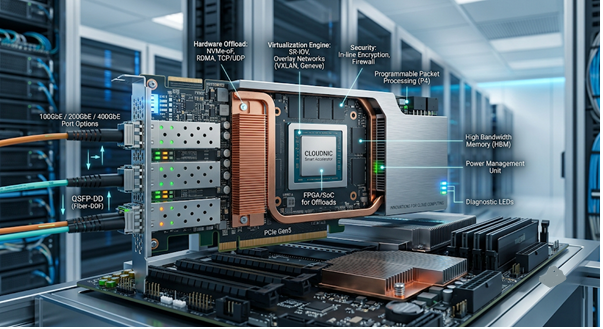
To meet these demands, modern networking systems are adopting highly advanced NIC architectures such as SmartNICs, programmable NICs, AI-accelerated network interfaces, and hardware-offloaded virtualization technologies. These innovations are transforming how cloud infrastructure handles communication, scalability, and computational efficiency.
What Is a Network Interface Card (NIC)?
A Network Interface Card is a hardware component that enables devices such as servers and computers to connect to communication networks.
NICs handle:
- Data transmission
- Packet reception
- Network protocol processing
- Communication between systems
In cloud infrastructure, NICs are critical for maintaining high-speed communication between:
- Servers
- Storage systems
- Virtual machines
- Containers
- Edge devices
- Cloud applications
Why NIC Innovation Is Important for Cloud Computing
Modern cloud environments generate enormous network traffic volumes due to:
- AI workloads
- Big data analytics
- Video streaming
- Virtualization
- Distributed applications
- Edge computing
- Multi-cloud architectures
Traditional NICs create several bottlenecks:
- CPU overhead
- Latency limitations
- Limited scalability
- Inefficient virtualization handling
Advanced NIC innovations help solve these challenges.
Evolution of Network Interface Cards
Traditional NICs
Earlier NICs focused mainly on:
- Ethernet connectivity
- Basic packet handling
- Standard protocol processing
Most networking tasks relied heavily on CPUs.
Modern Cloud NICs
Modern NICs include advanced capabilities such as:
- Hardware acceleration
- AI-assisted processing
- Security offloading
- Programmable packet processing
- Virtualization support
These enhancements improve cloud performance significantly.
Core Components of Modern NIC Hardware
Packet Processing Engines
Handle high-speed packet transmission and reception.
Memory Buffers
Temporarily store incoming and outgoing packets.
DMA Controllers
Enable Direct Memory Access for faster data transfer.
Hardware Accelerators
Offload networking tasks from CPUs.
Security Modules
Support encryption and secure communication.
SmartNIC Technology
SmartNICs are advanced programmable network interface cards designed for cloud-scale infrastructure.
Capabilities
SmartNICs can perform:
- Packet filtering
- Virtual switching
- Security enforcement
- Traffic management
- Storage acceleration
- AI-assisted networking
Without burdening the server CPU.
Why SmartNICs Matter
Traditional CPUs often spend significant resources handling networking operations.
SmartNICs reduce CPU overhead by offloading tasks such as:
- Encryption
- Firewall processing
- Load balancing
- Virtual network management
This improves server efficiency and scalability.
Data Processing Units (DPUs)
DPUs represent the next evolution of NIC technology.
What Is a DPU?
A DPU is a specialized processor designed to manage:
- Networking
- Security
- Storage
- Infrastructure services
DPUs combine:
- Multi-core processors
- Hardware accelerators
- High-speed networking interfaces
Into a single intelligent infrastructure platform.
Programmable NIC Architectures
Modern cloud environments require adaptable networking systems.
Programmable NICs allow organizations to customize hardware behavior for specific workloads.
Benefits
- Flexible packet processing
- Dynamic protocol support
- Custom security functions
- Application-specific optimization
This enables highly specialized cloud infrastructure.
Hardware Offloading in Cloud NICs
One of the most important NIC innovations is hardware offloading.
What Is Hardware Offloading?
Specific networking tasks are transferred from CPUs to dedicated NIC hardware.
Common Offloaded Tasks
- TCP/IP processing
- Encryption
- Compression
- Packet filtering
- Storage networking
This significantly improves overall system performance.
TCP Offload Engines (TOE)
TCP processing consumes substantial CPU resources.
TOE hardware accelerates:
- TCP segmentation
- Checksum calculations
- Connection management
This reduces server workload and latency.
RDMA Technology
Remote Direct Memory Access (RDMA) enables direct memory communication between systems.
Advantages
- Ultra-low latency
- Reduced CPU usage
- Faster data transfer
- Improved distributed computing performance
RDMA is especially important for:
- AI clusters
- High-performance computing
- Cloud storage systems
NIC Virtualization Technologies
Cloud computing heavily relies on virtualization.
Modern NICs support advanced virtualization through:
SR-IOV (Single Root I/O Virtualization)
Allows multiple virtual machines to share NIC hardware efficiently.
Benefits
- Lower latency
- Improved throughput
- Better VM isolation
- Reduced hypervisor overhead
Container Networking Optimization
Containers create highly dynamic networking environments.
Advanced NICs support:
- Container traffic acceleration
- Service mesh optimization
- Microservice communication efficiency
This improves cloud-native application performance.
AI and Machine Learning Integration
Artificial Intelligence is increasingly integrated into networking hardware.
AI-Based Traffic Analysis
Machine learning analyzes traffic patterns in real time.
Predictive Congestion Management
AI predicts network bottlenecks before they occur.
Dynamic Optimization
NICs automatically adjust resource allocation based on workloads.
Security Intelligence
AI identifies suspicious network behavior.
Cloud Security and NIC Hardware
Networking hardware plays a major role in cloud security.
Hardware-Based Encryption
Dedicated encryption accelerators improve secure communication.
Micro-Segmentation
Advanced NICs enforce workload-level security isolation.
Threat Detection
SmartNICs can detect malicious traffic directly within hardware pipelines.
Zero Trust Networking
Modern NICs increasingly support identity-based communication security.
High-Speed Ethernet Innovations
Cloud infrastructure demands extremely high network speeds.
Modern NICs support:
- 100G Ethernet
- 200G Ethernet
- 400G Ethernet
- Emerging terabit networking
These speeds are critical for AI and hyperscale cloud systems.
Optical Connectivity Integration
Modern NICs increasingly integrate optical communication technologies.
Benefits
- Higher bandwidth
- Lower latency
- Reduced signal interference
- Improved scalability
Optical NIC integration is becoming important in hyperscale data centers.
Low-Latency Cloud Networking
Latency directly impacts cloud application performance.
NIC innovations reduce latency through:
- Hardware acceleration
- RDMA
- Intelligent packet scheduling
- Direct data paths
This is essential for:
- Real-time analytics
- Financial systems
- AI inference
- Online gaming
- Streaming platforms
Edge Computing and NIC Innovation
Edge environments require intelligent local networking.
Advanced NICs support:
- Edge AI processing
- Real-time analytics
- Autonomous networking
- Reduced cloud dependency
This improves distributed infrastructure performance.
AI Infrastructure and NICs
AI training systems generate massive data movement requirements.
NIC innovations improve:
- GPU communication
- Distributed AI training
- High-speed data synchronization
- Cluster scalability
Modern AI infrastructure depends heavily on advanced networking hardware.
Storage Networking Acceleration
Cloud storage systems require fast and reliable communication.
NIC innovations support:
- NVMe over Fabrics
- Storage virtualization
- High-speed replication
- Distributed storage clusters
This improves cloud storage efficiency.
Energy Efficiency in Modern NICs
Large-scale cloud infrastructure consumes enormous amounts of power.
Advanced NICs improve energy efficiency through:
- Intelligent workload management
- Dynamic power scaling
- Hardware acceleration
- Efficient packet processing
This reduces operational costs and environmental impact.
Software-Defined Networking (SDN) Integration
Modern cloud infrastructure increasingly uses SDN architectures.
NIC innovations support SDN by enabling:
- Programmable traffic management
- Dynamic policy enforcement
- Virtualized networking
- Centralized network orchestration
This improves cloud scalability and flexibility.
Challenges in NIC Innovation
Increasing Hardware Complexity
Advanced NICs require sophisticated architectures.
Thermal Management
High-performance networking hardware generates substantial heat.
Security Risks
Programmable NICs increase attack surfaces.
Compatibility Challenges
Legacy systems may struggle with modern NIC technologies.
Cost Considerations
Advanced cloud networking hardware can be expensive.
Future Trends in Cloud NIC Technology
AI-Native NICs
Integrated AI processors for autonomous networking optimization.
Terabit Networking
Ultra-high-speed cloud communication systems.
Quantum-Safe Networking
Advanced cryptographic hardware for future security requirements.
Composable Infrastructure
Dynamically configurable cloud hardware resources.
Fully Autonomous Cloud Networking
Self-managing infrastructure powered by AI-driven NIC systems.
Applications Across Industries
Hyperscale Cloud Providers
Managing massive distributed infrastructure.
Artificial Intelligence Platforms
Supporting high-speed AI training systems.
Financial Services
Ultra-low-latency transaction networks.
Telecommunications
5G and edge communication systems.
Healthcare
Secure high-speed medical data transfer.
Scientific Research
Large-scale distributed computing environments.
Educational Importance
Studying NIC innovations provides knowledge in:
- Computer Networking
- Embedded Systems
- Cloud Computing
- AI Infrastructure
- Cybersecurity
- High-Performance Computing
- Hardware Acceleration
These interdisciplinary skills are highly valuable in modern technology industries.
Conclusion
Network Interface Card Innovations for Cloud Computing are transforming modern digital infrastructure by enabling ultra-fast communication, intelligent traffic management, hardware acceleration, virtualization optimization, AI-driven networking, and advanced cloud security. Through SmartNICs, DPUs, programmable architectures, RDMA technologies, AI integration, and optical networking capabilities, modern NIC hardware is becoming a foundational technology for hyperscale cloud environments and next-generation digital ecosystems.
As cloud computing continues evolving toward AI-native infrastructure, edge computing, distributed systems, and autonomous networking, advanced NIC technologies will play an increasingly critical role in delivering scalable, secure, and high-performance communication systems. Although challenges related to complexity, thermal management, compatibility, and security remain significant, ongoing innovations in hardware engineering and intelligent networking continue to redefine the future of cloud infrastructure.
The future of cloud networking will depend not only on faster communication speeds but also on intelligent networking hardware capable of autonomously optimizing performance, security, and scalability across global digital ecosystems.