
Introduction
Foldable devices represent one of the most significant innovations in modern consumer electronics and mobile computing. By enabling screens and hardware systems to bend, fold, and transform into multiple form factors, foldable technology is redefining how users interact with smartphones, tablets, wearable devices, laptops, and future intelligent systems.
Unlike traditional rigid electronic devices, foldable products require highly advanced engineering solutions that combine flexible displays, compact mechanical systems, durable materials, adaptive electronics, and intelligent power management. Designing hardware capable of surviving repeated folding while maintaining performance, reliability, and user comfort introduces a unique set of engineering challenges.
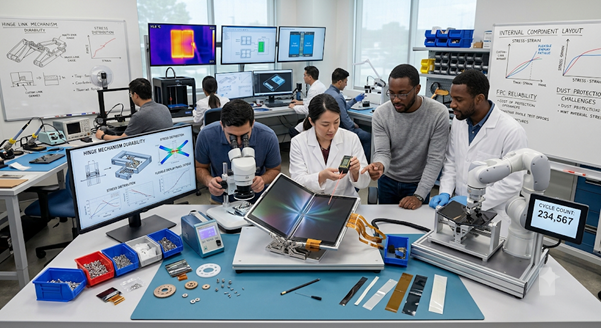
As manufacturers continue pushing the boundaries of flexible electronics, overcoming these hardware engineering obstacles has become critical for the future success of foldable devices across consumer, industrial, medical, and enterprise markets.
What Are Foldable Devices?
Foldable devices are electronic systems designed with flexible hardware architectures that allow the device to physically bend or fold without damaging functionality.
These devices commonly include:
- Flexible displays
- Folding hinges
- Adaptive internal layouts
- Flexible circuit systems
- Reinforced structural materials
Foldable designs provide multiple operational modes within a single device.
Why Foldable Technology Matters
Foldable hardware enables:
- Larger displays in compact devices
- Improved portability
- Enhanced multitasking
- Adaptive user experiences
- Innovative product designs
Applications extend beyond smartphones into:
- Tablets
- Laptops
- Wearables
- Automotive systems
- Industrial equipment
- Healthcare devices
Foldable engineering is becoming a major direction in next-generation hardware development.
Core Hardware Components in Foldable Devices
Flexible Displays
Flexible displays are the central component of foldable devices.
These displays must:
- Bend repeatedly
- Maintain image quality
- Resist cracking
- Support touch interaction
Flexible OLED technology is widely used because of its thin and adaptable structure.
Hinge Mechanisms
The hinge system controls folding movement and structural stability.
Requirements include:
- Mechanical durability
- Smooth operation
- Precise alignment
- Minimal thickness
The hinge is one of the most complex engineering components in foldable hardware.
Flexible Circuit Boards
Traditional rigid PCBs cannot tolerate repeated bending.
Foldable systems use:
- Flexible printed circuits
- Bendable interconnects
- Adaptive wiring structures
These components allow electrical connectivity across moving sections.
Battery Systems
Foldable devices require specially designed battery layouts.
Challenges include:
- Space optimization
- Flexible packaging
- Thermal management
- Structural balancing
Battery engineering plays a major role in device thickness and usability.
Mechanical Engineering Challenges
Repeated Folding Stress
Foldable devices experience continuous mechanical stress during operation.
This can cause:
- Material fatigue
- Structural deformation
- Component failure
- Reduced durability
Engineers must design systems capable of surviving hundreds of thousands of folding cycles.
Hinge Durability
The hinge mechanism must maintain reliable operation over long-term usage.
Engineering concerns include:
- Friction management
- Wear resistance
- Dust protection
- Structural reinforcement
A poorly designed hinge can significantly reduce product lifespan.
Thickness Constraints
Users expect foldable devices to remain slim and lightweight.
However, integrating:
- Hinges
- Flexible displays
- Cooling systems
- Batteries
Within compact designs creates substantial engineering complexity.
Flexible Display Engineering Challenges
Display Creasing
Repeated folding often creates visible creases along the folding area.
This affects:
- Visual quality
- User experience
- Structural reliability
Reducing crease visibility remains one of the biggest display engineering challenges.
Display Material Fatigue
Flexible displays undergo constant bending stress.
Potential issues include:
- Pixel degradation
- Cracking
- Delamination
- Touch sensitivity reduction
Advanced material science is critical for improving display durability.
Protective Layer Design
Traditional glass cannot easily bend.
Foldable displays require alternative protective materials that are:
- Flexible
- Scratch resistant
- Thin
- Durable
Developing strong yet bendable protective layers remains difficult.
Thermal Management Challenges
Foldable devices contain powerful processors within compact spaces.
Heat Concentration
Limited internal space restricts cooling system size.
This can lead to:
- Thermal throttling
- Reduced performance
- Component degradation
Flexible Cooling Solutions
Traditional cooling systems are difficult to integrate into bendable devices.
Engineers must develop:
- Thin heat spreaders
- Flexible thermal materials
- Compact cooling architectures
Efficient thermal management is essential for performance stability.
Battery Engineering Challenges
Space Distribution
Foldable devices often divide batteries across multiple sections.
This requires:
- Balanced power distribution
- Safe interconnection systems
- Compact battery layouts
Flexible Battery Research
Researchers are exploring flexible battery technologies capable of bending with the device.
Key goals include:
- Improved safety
- Mechanical flexibility
- High energy density
Power Efficiency
Foldable displays and large screens consume substantial energy.
Optimizing power consumption is necessary for acceptable battery life.
Flexible PCB and Connectivity Challenges
Repeated Bending of Electrical Connections
Electrical pathways experience continuous movement during folding.
Potential issues include:
- Signal degradation
- Connector fatigue
- Electrical failure
Miniaturization Complexity
Internal hardware must fit within extremely compact spaces.
This increases the complexity of:
- Circuit routing
- Signal integrity
- Component placement
Material Engineering Challenges
Balancing Flexibility and Strength
Materials must be flexible enough to bend while remaining strong enough to resist damage.
This requires innovations in:
- Polymers
- Composite materials
- Thin-film electronics
- Flexible coatings
Scratch Resistance
Flexible materials are often softer than traditional rigid glass.
Improving scratch resistance without reducing flexibility remains difficult.
Long-Term Reliability
Materials must maintain performance under:
- Repeated folding
- Heat exposure
- Environmental stress
- Mechanical impact
Dust and Particle Protection
Foldable devices contain moving mechanical parts.
Hinge Contamination Risks
Dust particles can enter hinge mechanisms and damage internal components.
This may cause:
- Display scratches
- Mechanical wear
- Folding instability
Sealing Challenges
Creating waterproof and dust-resistant foldable devices is significantly more difficult than designing rigid devices.
Software-Hardware Integration Challenges
Foldable devices require close coordination between hardware and software.
Dynamic Display Adaptation
The operating system must detect:
- Folding states
- Orientation changes
- Screen transitions
In real time.
Performance Optimization
Software must manage:
- Power consumption
- Display rendering
- Thermal conditions
Based on device usage patterns.
Weight Distribution Challenges
Foldable devices often contain components distributed across multiple sections.
Improper balancing can create:
- User discomfort
- Structural stress
- Folding instability
Engineers must optimize weight distribution carefully.
Manufacturing Complexity
Foldable devices require highly sophisticated manufacturing processes.
Precision Assembly
Tiny alignment errors can affect:
- Folding accuracy
- Display reliability
- Mechanical performance
Yield Management
Flexible displays and advanced hinge systems increase manufacturing difficulty.
This may lead to:
- Higher defect rates
- Increased production costs
- Lower manufacturing efficiency
Testing and Reliability Validation
Foldable hardware requires extensive testing.
Folding Cycle Tests
Devices undergo repeated folding simulations.
Environmental Testing
Hardware is tested under:
- Heat
- Humidity
- Mechanical vibration
- Impact conditions
Stress Analysis
Engineers evaluate long-term structural durability.
Edge Processing and AI Integration
Modern foldable devices increasingly integrate AI capabilities.
Adaptive User Interfaces
AI optimizes layouts based on device posture.
Thermal Prediction
Machine learning predicts overheating conditions.
Battery Optimization
AI dynamically manages power consumption.
Applications of Foldable Hardware
Smartphones
Expandable displays improve multitasking and entertainment experiences.
Foldable Tablets
Portable large-screen productivity devices.
Wearable Electronics
Flexible devices integrated into clothing or accessories.
Medical Devices
Portable foldable diagnostic systems.
Industrial Systems
Compact foldable interfaces for field operations.
Security Considerations
Foldable devices require secure hardware architectures.
Flexible Biometric Systems
Fingerprint and facial recognition systems must function across changing device configurations.
Secure Data Storage
Protecting sensitive information remains essential.
Future Trends in Foldable Hardware
Rollable Displays
Displays capable of extending dynamically.
Stretchable Electronics
Highly deformable hardware systems.
Self-Healing Materials
Materials capable of repairing minor damage automatically.
Ultra-Thin Flexible Batteries
Improved power systems for compact designs.
Educational Importance
Studying foldable device engineering provides knowledge in:
- Flexible Electronics
- Materials Science
- Embedded Systems
- Mechanical Engineering
- Thermal Engineering
- Display Technology
- Hardware Design
These interdisciplinary skills are increasingly important in modern hardware innovation.
Conclusion
Foldable device hardware engineering represents one of the most advanced and challenging areas in modern electronics design. Creating devices capable of bending and transforming while maintaining durability, performance, efficiency, and user comfort requires breakthroughs in flexible displays, materials science, mechanical systems, power management, and thermal engineering.
Although challenges related to hinge durability, display creasing, heat management, battery integration, and manufacturing complexity remain significant, continuous innovation is steadily improving the reliability and practicality of foldable technology. As research advances and manufacturing processes mature, foldable devices are expected to become more durable, affordable, and widely adopted across consumer electronics, healthcare, industrial systems, and future intelligent computing platforms.
Foldable hardware is not only changing the shape of devices but also reshaping the future of human interaction with technology.