
Introduction
Augmented Reality (AR) and Virtual Reality (VR) technologies are rapidly transforming the way humans interact with digital environments. From gaming and entertainment to healthcare, industrial training, education, engineering, and remote collaboration, AR and VR systems are becoming increasingly important across multiple industries. At the center of these immersive experiences lies advanced headset hardware designed to deliver realistic visuals, responsive interaction, and real-time environmental awareness.
Modern AR/VR headsets combine high-performance processors, advanced sensors, specialized displays, intelligent tracking systems, spatial audio, and edge computing technologies into compact wearable devices. As demand for immersive computing grows, hardware manufacturers are continuously innovating to improve comfort, visual quality, latency, power efficiency, and processing capability.
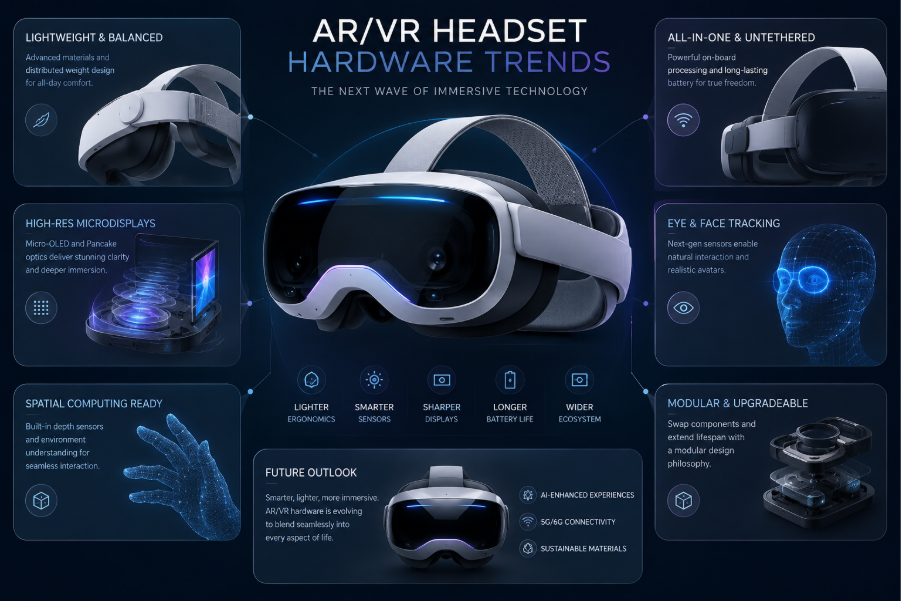
The evolution of AR/VR hardware is shaping the future of spatial computing and redefining how humans experience digital information.
Understanding AR and VR Technologies
What Is Virtual Reality (VR)?
Virtual Reality creates a fully immersive digital environment that replaces the user’s physical surroundings.
Users interact with computer-generated environments through:
- VR headsets
- Motion controllers
- Tracking systems
- Spatial audio systems
VR is widely used for gaming, simulation, education, and training.
What Is Augmented Reality (AR)?
Augmented Reality overlays digital information onto the real world.
AR systems enhance physical environments using:
- Transparent displays
- Cameras
- Sensors
- Real-time rendering systems
AR applications include:
- Navigation
- Industrial maintenance
- Healthcare visualization
- Smart retail systems
Evolution of AR/VR Headset Hardware
Early VR Systems
Initial VR systems were:
- Large
- Heavy
- Expensive
- Limited in processing capability
These systems often suffered from low resolution and high latency.
Modern Immersive Headsets
Recent advancements have introduced:
- Lightweight designs
- High-resolution displays
- Real-time tracking
- AI-assisted processing
- Wireless operation
Modern hardware delivers significantly improved user experiences.
Core Hardware Components of AR/VR Headsets
Display Systems
Displays are one of the most critical components in immersive headsets.
Modern systems utilize:
- OLED displays
- LCD panels
- MicroLED technology
- High-refresh-rate screens
Key requirements include:
- High resolution
- Low latency
- Wide field of view
- Accurate color reproduction
Processing Units
AR/VR systems require substantial computational power.
Processors handle:
- Graphics rendering
- Sensor processing
- Motion tracking
- AI inference
- Spatial mapping
Modern headsets increasingly integrate dedicated AI and graphics accelerators.
Sensor Systems
Sensors provide environmental awareness and motion tracking.
Common sensors include:
- Accelerometers
- Gyroscopes
- Magnetometers
- Depth sensors
- Cameras
- Eye-tracking sensors
These systems enable immersive and responsive experiences.
Tracking Hardware
Tracking systems determine user position and movement.
Inside-Out Tracking
Uses onboard cameras and sensors.
Benefits include:
- Reduced external hardware
- Greater portability
- Easier setup
Outside-In Tracking
Relies on external tracking devices for enhanced precision.
Used in:
- High-end simulation systems
- Professional VR environments
High-Resolution Display Trends
Display quality is a major focus in modern AR/VR hardware development.
Ultra-High Pixel Density
Higher pixel density reduces visible screen artifacts and improves realism.
High Refresh Rates
Modern headsets support higher refresh rates for smoother visuals.
Benefits include:
- Reduced motion blur
- Improved immersion
- Lower motion sickness
Wide Field of View
Expanded viewing angles improve spatial awareness and realism.
MicroLED Display Technology
MicroLED is emerging as a next-generation display solution.
Advantages
- High brightness
- Low power consumption
- Excellent contrast
- Long operational lifespan
MicroLED displays are particularly valuable for AR systems operating in bright environments.
Pancake Lens Technology
Traditional VR lenses can make headsets bulky.
Pancake lens systems reduce headset size by:
- Folding optical paths
- Improving compactness
- Reducing weight
Benefits include:
- Improved comfort
- Better portability
- Slimmer headset designs
Eye Tracking Hardware
Eye tracking is becoming a major feature in next-generation headsets.
Functions
- Gaze detection
- User interaction
- Attention analysis
- Foveated rendering
Foveated Rendering
This technique renders high detail only where the user is looking.
Benefits include:
- Reduced GPU workload
- Improved performance
- Lower power consumption
AI Integration in AR/VR Headsets
Artificial Intelligence is significantly improving immersive experiences.
Environmental Understanding
AI helps headsets recognize:
- Objects
- Rooms
- Obstacles
- User behavior
Gesture Recognition
Machine learning algorithms enable natural hand tracking and interaction.
Voice Interaction
AI-powered voice systems support hands-free operation.
Adaptive Rendering
AI dynamically adjusts graphics settings based on hardware conditions.
Spatial Audio Hardware
Audio plays a critical role in immersion.
3D Audio Systems
Spatial audio creates realistic sound positioning.
Noise Isolation
Improves user focus and immersion.
Directional Audio Processing
Enhances environmental realism.
Wireless Connectivity Trends
Modern AR/VR systems increasingly support wireless operation.
Low-Latency Wireless Streaming
Enables untethered experiences with minimal lag.
Wi-Fi and Edge Connectivity
Supports cloud rendering and remote computation.
Bluetooth Integration
Allows communication with accessories and peripherals.
Wireless technology significantly improves mobility and usability.
Edge Processing in AR/VR Systems
Edge computing is becoming increasingly important for immersive hardware.
Local Processing
Data is processed directly on the device rather than relying entirely on cloud systems.
Benefits include:
- Lower latency
- Improved privacy
- Reduced bandwidth usage
- Faster responses
Real-Time AI Processing
Edge AI supports:
- Scene recognition
- Motion prediction
- Environmental mapping
Battery and Power Management Trends
Battery life remains a major challenge for AR/VR devices.
Energy-Efficient Processors
Modern chipsets reduce power consumption while maintaining performance.
Dynamic Power Scaling
Systems adjust performance based on workload demands.
Fast Charging Technologies
Reduce downtime between usage sessions.
Advanced Battery Architectures
Higher energy density batteries improve operating duration.
Thermal Management Innovations
AR/VR headsets generate substantial heat during operation.
Passive Cooling Systems
Use advanced thermal materials and heat spreaders.
Compact Active Cooling
Some systems integrate miniature fans or liquid cooling methods.
AI-Based Thermal Optimization
Intelligent systems dynamically manage performance to control temperature.
Lightweight and Ergonomic Design Trends
User comfort is critical for immersive experiences.
Weight Reduction
Modern materials help reduce overall headset weight.
Balanced Hardware Layout
Improves long-term wearability.
Custom Fit Systems
Adjustable hardware enhances user comfort and stability.
Mixed Reality Hardware Evolution
Mixed Reality combines elements of both AR and VR.
Environmental Mapping
Advanced sensors create detailed spatial models.
Passthrough Video Systems
Users can see real-world environments while interacting with digital objects.
Hybrid Display Architectures
Support seamless transitions between immersive and augmented experiences.
Applications of AR/VR Headset Hardware
Gaming and Entertainment
Immersive gameplay and virtual experiences.
Healthcare
Applications include:
- Surgical training
- Rehabilitation
- Medical visualization
Education and Training
Interactive learning and simulation environments.
Industrial Maintenance
AR guidance improves repair and maintenance efficiency.
Remote Collaboration
Virtual workspaces enable distributed teamwork.
Architecture and Engineering
3D visualization and design interaction.
Security and Privacy Considerations
Immersive systems collect significant user data.
Biometric Data Protection
Eye tracking and facial analysis require secure handling.
Secure Wireless Communication
Encryption protects transmitted information.
Privacy-Aware AI Processing
Local edge processing reduces cloud exposure.
Challenges in AR/VR Hardware Development
Power Consumption
Immersive processing requires substantial energy.
Heat Dissipation
Compact wearable devices have limited cooling capacity.
Latency Reduction
Low latency is essential for user comfort.
Cost Management
Advanced hardware components remain expensive.
Miniaturization
Balancing performance with lightweight design is challenging.
Future Trends in AR/VR Hardware
AI-Optimized Spatial Computing
Smarter environmental understanding and interaction.
Ultra-Lightweight Headsets
Near-glasses-sized immersive devices.
Cloud and Edge Hybrid Rendering
Distributed processing architectures.
Advanced Haptic Feedback
More realistic physical interaction systems.
Neural Interface Integration
Potential brain-computer interaction support.
All-Day Wearable AR Devices
Practical everyday augmented computing systems.
Educational Importance
Studying AR/VR headset hardware involves knowledge in:
- Embedded Systems
- Computer Vision
- Artificial Intelligence
- Optics Engineering
- Wireless Communication
- Human-Computer Interaction
- Real-Time Graphics Processing
These interdisciplinary skills are increasingly valuable in modern technology industries.
Conclusion
AR/VR headset hardware is rapidly evolving into one of the most important areas of modern computing technology. Through advancements in display systems, AI acceleration, edge processing, spatial tracking, wireless communication, and ergonomic design, immersive headsets are becoming more powerful, efficient, and practical for real-world applications.
As industries continue adopting immersive technologies for entertainment, healthcare, education, manufacturing, and collaboration, the demand for advanced AR/VR hardware will continue to grow. Although challenges related to battery life, heat management, latency, and cost remain, ongoing innovation is steadily overcoming these limitations.
The future of AR/VR hardware points toward lightweight, intelligent, and highly immersive wearable systems that seamlessly integrate digital experiences into everyday life, ultimately reshaping how humans interact with technology and information.