
Introduction
As the world becomes increasingly dependent on technology, the environmental impact of hardware manufacturing has become a major global concern. Modern electronic devices require vast amounts of raw materials, energy-intensive production processes, and complex global supply chains. While technological innovation has improved productivity and connectivity, it has also contributed to electronic waste, carbon emissions, resource depletion, and environmental pollution.
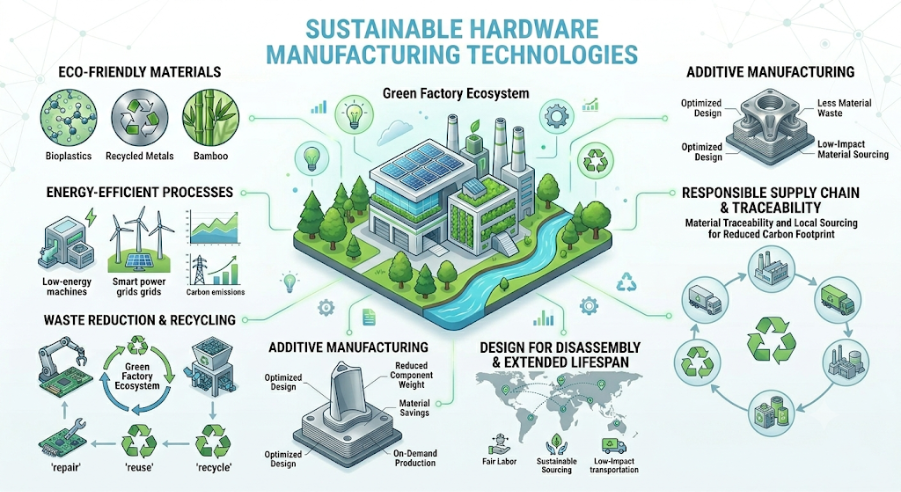
To address these challenges, industries are shifting toward Sustainable Hardware Manufacturing Technologies. Sustainable manufacturing focuses on reducing environmental impact while maintaining product quality, economic viability, and technological advancement. This approach involves the use of eco-friendly materials, energy-efficient production methods, waste reduction strategies, recyclable designs, and intelligent manufacturing systems.
Sustainable hardware manufacturing is rapidly becoming one of the most important priorities in electronics engineering, industrial design, semiconductor production, and global supply chain management.
What Is Sustainable Hardware Manufacturing?
Sustainable hardware manufacturing refers to the design and production of electronic and mechanical systems using environmentally responsible methods.
The goal is to minimize:
- Energy consumption
- Carbon emissions
- Toxic waste
- Resource depletion
- Environmental pollution
While maximizing:
- Efficiency
- Product lifespan
- Recyclability
- Material recovery
- Manufacturing optimization
This approach supports long-term environmental and economic sustainability.
Why Sustainability Matters in Hardware Manufacturing
The rapid growth of technology has significantly increased hardware production worldwide.
This has created several major challenges:
- Rising electronic waste
- High energy usage
- Scarcity of raw materials
- Increased greenhouse gas emissions
- Toxic chemical disposal problems
Sustainable manufacturing helps reduce these issues while supporting responsible technological growth.
Environmental Impact of Traditional Hardware Manufacturing
Traditional manufacturing methods often rely on processes that consume large amounts of energy and generate substantial waste.
Resource Extraction
Electronic devices require materials such as:
- Metals
- Rare earth elements
- Plastics
- Semiconductor materials
Mining and extraction activities can damage ecosystems and consume natural resources.
High Energy Consumption
Manufacturing facilities often require significant electrical power for:
- Semiconductor fabrication
- Material processing
- Precision machining
- Assembly operations
This contributes to increased carbon emissions.
Electronic Waste Generation
Short product lifecycles and rapid technological upgrades have resulted in massive volumes of discarded electronics.
Improper disposal can release hazardous substances into the environment.
Core Principles of Sustainable Manufacturing
Energy Efficiency
Reducing energy usage during manufacturing operations.
Material Optimization
Using fewer raw materials while maximizing product performance.
Waste Reduction
Minimizing production waste and improving recycling processes.
Lifecycle Sustainability
Designing products for durability, repairability, and recyclability.
Environmental Responsibility
Reducing pollution and harmful emissions throughout the production lifecycle.
Eco-Friendly Materials in Hardware Manufacturing
Material selection plays a critical role in sustainability.
Recyclable Metals
Manufacturers increasingly use recyclable metals to reduce mining demands.
Benefits include:
- Reduced environmental damage
- Lower resource consumption
- Improved material recovery
Biodegradable Plastics
Traditional plastics contribute significantly to pollution.
Biodegradable alternatives help reduce:
- Plastic waste
- Environmental contamination
- Long-term disposal issues
Low-Toxicity Materials
Reducing hazardous substances improves both environmental and workplace safety.
Examples include minimizing the use of:
- Toxic solvents
- Harmful coatings
- Heavy metals
Energy-Efficient Manufacturing Systems
Modern factories are adopting energy-efficient technologies to reduce operational impact.
Smart Power Management
Intelligent systems optimize electricity consumption across manufacturing equipment.
High-Efficiency Machinery
Advanced machines consume less power while maintaining production quality.
Renewable Energy Integration
Factories increasingly utilize:
- Solar power
- Wind energy
- Energy storage systems
To reduce dependence on fossil fuels.
Green Semiconductor Manufacturing
Semiconductor fabrication is one of the most resource-intensive areas of electronics production.
Water Conservation Technologies
Chip manufacturing requires substantial water usage.
Advanced recycling systems help reduce water waste.
Low-Energy Fabrication Processes
Modern fabrication techniques aim to minimize:
- Heat generation
- Energy usage
- Chemical waste
Cleanroom Efficiency Improvements
Optimized airflow and environmental controls reduce power consumption in cleanroom facilities.
Additive Manufacturing and Sustainability
Additive manufacturing, commonly known as 3D printing, offers several sustainability benefits.
Reduced Material Waste
Unlike subtractive manufacturing, additive methods use only the material required for production.
Localized Production
Products can be manufactured closer to consumers, reducing transportation emissions.
Rapid Prototyping
Efficient prototyping minimizes wasted materials during product development.
Circular Economy in Hardware Manufacturing
The circular economy model focuses on extending product lifecycles and reusing materials.
Product Reusability
Hardware components are designed for refurbishment and reuse.
Recycling Systems
Recovered materials can be reintroduced into manufacturing processes.
Repairable Hardware Designs
Products designed for easy repair reduce electronic waste generation.
Sustainable PCB Manufacturing
Printed Circuit Boards (PCBs) are essential components in electronic devices.
Eco-Friendly PCB Materials
Manufacturers are developing environmentally safer substrate materials.
Reduced Chemical Usage
Cleaner etching and fabrication methods reduce hazardous waste.
Efficient Layer Design
Optimized PCB layouts minimize material consumption.
AI and Smart Manufacturing Systems
Artificial Intelligence is increasingly improving sustainability in manufacturing operations.
Predictive Maintenance
AI identifies equipment issues before failures occur.
Benefits include:
- Reduced downtime
- Lower waste
- Improved efficiency
Production Optimization
Machine learning algorithms optimize:
- Resource allocation
- Energy usage
- Manufacturing throughput
Supply Chain Intelligence
AI helps reduce unnecessary transportation and inventory waste.
Robotics and Automation
Automation technologies improve manufacturing precision and efficiency.
Reduced Material Waste
Robotic systems minimize production errors.
Energy Optimization
Automated processes can dynamically adjust power usage.
Improved Production Consistency
Consistent manufacturing reduces defective products and waste generation.
Sustainable Cooling Technologies
Manufacturing equipment generates significant heat.
Liquid Cooling Systems
More efficient than traditional air cooling methods.
Heat Recovery Systems
Excess heat can be captured and reused.
Smart Thermal Management
Intelligent cooling systems optimize energy consumption.
Hardware Lifecycle Management
Sustainability extends beyond manufacturing into the full hardware lifecycle.
Longer Product Lifespan
Durable products reduce replacement frequency.
Upgradeable Hardware
Modular systems extend usability through component upgrades.
Responsible Disposal
Proper recycling and disposal prevent environmental contamination.
Green Data Center Hardware Manufacturing
Data center infrastructure requires large amounts of hardware.
Sustainable manufacturing focuses on:
- Energy-efficient servers
- Low-power processors
- Recyclable components
- Efficient cooling systems
These improvements reduce operational carbon footprints.
Sustainable Battery Manufacturing
Battery production has major environmental implications.
Material Recovery
Recovering valuable materials reduces mining requirements.
Safer Battery Chemistry
Environmentally safer battery technologies improve sustainability.
Efficient Manufacturing Processes
Reducing waste during battery production lowers environmental impact.
Supply Chain Sustainability
Global supply chains significantly influence environmental impact.
Local Manufacturing
Shorter supply chains reduce transportation emissions.
Ethical Material Sourcing
Responsible sourcing improves environmental and social sustainability.
Efficient Logistics
Optimized transportation systems reduce fuel consumption.
Challenges in Sustainable Hardware Manufacturing
High Initial Investment
Sustainable technologies may require significant upfront costs.
Material Availability
Eco-friendly materials can be difficult to source at scale.
Manufacturing Complexity
New sustainable processes may require advanced engineering expertise.
Performance Trade-Offs
Balancing sustainability with hardware performance remains challenging.
Global Standardization
Industry-wide sustainability standards are still evolving.
Emerging Technologies in Sustainable Manufacturing
Nanomaterial Engineering
Advanced materials improve efficiency while reducing resource usage.
Bio-Based Electronics
Organic and biodegradable electronics are gaining research interest.
Carbon-Neutral Manufacturing
Factories aim to eliminate net carbon emissions.
Smart Energy Grids
Manufacturing plants increasingly integrate intelligent energy management systems.
Autonomous Sustainable Factories
AI-driven facilities optimize resources automatically.
Applications Across Industries
Consumer Electronics
Environmentally friendly smartphones, laptops, and wearable devices.
Automotive Manufacturing
Electric and autonomous vehicle hardware production.
Industrial Automation
Energy-efficient robotics and manufacturing systems.
Healthcare Equipment
Sustainable medical electronics and monitoring systems.
Telecommunications Infrastructure
Low-power networking and communication hardware.
Educational Importance
Studying sustainable hardware manufacturing provides knowledge in:
- Electronics Engineering
- Industrial Automation
- Materials Science
- Renewable Energy Systems
- Environmental Engineering
- Manufacturing Technology
- Supply Chain Management
These disciplines are becoming increasingly critical in modern engineering.
Future Trends
Fully Recyclable Electronics
Devices designed for complete material recovery.
AI-Driven Sustainable Factories
Intelligent systems optimizing manufacturing efficiency in real time.
Zero-Waste Production Systems
Manufacturing processes with minimal environmental impact.
Energy-Positive Manufacturing Facilities
Factories generating more energy than they consume.
Advanced Green Semiconductor Technologies
Highly efficient and environmentally responsible chip production.
Conclusion
Sustainable Hardware Manufacturing Technologies are reshaping the future of electronics and industrial production by prioritizing environmental responsibility alongside technological advancement. Through innovations in eco-friendly materials, energy-efficient systems, intelligent manufacturing, recyclable designs, and circular economy principles, manufacturers are reducing the environmental impact of hardware production while improving efficiency and long-term sustainability.
As industries continue to expand and global demand for electronic devices increases, sustainable manufacturing will become essential for balancing innovation with environmental preservation. Although challenges related to cost, material availability, and production complexity remain, ongoing advancements in engineering, automation, and green technology are paving the way toward a cleaner, smarter, and more sustainable future for hardware manufacturing worldwide.