
Introduction
Display technology has evolved dramatically over the past few decades, transforming from bulky cathode-ray tube screens to ultra-thin, high-resolution panels used in smartphones, televisions, laptops, and wearable devices. As technology continues advancing, the next major revolution in visual hardware is the emergence of Flexible Display Technology.
Flexible displays are redefining how users interact with electronic devices by enabling screens that can bend, curve, fold, roll, and even stretch. These advanced display systems are opening new possibilities for next-generation consumer electronics, wearable devices, healthcare systems, automotive dashboards, industrial equipment, and smart environments.
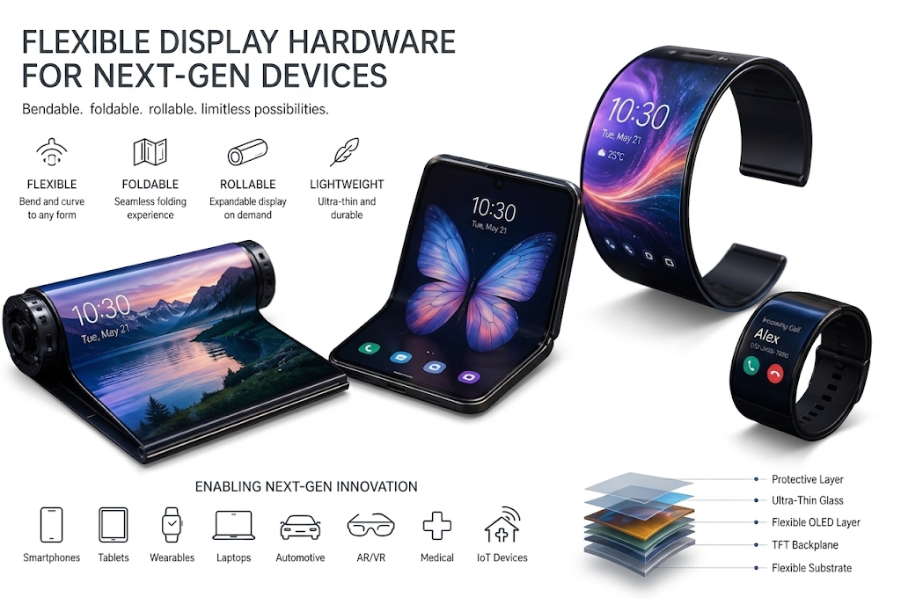
The development of flexible display hardware combines innovations in materials science, semiconductor engineering, embedded electronics, and manufacturing technologies. As demand for lighter, thinner, and more adaptable devices grows, flexible display hardware is becoming one of the most important areas in modern electronics engineering.
What Are Flexible Displays?
Flexible displays are electronic screens built using materials and hardware architectures that allow physical bending without damaging functionality.
Unlike traditional rigid displays, flexible displays can:
- Bend
- Fold
- Curve
- Roll
- Twist
While maintaining image quality and touch functionality.
These displays use advanced materials and flexible electronic components instead of rigid glass-based structures.
Evolution of Display Technology
Traditional Display Systems
Early displays relied on rigid and heavy hardware structures.
Characteristics included:
- Thick glass panels
- High power consumption
- Limited portability
These systems lacked flexibility and durability.
Flat Panel Displays
The introduction of flat-panel technology improved:
- Display thickness
- Resolution
- Energy efficiency
This led to the widespread adoption of modern digital displays.
Flexible Display Era
Flexible display technology introduced:
- Bendable form factors
- Lightweight construction
- Portable designs
- Adaptive interfaces
This innovation is driving the future of next-generation electronics.
Core Components of Flexible Display Hardware
Flexible Substrates
Traditional displays use rigid glass substrates.
Flexible displays instead utilize bendable materials such as:
- Plastic polymers
- Thin metal foils
- Flexible composite materials
These substrates provide mechanical flexibility while supporting electronic circuits.
Flexible Thin-Film Transistors (TFTs)
Thin-film transistors control individual display pixels.
Flexible TFT technologies are designed to:
- Maintain electrical performance
- Resist mechanical stress
- Operate during bending
Flexible transistor development is essential for reliable display operation.
Display Panels
Flexible displays use advanced panel technologies including:
- Organic Light Emitting Diodes
- Flexible LCD structures
- MicroLED systems
These technologies support high image quality while enabling flexible form factors.
Protective Layers
Flexible displays require specialized protective materials to prevent damage from:
- Moisture
- Dust
- Mechanical stress
- Environmental exposure
Protective layers help improve durability and lifespan.
Organic Light Emitting Diode (OLED) Technology
OLED technology is one of the most important foundations of flexible displays.
How OLED Works
OLED displays generate light directly from organic materials without requiring separate backlighting systems.
Benefits include:
- Thin construction
- High contrast
- Wide viewing angles
- Low power consumption
Why OLED Supports Flexibility
Because OLED panels are thinner and simpler than traditional displays, they can be integrated into flexible hardware structures more easily.
Flexible LCD Technology
Although OLED dominates flexible displays, flexible LCD systems also exist.
Advantages
- Mature manufacturing techniques
- Lower production costs
- High brightness
Challenges
LCDs require backlighting systems, making flexibility more difficult compared to OLED technology.
MicroLED Flexible Displays
MicroLED technology is an emerging display innovation offering:
- High brightness
- Exceptional durability
- Improved efficiency
- Long operational lifespan
Flexible MicroLED systems may become a major component of future display hardware.
Foldable Display Hardware
Foldable displays are among the most visible applications of flexible technology.
How Foldable Displays Work
Specialized hinge mechanisms and flexible screen layers allow displays to fold repeatedly without damage.
Benefits
- Larger screen areas
- Compact portability
- Multi-mode device operation
Foldable hardware is increasingly used in next-generation mobile devices.
Rollable Display Systems
Rollable displays can retract or expand dynamically.
Advantages
- Space-saving design
- Adjustable screen sizes
- Enhanced portability
Applications
- Smart televisions
- Automotive systems
- Portable monitors
- Smart home devices
Rollable technology represents a significant advancement in adaptive display hardware.
Stretchable Display Technology
Stretchable displays extend flexibility even further by allowing screens to stretch and deform.
Potential Applications
- Wearable healthcare devices
- Smart clothing
- Robotics
- Human-machine interfaces
This technology remains an active area of research and development.
Flexible Touchscreen Hardware
Modern flexible displays often include touch-sensitive capabilities.
Flexible Touch Sensors
Flexible conductive materials detect user interactions even during bending.
Capacitive Touch Systems
Flexible capacitive sensors provide:
- Accurate touch detection
- Multi-touch functionality
- Responsive interaction
Display Driver Hardware
Display drivers control visual output and pixel management.
Flexible display drivers must support:
- Dynamic display behavior
- Variable form factors
- Energy-efficient operation
Advanced display controller hardware is critical for smooth performance.
Power Management in Flexible Displays
Energy efficiency is essential for portable flexible devices.
Low-Power Display Architectures
Flexible displays are optimized to reduce power consumption.
Adaptive Brightness Systems
Brightness automatically adjusts based on environmental conditions.
Efficient Driver Electronics
Modern driver hardware minimizes unnecessary energy usage.
Materials Used in Flexible Displays
Polyimide Films
Widely used due to:
- High flexibility
- Heat resistance
- Mechanical durability
Transparent Conductive Materials
Used for touch sensing and display conductivity.
Flexible Encapsulation Materials
Protect sensitive display components from environmental exposure.
Manufacturing Technologies
Producing flexible displays requires advanced fabrication techniques.
Roll-to-Roll Manufacturing
Allows continuous production of flexible electronics.
Benefits include:
- Faster manufacturing
- Reduced production costs
- Scalability
Thin-Film Deposition
Precise material deposition creates flexible electronic layers.
Laser Processing
Used for precision cutting and display shaping.
Challenges in Flexible Display Hardware
Mechanical Durability
Repeated bending can damage electronic layers over time.
Material Stability
Flexible materials must maintain performance under stress.
Manufacturing Complexity
Production processes are highly sophisticated.
Cost Factors
Advanced materials and manufacturing increase costs.
Thermal Management
Flexible devices require efficient heat dissipation systems.
Applications of Flexible Display Technology
Smartphones and Tablets
Foldable and rollable devices provide enhanced portability and larger displays.
Wearable Devices
Flexible displays enable:
- Smart watches
- Fitness trackers
- Smart glasses
- Medical wearables
Automotive Systems
Curved and adaptive displays improve:
- Dashboard interfaces
- Navigation systems
- Driver information displays
Healthcare Devices
Applications include:
- Flexible monitoring systems
- Wearable diagnostics
- Medical visualization tools
Industrial Applications
Flexible displays support:
- Rugged field equipment
- Portable industrial systems
- Smart manufacturing interfaces
Flexible Displays in Edge Devices
Edge devices increasingly require compact and adaptive interfaces.
Flexible display hardware improves:
- Portability
- User interaction
- Energy efficiency
Applications include:
- IoT systems
- Smart sensors
- Portable computing devices
Role of Artificial Intelligence
AI technologies enhance flexible display systems through:
Adaptive User Interfaces
Displays dynamically adjust based on usage behavior.
Power Optimization
AI algorithms reduce unnecessary energy consumption.
Predictive Maintenance
Systems identify potential hardware failures before they occur.
Future Trends in Flexible Display Hardware
Ultra-Thin Foldable Devices
Future displays will become thinner and more durable.
Transparent Flexible Displays
Displays integrated directly into windows and surfaces.
Stretchable Electronics
Highly deformable displays for wearable and biomedical systems.
Integrated Smart Surfaces
Flexible displays embedded into furniture, vehicles, and architecture.
Advanced Material Innovation
New nanomaterials and conductive polymers will improve durability and efficiency.
Educational Importance
Studying flexible display hardware provides valuable knowledge in:
- Electronics Engineering
- Materials Science
- Embedded Systems
- Semiconductor Technology
- Human-Computer Interaction
- Display Engineering
- Manufacturing Technologies
These interdisciplinary skills are increasingly important in modern hardware development.
Conclusion
Flexible display hardware is transforming the future of electronic devices by enabling adaptable, lightweight, and highly portable visual systems. Through advancements in OLED technology, flexible substrates, thin-film electronics, power management, and advanced manufacturing processes, flexible displays are becoming a core technology for next-generation consumer electronics and industrial systems.
From foldable smartphones and wearable devices to automotive dashboards and smart healthcare systems, flexible display technologies are creating entirely new possibilities for human-device interaction. Although challenges related to durability, manufacturing complexity, and cost remain, ongoing innovation continues to accelerate the adoption of flexible display hardware across multiple industries.
As technology evolves, flexible displays are expected to become increasingly intelligent, durable, and integrated into everyday life, shaping the future of digital experiences and next-generation hardware design.