
Introduction
Smart glasses are emerging as one of the most innovative wearable technologies of the modern era. By integrating advanced sensors, displays, cameras, processors, and wireless connectivity into a lightweight eyewear form factor, smart glasses have the potential to transform how people interact with digital information. From augmented reality experiences and industrial maintenance to healthcare assistance and navigation systems, smart glasses are becoming a key component of the next generation of human-computer interaction.
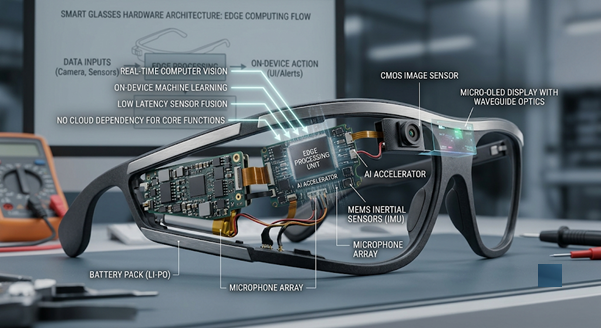
A critical factor driving the evolution of smart glasses is edge processing. Instead of relying entirely on cloud servers for computation, edge processing enables smart glasses to analyze and process data locally using onboard hardware. This approach reduces latency, improves privacy, conserves bandwidth, and enhances real-time responsiveness.
The combination of advanced hardware and edge intelligence is enabling smart glasses to become more powerful, efficient, and practical for everyday use across multiple industries.
What Are Smart Glasses?
Smart glasses are wearable computing devices designed to provide digital information directly within the user’s field of view.
Unlike conventional eyewear, smart glasses integrate:
- Display systems
- Cameras
- Sensors
- Microprocessors
- Wireless communication modules
- Audio systems
These components work together to deliver contextual information and interactive experiences.
Evolution of Smart Glasses Technology
First-Generation Wearables
Early smart glasses focused primarily on:
- Notifications
- Basic information display
- Simple voice commands
These systems had limited processing capabilities and relied heavily on external devices.
Augmented Reality Integration
Advancements in display technology introduced augmented reality features that overlay digital content onto the physical world.
Benefits included:
- Enhanced visualization
- Interactive guidance
- Improved user engagement
Edge AI-Enabled Smart Glasses
Modern smart glasses increasingly incorporate local AI processing, enabling:
- Real-time object recognition
- Voice understanding
- Gesture tracking
- Environmental awareness
This shift significantly improves performance and usability.
Core Hardware Components of Smart Glasses
Microprocessor Unit
The processor serves as the brain of the smart glasses.
Its responsibilities include:
- Data processing
- Sensor management
- Display rendering
- AI inference
- Communication control
Modern processors are designed to balance performance with energy efficiency.
Display Systems
Displays are one of the most important components of smart glasses.
Common display technologies include:
- Micro-displays
- Waveguide displays
- Projection systems
- Transparent displays
Key requirements include:
- High brightness
- Low power consumption
- Wide viewing angles
- Compact size
Camera Modules
Integrated cameras enable visual perception and data collection.
Applications include:
- Image capture
- Video recording
- Object recognition
- QR code scanning
- Environmental analysis
Modern smart glasses often include multiple cameras for enhanced functionality.
Microphones and Audio Hardware
Audio systems facilitate communication between users and devices.
Features include:
- Voice command recognition
- Audio feedback
- Noise reduction
- Environmental sound analysis
Advanced microphone arrays improve speech recognition accuracy.
Sensor Integration
Smart glasses incorporate numerous sensors to understand user behavior and environmental conditions.
Common sensors include:
- Accelerometers
- Gyroscopes
- Magnetometers
- Proximity sensors
- Ambient light sensors
These sensors support accurate tracking and context awareness.
Understanding Edge Processing
Edge processing refers to data computation performed directly on a device rather than in a remote cloud environment.
In smart glasses, edge processing enables:
- Local AI inference
- Real-time analysis
- Reduced communication delays
- Improved privacy
This approach is particularly valuable for wearable devices that require immediate responses.
Why Edge Processing Matters for Smart Glasses
Reduced Latency
Sending data to remote servers introduces delays.
Local processing enables:
- Faster responses
- Real-time interactions
- Improved user experience
Enhanced Privacy
Sensitive information remains on the device.
Benefits include:
- Improved security
- Reduced data exposure
- Better compliance with privacy regulations
Lower Bandwidth Usage
Edge processing reduces the need for continuous cloud communication.
This helps:
- Reduce network congestion
- Lower operational costs
- Improve performance in limited connectivity environments
Offline Functionality
Smart glasses can continue operating even when internet connectivity is unavailable.
Artificial Intelligence at the Edge
Modern smart glasses increasingly rely on edge AI capabilities.
Object Recognition
AI algorithms identify:
- Objects
- Products
- Equipment
- Landmarks
Applications include:
- Industrial inspection
- Retail assistance
- Navigation systems
Facial Recognition
Edge AI can analyze facial features for:
- Authentication
- User identification
- Access control
Speech Recognition
Local processing enables:
- Voice commands
- Language translation
- Hands-free interaction
Without requiring cloud connectivity.
Gesture Recognition
AI-powered gesture tracking improves user interaction through natural movements.
Hardware Accelerators for Edge AI
Dedicated hardware accelerators improve AI performance.
Neural Processing Units (NPUs)
NPUs are optimized for machine learning workloads.
Benefits include:
- Faster AI inference
- Lower power consumption
- Improved efficiency
Digital Signal Processors (DSPs)
DSPs accelerate:
- Audio processing
- Sensor analysis
- Real-time signal computation
Graphics Processing Units (GPUs)
Compact GPUs assist with:
- Graphics rendering
- Computer vision
- Parallel processing tasks
Power Management Systems
Battery life remains one of the biggest challenges for smart glasses.
Efficient Power Distribution
Power management hardware ensures energy is allocated effectively across system components.
Dynamic Performance Scaling
Processors can adjust performance based on workload demands.
Benefits include:
- Extended battery life
- Reduced heat generation
- Improved efficiency
Energy-Aware AI Processing
AI workloads are optimized to minimize power consumption while maintaining performance.
Wireless Connectivity Hardware
Smart glasses rely on multiple communication technologies.
Bluetooth Connectivity
Supports communication with:
- Smartphones
- Wearables
- Peripheral devices
Wi-Fi Integration
Provides:
- Internet access
- Cloud synchronization
- Data transfers
Low-Power Communication
Energy-efficient protocols reduce battery consumption while maintaining connectivity.
Thermal Management in Smart Glasses
Heat management is critical due to the compact form factor.
Passive Cooling Solutions
Common methods include:
- Heat spreaders
- Thermal materials
- Optimized component placement
Efficient Processor Design
Modern processors generate less heat while maintaining performance.
Thermal Monitoring Systems
Sensors continuously monitor operating temperatures to prevent overheating.
Augmented Reality and Smart Glasses
Augmented Reality (AR) is one of the primary applications of smart glasses.
Real-Time Information Overlay
Users receive contextual information directly within their field of view.
Examples include:
- Navigation directions
- Maintenance instructions
- Healthcare data
Industrial Assistance
AR-enabled smart glasses improve:
- Equipment servicing
- Training programs
- Workflow efficiency
Educational Applications
Students can access interactive visual content in real time.
Applications of Smart Glasses and Edge Processing
Healthcare
Applications include:
- Surgical assistance
- Remote consultations
- Patient monitoring
Manufacturing
Workers can access:
- Technical instructions
- Maintenance procedures
- Quality control information
Logistics and Warehousing
Smart glasses assist with:
- Inventory management
- Order fulfillment
- Route optimization
Public Safety
First responders can access:
- Navigation data
- Situational awareness
- Real-time communication
Consumer Applications
Users benefit from:
- Navigation
- Entertainment
- Fitness tracking
- Personal productivity
Security Considerations
Data Encryption
Protects information stored and transmitted by the device.
Secure Authentication
Methods include:
- Voice recognition
- Facial recognition
- Multi-factor authentication
Local Data Processing
Edge computing reduces the risk associated with transmitting sensitive information.
Challenges in Smart Glasses Hardware
Battery Limitations
Balancing performance and battery life remains challenging.
Miniaturization Requirements
Components must fit within lightweight wearable frames.
Heat Dissipation
Compact devices have limited cooling capacity.
Display Quality
Achieving high-quality visuals while maintaining energy efficiency remains difficult.
Processing Constraints
Edge devices must deliver strong performance within strict power budgets.
Future Trends
Advanced Edge AI Processors
More powerful and efficient processors will enable increasingly sophisticated AI applications.
Improved Battery Technologies
Longer-lasting batteries will enhance usability.
Enhanced Augmented Reality Experiences
Future displays will provide more immersive digital overlays.
Context-Aware Computing
Smart glasses will better understand user intent and surroundings.
Integration with Smart Ecosystems
Seamless connectivity with homes, vehicles, workplaces, and IoT devices.
Educational Importance
Studying smart glasses hardware and edge processing provides knowledge in:
- Embedded Systems
- Computer Vision
- Artificial Intelligence
- Wearable Technology
- Wireless Communications
- Human-Computer Interaction
- Edge Computing
These fields are becoming increasingly important as wearable devices continue to evolve.
Conclusion
Smart glasses represent a significant step toward the future of wearable computing, combining advanced hardware with intelligent edge processing capabilities. By integrating processors, sensors, displays, cameras, and AI accelerators into a compact form factor, smart glasses enable real-time interaction with digital information while maintaining mobility and convenience.
Edge processing further enhances these devices by reducing latency, improving privacy, minimizing bandwidth usage, and enabling offline functionality. As advancements continue in battery technology, AI hardware, display systems, and wireless communication, smart glasses are expected to become increasingly capable and widely adopted.
From healthcare and manufacturing to education and consumer applications, smart glasses powered by edge intelligence are poised to redefine how people interact with technology, creating more intuitive, responsive, and connected experiences in everyday life.