
Modern computing systems are facing a growing performance crisis. Artificial intelligence, big data analytics, edge computing, scientific simulations, and real-time processing workloads are generating unprecedented demands for speed, energy efficiency, and memory bandwidth. Traditional computer architectures, designed decades ago, are increasingly struggling to keep pace with modern computational requirements.
One of the biggest limitations in conventional computing systems is the constant movement of data between memory and processors. This bottleneck consumes enormous amounts of energy, increases latency, and limits overall system performance. To overcome these challenges, researchers and semiconductor engineers are exploring revolutionary computing paradigms capable of fundamentally changing how computation is performed.
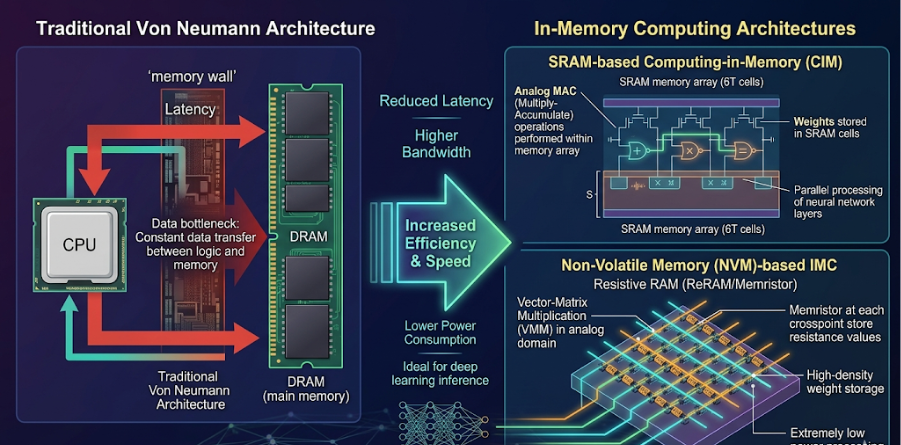
Among the most promising innovations is in-memory computing (IMC), a hardware architecture that performs computation directly inside memory rather than transferring data back and forth between processors and memory systems. In-memory computing has the potential to dramatically accelerate AI workloads, reduce energy consumption, improve data processing speed, and enable entirely new classes of intelligent hardware systems.
What Is In-Memory Computing?
In-memory computing is a hardware architecture where data processing occurs directly within memory arrays instead of relying entirely on separate CPUs or GPUs.
Traditional computers follow the:
- Von Neumann architecture
where:
- Memory stores data
- Processors perform computation
This separation creates continuous data movement.
In-memory computing minimizes this transfer by integrating:
- Storage
- Processing
within the same physical hardware structure.
The Von Neumann Bottleneck
The fundamental problem with conventional computing is known as the Von Neumann bottleneck.
In traditional systems:
- Data is fetched from memory
- Sent to processor
- Computation occurs
- Results are written back
This constant data transfer causes:
- High latency
- Energy waste
- Bandwidth limitations
- Performance bottlenecks
Modern AI systems process enormous datasets, making memory transfer one of the largest contributors to power consumption.
Why In-Memory Computing Matters
In-memory computing addresses several critical modern computing challenges.
1. Reduced Data Movement
Since computation occurs within memory:
- Less data transfer is required
- Memory bandwidth limitations decrease
- Latency improves significantly
2. Lower Power Consumption
Data movement consumes substantial energy.
IMC architectures reduce:
- Bus activity
- Processor-memory communication
- Memory access overhead
making systems far more energy efficient.
3. Faster AI Processing
AI workloads involve massive matrix operations.
In-memory architectures can accelerate:
- Neural network inference
- Vector operations
- Parallel computation
dramatically improving AI performance.
4. Higher Parallelism
Memory arrays naturally support parallel operations across large datasets.
This enables:
- Massive concurrent computation
- Faster analytics
- Real-time processing
Types of In-Memory Computing Architectures
Several architectural approaches exist for implementing in-memory computing.
1. Analog In-Memory Computing
Analog IMC performs computations using physical electrical properties.
Examples:
- Current summation
- Voltage accumulation
- Resistance modulation
Advantages:
- Extremely energy efficient
- Highly parallel
- Ideal for AI inference
Challenges:
- Noise sensitivity
- Precision limitations
- Calibration complexity
2. Digital In-Memory Computing
Digital IMC performs logic operations directly inside memory arrays.
Advantages:
- Higher accuracy
- Better reliability
- Easier integration with existing systems
Challenges:
- Higher complexity
- Greater area overhead
3. Near-Memory Computing
Near-memory computing places processing units very close to memory rather than fully inside memory.
This reduces:
- Data transfer distance
- Communication latency
without completely redesigning memory architecture.
Memory Technologies Used in IMC
Several advanced memory technologies support in-memory computing.
SRAM-Based IMC
Static RAM (SRAM) is commonly used for:
- High-speed AI accelerators
- Cache-level computation
Advantages:
- Fast operation
- Mature technology
Disadvantages:
- Larger area
- Higher leakage power
DRAM-Based IMC
Dynamic RAM (DRAM) allows:
- High-density storage
- Bulk parallel operations
Used in:
- Large-scale data processing
- High-bandwidth systems
ReRAM (Resistive RAM)
ReRAM is one of the most promising IMC technologies.
Advantages:
- Non-volatile storage
- Analog computation support
- Low energy usage
Highly suitable for:
- Neural network acceleration
- Neuromorphic systems
Phase Change Memory (PCM)
PCM changes resistance states using heat.
Advantages:
- High density
- Non-volatility
- Analog-like behavior
Applications:
- AI accelerators
- Neuromorphic computing
MRAM (Magnetoresistive RAM)
MRAM uses magnetic states for storage.
Advantages:
- Fast switching
- Durability
- Non-volatility
Potential use cases:
- Embedded AI systems
- Low-power processors
In-Memory Computing for Artificial Intelligence
AI is one of the biggest drivers of IMC research.
Neural networks involve repeated:
- Matrix multiplication
- Vector operations
- Parallel arithmetic
Traditional processors struggle with:
- Data movement overhead
- Energy inefficiency
IMC architectures perform these operations directly in memory arrays.
AI Acceleration Benefits
In-memory AI accelerators provide:
- Lower latency
- Faster inference
- Reduced power consumption
- Improved edge AI capability
This is especially important for:
- Autonomous vehicles
- Robotics
- Smart cameras
- IoT devices
Crossbar Array Architectures
One of the most common IMC structures is the crossbar array.
A crossbar consists of:
- Horizontal lines
- Vertical lines
- Programmable memory cells at intersections
These arrays naturally support:
- Parallel matrix multiplication
- Analog computation
Crossbar architectures are heavily researched for AI hardware acceleration.
Neuromorphic Computing and IMC
In-memory computing closely aligns with neuromorphic computing concepts.
The human brain:
- Stores memory
- Processes information
within interconnected neural structures simultaneously.
IMC architectures attempt to mimic this by combining:
- Memory
- Computation
within unified structures.
This improves:
- Energy efficiency
- Parallel processing
- AI scalability
Edge Computing Applications
Edge devices require:
- Low power
- Real-time inference
- Compact hardware
IMC enables intelligent edge systems by reducing:
- Power usage
- Cloud dependency
- Latency
Applications include:
- Smart sensors
- Drones
- Industrial IoT
- Wearable devices
Data Center Applications
Large-scale AI data centers consume enormous amounts of energy.
In-memory architectures can improve:
- AI training efficiency
- Memory bandwidth
- Thermal management
while reducing:
- Cooling costs
- Infrastructure power demand
Challenges in In-Memory Computing
Despite enormous potential, IMC faces several engineering challenges.
1. Precision and Accuracy
Analog IMC systems may suffer from:
- Electrical noise
- Device variability
- Drift effects
This can reduce computational accuracy.
2. Manufacturing Complexity
Emerging memory technologies require:
- Advanced fabrication techniques
- Specialized process integration
Scaling production remains difficult.
3. Programming Model Challenges
Traditional software tools are designed for conventional processors.
IMC requires:
- New compilers
- New programming frameworks
- AI model optimization techniques
4. Integration with Existing Systems
Modern computing infrastructure is heavily optimized for:
- CPUs
- GPUs
- Conventional memory hierarchies
Integrating IMC requires architectural redesigns.
5. Thermal Management
Dense memory-compute integration creates:
- Localized heat generation
- Thermal stability concerns
Advanced cooling methods may become necessary.
In-Memory Computing vs Traditional Architectures
| Feature | Traditional Computing | In-Memory Computing |
| Data Movement | High | Minimal |
| Energy Efficiency | Lower | Higher |
| AI Acceleration | Limited by bandwidth | Highly optimized |
| Latency | Higher | Lower |
| Parallelism | Moderate | Massive |
| Memory Bottleneck | Significant | Reduced |
Future of In-Memory Computing
Several trends are accelerating IMC development.
AI Hardware Explosion
AI demand continues growing rapidly.
Future AI systems may depend heavily on:
- Memory-centric architectures
- Analog accelerators
- Neuromorphic hardware
Post-Moore’s Law Computing
As traditional transistor scaling slows, architectural innovation becomes critical.
IMC represents a major candidate for:
- Beyond-silicon computing
- Next-generation AI hardware
Hybrid Computing Architectures
Future systems may combine:
- CPUs
- GPUs
- In-memory accelerators
- Neuromorphic cores
within unified computing platforms.
Edge AI Growth
Edge intelligence requires:
- Low-power inference
- Fast local processing
IMC is highly suited for:
- Smart cameras
- Autonomous systems
- Real-time robotics
Quantum-Inspired Architectures
Some future architectures may combine:
- In-memory processing
- Neuromorphic design
- Quantum-inspired algorithms
for advanced computational efficiency.
Sustainability Benefits
Global data center energy consumption is increasing rapidly.
IMC can significantly reduce:
- AI power requirements
- Cooling demands
- Carbon emissions
making it important for sustainable computing infrastructure.
Educational Importance
In-memory computing is becoming an important interdisciplinary field involving:
- Semiconductor engineering
- AI hardware
- Computer architecture
- Materials science
- Embedded systems
Understanding IMC may become essential for future hardware engineers and AI architects.
Final Thoughts
In-memory computing hardware architectures represent one of the most important shifts in modern computer engineering. By breaking the traditional separation between memory and computation, IMC has the potential to overcome fundamental performance limitations that have constrained computing systems for decades.
As artificial intelligence, edge computing, and hyperscale data processing continue to expand, the demand for faster and more energy-efficient architectures will only increase. In-memory computing offers a promising path toward systems capable of delivering massive parallelism, low latency, and sustainable computational performance.
The future of computing may no longer revolve around faster processors alone. Instead, it may depend on how intelligently memory itself can compute.