
As technology continues its relentless march toward miniaturization, researchers and engineers are now operating at the atomic scale—a domain where individual atoms and electrons become the building blocks of devices. This frontier promises revolutionary advancements in computing, energy, medicine, and materials science. However, working at such an extreme scale introduces a unique set of challenges alongside transformative opportunities.
Understanding Atomic-Scale Devices
Atomic-scale devices are systems where the behavior and arrangement of individual atoms determine functionality. Examples include single-atom transistors, quantum dots, and molecular electronics. Unlike traditional semiconductor devices, these systems rely heavily on quantum mechanics rather than classical physics.
Key Challenges
1. Quantum Effects and Unpredictability
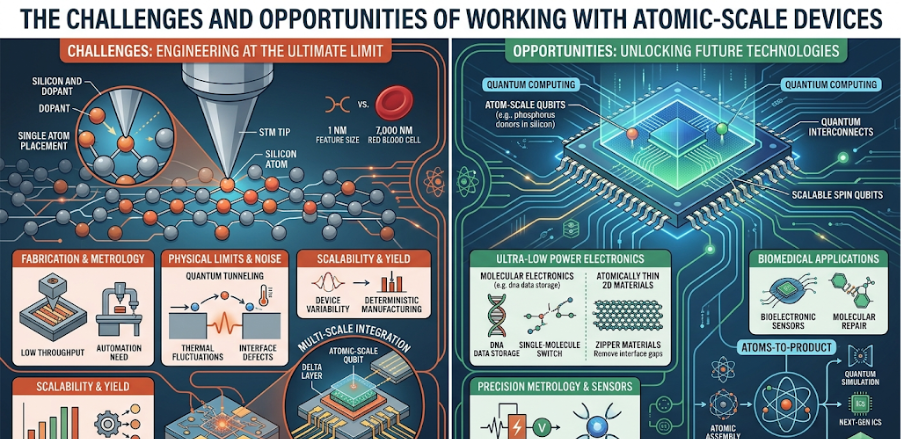
At the atomic level, classical laws break down. Phenomena like quantum tunneling, superposition, and electron wave interference dominate behavior. While these effects can be harnessed, they also introduce unpredictability, making device design and stability difficult.
2. Fabrication Precision
Building devices atom-by-atom requires extraordinary precision. Techniques such as scanning tunneling microscopy (STM) and atomic force microscopy (AFM) are used, but scaling these methods for mass production remains a significant hurdle.
3. Environmental Sensitivity
Atomic-scale devices are extremely sensitive to environmental factors such as temperature, electromagnetic interference, and even minor vibrations. A single stray atom or impurity can disrupt functionality.
4. Reliability and Stability
Over time, atomic arrangements can shift due to thermal fluctuations or external forces. Ensuring long-term stability and repeatability is a major concern for practical applications.
5. Integration with Existing Systems
Bridging the gap between atomic-scale components and conventional electronic systems is complex. Compatibility with current manufacturing processes and architectures is still an ongoing challenge.
Emerging Opportunities
1. Ultra-Low Power Computing
Atomic-scale devices can operate with significantly lower energy consumption compared to traditional transistors. This opens the door to highly energy-efficient computing systems, critical for future data centers and portable electronics.
2. Quantum Computing Advancements
Atomic-level control is essential for quantum bits (qubits), which form the backbone of quantum computing. Atomic-scale engineering enables more stable and scalable qubit designs.
3. Breakthroughs in Materials Science
Manipulating atoms allows scientists to create custom materials with tailored properties—stronger, lighter, or more conductive than anything previously possible.
4. Medical and Biological Applications
Atomic-scale devices could revolutionize medicine through targeted drug delivery, nanoscale sensors, and even molecular machines capable of repairing cells.
5. Data Storage Revolution
Atomic-scale storage could dramatically increase data density. Experimental systems have already demonstrated storing bits in single atoms, potentially leading to storage devices far beyond current capacities.
The Path Forward
To fully realize the potential of atomic-scale devices, interdisciplinary collaboration is essential. Advances in physics, chemistry, materials science, and engineering must converge. Additionally, new fabrication techniques, simulation tools, and error-correction strategies will play a crucial role.
Governments and private industries are investing heavily in this field, recognizing its potential to redefine entire industries. While commercialization may still be years away, the progress being made today is laying the groundwork for a new technological era.
Conclusion
Working with atomic-scale devices is both a formidable challenge and an extraordinary opportunity. The difficulties—ranging from quantum unpredictability to fabrication limits—are significant, but the rewards could reshape computing, medicine, and materials science. As researchers continue to push the boundaries of what is possible, atomic-scale technology stands poised to become one of the most transformative innovations of the 21st century.