
Introduction
Chiplet architecture is changing the way engineers design modern AI hardware. Instead of building an entire processor on one large piece of silicon, designers can divide the system into smaller chips called chiplets.
As AI models become larger, hardware needs more computing power, memory bandwidth, and faster data movement. Therefore, building one extremely large chip can become difficult and expensive.
Chiplets offer another approach. They allow engineers to combine smaller chips inside one package. As a result, manufacturers can create flexible and scalable processors for AI, high-performance computing, and data centers.
However, chiplets are not always better than monolithic chips. Instead, each architecture has different advantages.
So, what is the difference between chiplets and monolithic chips? More importantly, why is chiplet architecture becoming important for AI hardware?
What Is a Monolithic Chip?
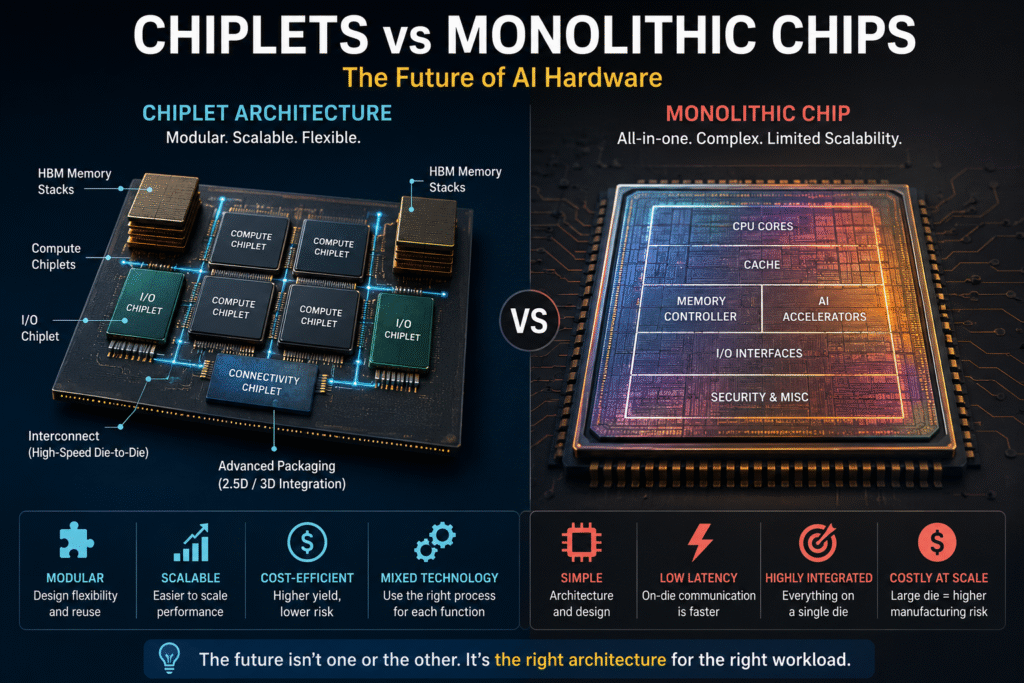
A monolithic chip contains most of its important components on a single silicon die. For example, a processor can include CPU cores, cache, memory controllers, I/O interfaces, and accelerators on the same die.
This design has been used successfully for many years.
Because the components are located on the same piece of silicon, they can communicate quickly. As a result, monolithic chips can provide low latency and efficient data transfer.
Advantages of Monolithic Chips
Monolithic designs offer several benefits:
- Simple chip design
- Fast on-chip communication
- Low latency
- Efficient power usage
- Well-established manufacturing methods
However, the situation becomes more difficult when the chip becomes extremely large.
A larger die has a higher chance of containing manufacturing defects. Therefore, producing very large monolithic chips can reduce manufacturing yield and increase costs.
What Is Chiplet Architecture?
Chiplet architecture takes a different approach.
Instead of placing every function on one large die, engineers divide the processor into several smaller dies. Each die can perform a specific function.
For example, an AI processor could contain:
- Compute chiplets
- I/O chiplets
- Memory interfaces
- Cache chiplets
- Networking chiplets
- AI acceleration chiplets
These chiplets are connected using high-speed die-to-die links. Together, they operate as one larger computing system.
As a result, chiplet architecture provides greater flexibility than a traditional single-die design.
Chiplets vs Monolithic Chips
The two architectures have different strengths.
| Feature | Chiplet Architecture | Monolithic Chip |
|---|---|---|
| Design | Multiple smaller dies | One large die |
| Scalability | High | More limited |
| Reuse | Easier | More difficult |
| Manufacturing | Flexible | More challenging at large sizes |
| Packaging | More complex | Simpler |
| Customization | High | Lower |
| Communication | Die-to-die links | On-die connections |
| Large AI systems | Well suited | Increasingly challenging |
In simple terms, monolithic chips focus on integrating everything into one die. In contrast, chiplet architecture focuses on combining multiple specialized dies.
Why Is Chiplet Architecture Important for AI?
AI workloads are growing rapidly. Modern AI systems need enormous computing power as well as fast access to data.
For this reason, AI processors need more than powerful compute cores. They also need high-bandwidth memory, fast I/O, networking, and efficient data movement.
Trying to place every function onto one enormous die can create design and manufacturing challenges.
Chiplet architecture helps solve this problem by separating different functions.
For example, an AI processor could use multiple compute chiplets together with dedicated I/O and memory components. Consequently, engineers can increase system performance without making one single die extremely large.
Chiplets Can Improve Manufacturing Flexibility
Another major advantage of chiplet architecture is manufacturing flexibility.
Different parts of a processor do not always need the same manufacturing technology.
For example, compute chiplets may benefit from an advanced process node. Meanwhile, I/O components may work well with a mature and less expensive process.
Therefore, manufacturers can select the most suitable process for each chiplet.
This approach can provide several benefits:
- Lower manufacturing costs
- Better yield
- Greater design flexibility
- Reusable components
- Easier product customization
Furthermore, smaller dies can be easier to manufacture than one very large die.
Chiplets Enable Modular AI Hardware
Chiplets also make hardware more modular.
Imagine a company wants to build three different AI processors. One processor may target AI training, another may focus on inference, and a third may target high-performance computing.
Instead of creating three completely different chips, the company could reuse some common chiplets.
For example, the same I/O chiplet could be used across several products. Meanwhile, different compute chiplets could be added based on the target workload.
As a result, companies can potentially reduce development time and create multiple products from a common hardware platform.
The Role of UCIe in Chiplet Architecture
One important challenge with chiplets is communication.
If every company uses a different chiplet interface, connecting chiplets from different vendors becomes difficult. Therefore, industry standards are important.
Universal Chiplet Interconnect Express (UCIe) is an open standard designed for communication between chiplets inside a package.
UCIe aims to support an open chiplet ecosystem and make it easier to connect chiplets from different sources.
As chiplet systems become more advanced, standards such as UCIe can help improve interoperability and simplify system development.
For more information, see the official UCIe specifications.
Chiplets and Advanced Packaging
Chiplet architecture also depends heavily on advanced packaging.
When several dies are placed inside the same package, the package becomes an important part of the system design.
For example, modern systems can use technologies such as:
- 2.5D packaging
- 3D packaging
- Silicon interposers
- Hybrid bonding
- High-density die-to-die connections
These technologies help chiplets communicate efficiently.
Moreover, advanced packaging can place compute chiplets closer to memory. This can help reduce communication distance and improve overall system performance.
Therefore, chiplet architecture and advanced packaging are closely connected.
Chiplets and HBM
High Bandwidth Memory (HBM) is another important technology for AI hardware.
AI processors need to move large amounts of data between memory and compute units. Therefore, memory bandwidth can become a major performance factor.
Our Hashing Hardware article, Inside HBM4: The Memory Tech Powering the Next AI Boom, explains how HBM technology is supporting the growing demands of AI workloads.
Chiplet architecture can complement HBM by combining compute chiplets with high-bandwidth memory in the same advanced package.
Consequently, a modern AI package may combine:
Compute Chiplets + HBM + I/O Chiplets + High-Speed Interconnect
This creates a scalable platform for demanding AI workloads.
Chiplet Architecture and Custom Silicon
Chiplets also support the growth of custom AI hardware.
Our article on The New Era of Custom Silicon for Enterprise AI explores how organizations are developing hardware that is optimized for specific workloads.
Chiplet architecture can make custom hardware more flexible.
Instead of designing an entire processor from the beginning, companies can potentially combine existing chiplets with custom components.
As a result, businesses may be able to create specialized processors while reducing some of the design work required for a completely new chip.
Challenges of Chiplet Architecture
Although chiplets provide many benefits, they also introduce new challenges.
1. Interconnect Complexity
Chiplets must communicate quickly and reliably.
If the connection between chiplets is too slow, the overall system may lose some of its performance advantages. Therefore, high-speed interconnect technology is essential.
2. Power Consumption
Moving data between separate dies can consume additional energy.
For this reason, engineers need to carefully design the connections between chiplets. Efficient interconnects can help reduce unnecessary power consumption.
3. Packaging Cost
Advanced packaging is more complex than traditional chip packaging.
As the number of chiplets increases, packaging requirements can also become more difficult. Therefore, companies need to balance performance improvements against manufacturing costs.
4. Testing
Testing multiple chiplets creates additional challenges.
Each chiplet needs to work correctly on its own. In addition, the complete package must be tested after the chiplets are connected.
Consequently, chiplet systems require strong testing and validation methods.
5. Thermal Management
AI processors can generate significant amounts of heat.
When multiple high-performance chiplets are placed close together, heat can become concentrated in specific areas.
Therefore, thermal design is an important part of chiplet-based AI systems.
Are Chiplets Better Than Monolithic Chips?
There is no single answer.
Monolithic chips can still be the better option when a design requires:
- Very low latency
- Simple packaging
- Efficient on-die communication
- A relatively small processor
- Lower packaging costs
On the other hand, chiplet architecture can be more attractive when a system requires:
- High scalability
- Multiple manufacturing processes
- Component reuse
- Large computing capacity
- Product customization
- Advanced AI capabilities
Therefore, the best architecture depends on the workload and product requirements.
Will Chiplets Replace Monolithic Chips?
Chiplets are unlikely to completely replace monolithic chips.
Instead, both approaches will continue to serve different purposes.
Monolithic designs remain useful for processors where integration, latency, and simplicity are important. Meanwhile, chiplet architecture is becoming increasingly attractive for large AI accelerators, data-center processors, networking systems, and high-performance computing.
In the future, we may see more hybrid designs that combine monolithic and chiplet-based components.
As AI workloads continue to grow, this flexibility could become increasingly important.
The Future of Chiplet Architecture
The semiconductor industry is moving toward increasingly complex systems.
AI processors need more compute power, more memory bandwidth, faster networking, and better energy efficiency. At the same time, manufacturing large monolithic dies is becoming increasingly challenging.
Chiplet architecture offers a practical way to address some of these problems.
Furthermore, improvements in advanced packaging and die-to-die standards can make chiplet systems more efficient and easier to develop.
As a result, chiplets could become an important building block for next-generation AI hardware.
Final Thoughts
The future of semiconductor design is not simply about choosing chiplets or monolithic chips.
Instead, it is about selecting the right architecture for the right workload.
Monolithic chips still provide excellent performance and low-latency communication. However, chiplet architecture offers modularity, scalability, manufacturing flexibility, and easier customization.
For AI and high-performance computing, these benefits are becoming increasingly valuable.
Ultimately, the industry may move toward a more modular approach where multiple specialized chiplets work together as one powerful computing system.
The future of AI hardware may not be one giant chip. It may be a collection of smaller chips working together.
Frequently Asked Questions
What is chiplet architecture?
Chiplet architecture is a semiconductor design approach where multiple smaller dies are combined inside one package to create a larger computing system.
What is the difference between chiplets and monolithic chips?
A monolithic chip places most components on one silicon die. In contrast, chiplet architecture divides those functions across multiple smaller dies.
Why are chiplets useful for AI?
AI systems require large amounts of computing power and memory bandwidth. Chiplets can help engineers scale these systems while providing greater design flexibility.
What is UCIe?
UCIe, or Universal Chiplet Interconnect Express, is an open standard designed to support communication between chiplets.
Will chiplets replace monolithic chips?
Not completely. Both architectures have advantages, and the best choice depends on the performance, cost, power, and scalability requirements of the product.