
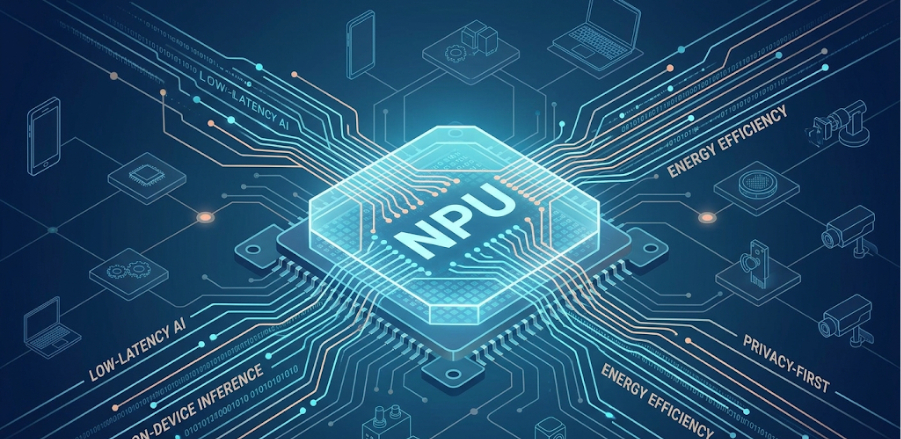
To fully understand why the NPU is becoming the cornerstone of modern hardware, we have to look at how it alters the relationship between software demands and physical constraints.
1. The Death of the “AI Tax” on Battery Life
Historically, running complex machine learning models on a laptop or mobile device led to thermal throttling and rapid battery drain. The NPU eliminates this “AI tax” by utilizing Domain-Specific Architecture (DSA). Because it is physically wired to perform the specific math required for neural networks, it achieves orders of magnitude better performance-per-watt than a general-purpose CPU.
2. Facilitating Small Language Models (SLMs)
While Large Language Models (LLMs) grab the headlines, the NPU is the primary driver for Small Language Models. These are efficient, highly capable models (often under 7B parameters) that can run entirely offline. NPUs enable these models to provide context-aware assistance and automated workflows without ever needing an internet connection, ensuring business continuity in low-connectivity environments.
3. Real-Time Hardware-Level Security
Beyond performance, NPUs are being utilized to enhance hardware-based security. They can be trained to detect anomalous patterns in system memory or network traffic at the silicon level. By identifying a zero-day exploit or a firmware-level intrusion in real-time—without taxing the main processor—NPUs add a critical layer of defense to the hardware supply chain.
4. Integration with Event-Based Vision
NPUs are uniquely suited to work with event-based sensors (neuromorphic imaging). Unlike traditional cameras that capture full frames, event-based sensors only record changes in pixels. NPUs can process this sparse data stream with incredible speed, enabling ultra-low-latency responses in autonomous systems, robotics, and advanced gesture-controlled interfaces.
5. Standardizing the Software Abstraction Layer
One of the biggest hurdles for specialized hardware has been software compatibility. However, the rise of unified frameworks—like ONNX Runtime, OpenVINO, and TensorFlow Lite—allows developers to target NPUs without rewriting their entire codebase. This maturing ecosystem means that enterprise applications, from ERP systems to car rental platforms, can leverage hardware acceleration with minimal friction.
6. Managing Global Energy Volatility
As corporate ESG (Environmental, Social, and Governance) goals become more stringent, the energy efficiency of a company’s fleet of devices matters. Shifting AI workloads to NPUs is a pragmatic strategy to reduce aggregate power consumption. In a world of fluctuating energy costs, the NPU isn’t just a performance booster; it’s a tool for operational cost stability.
Conclusion: The New Foundation of the Compute Stack
The rapid rise of the NPU signal a permanent shift in how we define a “capable” computer. We are moving away from a world where AI is a remote service to one where it is a local, physical utility.
By 2026, the NPU has evolved from a niche coprocessor into a non-negotiable requirement for the modern workspace. With market projections suggesting nearly half of all global chip sales will be driven by AI accelerators this year, the business case is clear: hardware is no longer just a vessel for software, but a specialized partner in its execution.
The evolution of the NPU proves that the future of computing isn’t just about “faster” chips—it’s about smarter allocation of resources. By moving intelligence to the edge, we are creating a more resilient, private, and sustainable digital infrastructure.