
In 2026, the energy market is no longer a predictable utility cost; it is a high-stakes variable that can make or break a company’s bottom line. For any business heavily reliant on data centers, edge computing, or industrial IoT, energy price volatility is now a primary business risk.
While most organizations try to hedge this risk through financial instruments or long-term utility contracts, the most resilient leaders are looking elsewhere: the hardware architecture itself.
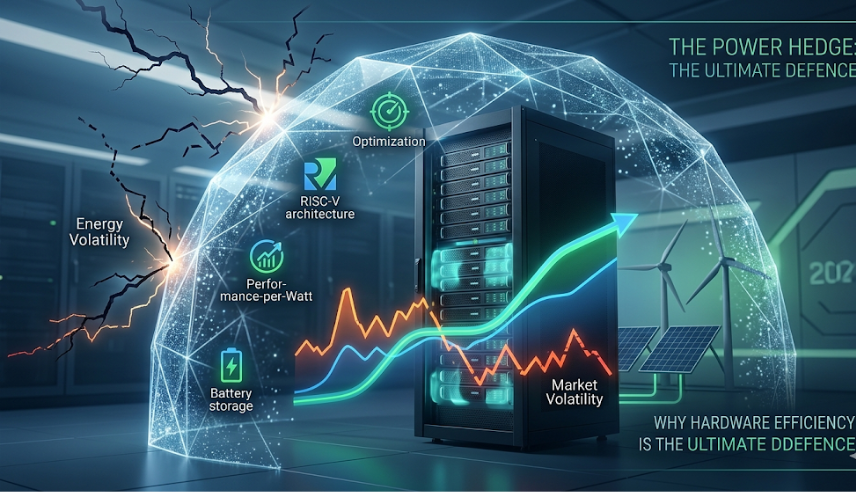
Efficiency as an Insurance Policy
We have entered an era where “Performance-per-Watt” is the most important financial metric in the tech stack. When energy prices spike, an inefficient infrastructure acts like a hole in your bucket.
By prioritizing hardware efficiency, you aren’t just being “green”—you are building a buffer against market shocks.
- The RISC-V Advantage: Custom, application-specific silicon allows companies to strip away the “dark silicon” (unused transistors) that waste power in general-purpose chips. A leaner architecture means a lower “idling” cost when energy prices are at their peak.
- Thermal Resilience: Efficient hardware generates less heat. In a heatwave or a period of high electricity costs, the secondary expense of cooling infrastructure can often exceed the cost of the compute itself. Reducing heat at the chip level provides a double-win for cost savings.
To give this article more depth and authority, here are several additional points that connect hardware architecture directly to financial and operational resilience.
1. The “Peak Shaving” Strategy at the Chip Level
In many regions, energy providers charge “peak-demand” pricing. If your hardware architecture is inefficient, your systems hit power spikes during high-traffic periods, triggering massive surcharges.
- Point: Efficient hardware (like specialized NPUs or low-power RISC-V cores) flattens your power consumption curve.
- Impact: By “shaving” those peaks at the silicon level, you avoid the most expensive energy tiers, turning a technical spec into a direct utility cost-saving strategy.
2. Extending the “Hardware Refresh” Cycle
Energy volatility isn’t just about the bill—it’s about the cost of the hardware itself in a strained supply chain.
- Point: Inefficient hardware runs hotter, leading to faster component degradation (electromigration).
- Impact: Efficient hardware stays within optimal thermal envelopes longer. This extends the lifespan of your infrastructure, allowing you to delay expensive capital outlays for new equipment during periods of economic or supply-chain instability.
3. Energy-Aware Workload Orchestration
The hardware of 2026 isn’t just passive; it’s intelligent.
- Point: Modern SoC (System on Chip) designs now support granular power-gating and dynamic voltage scaling that can be tied to real-time energy pricing data.
- Impact: Imagine a system that automatically shifts non-critical background tasks to lower-power “efficiency cores” the moment energy prices cross a certain threshold. This turns your infrastructure into an autonomous financial optimizer.
4. Reducing the “Cooling Tax”
For every watt consumed by a server, a significant percentage of an additional watt is required just to cool it (Power Usage Effectiveness, or PUE).
- Point: When energy prices double, your “cooling tax” doubles as well.
- Impact: Hardware efficiency has a multiplier effect. By reducing heat at the source, you see exponential savings in HVAC and liquid cooling costs, making your physical data center footprint far more resilient to climate-driven energy spikes.
5. Local Power Autonomy (Microgrids + Edge)
As companies move toward on-site renewables (solar/wind), they face the challenge of intermittent supply.
- Point: If your hardware is “energy-hungry,” you need massive, expensive battery arrays to keep things running during low-sun/low-wind periods.
- Impact: Lean, efficient hardware allows you to run longer on smaller battery reserves. It makes the dream of a “Net Zero” or “Off-Grid” edge facility financially viable because the “energy budget” required to stay operational is significantly lower.
Decoupling Growth from Power Consumption
The old model of scaling meant that as your data needs grew, your power bill grew in a linear (or even exponential) fashion. To remain resilient in 2026, enterprises must decouple compute growth from energy draw.
This is being achieved through:
- Edge-Heavy Architectures: By processing data at the source on low-power ARM or RISC-V gateways, you avoid the massive energy “tax” of hauling data to the cloud and back.
- Accelerated Computing: Moving workloads from general CPUs to specialized TPUs or NPUs. These accelerators can often complete AI tasks at a fraction of the energy cost, effectively “stretching” every dollar spent on electricity.
The Strategic Shift: From OPEX to CAPEX
Resiliency requires a shift in mindset. Instead of accepting high energy bills as a fluctuating Operating Expense (OPEX), forward-thinking firms are treating hardware upgrades as a Capital Expenditure (CAPEX) that pays for itself through energy “dividends.”
Investing in high-efficiency hardware today is essentially pre-paying for your energy savings for the next five years. It turns a volatile variable into a controlled constant.
Conclusion: The New Standard for Digital Infrastructure
As we navigate the energy realities of 2026, the definition of “performance” has permanently shifted. We are no longer in an era where we can simply throw more power at a problem to solve it. In a volatile market, inefficiency is a debt that gets called in every time energy prices spike.
By integrating hardware efficiency into your corporate strategy, you achieve three critical outcomes:
- Economic Predictability: You turn your power bill from a volatile risk into a controlled, manageable baseline.
- Operational Agility: You enable your infrastructure to thrive in environments—from the edge to the microgrid—where energy is a finite resource.
- True ESG Leadership: You move beyond carbon offsets and start addressing the environmental impact of your technology at its physical source.