
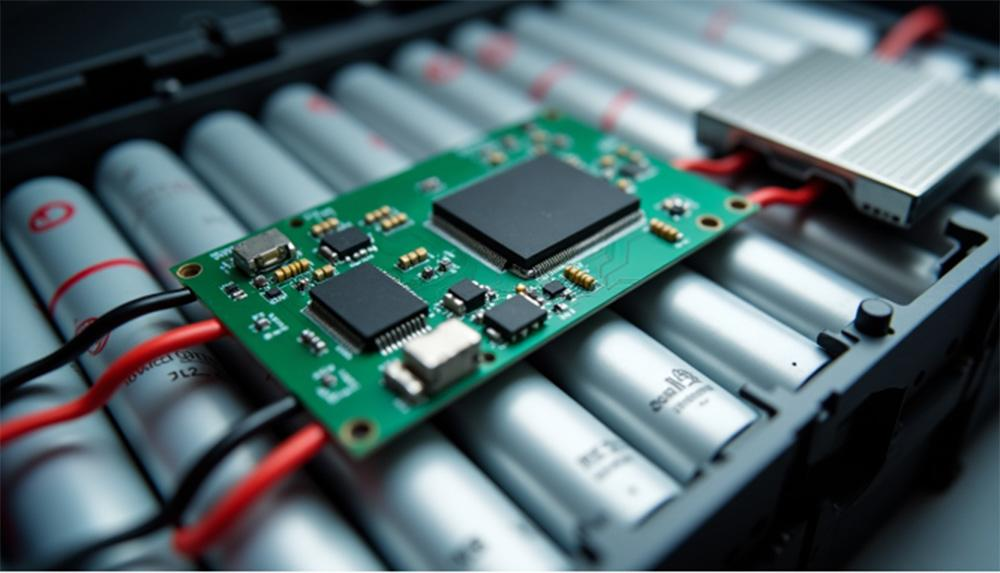
Introduction
Batteries power many of the electronic devices we use today. From smartphones and laptops to electric vehicles, industrial equipment, and energy storage systems, batteries have become an essential part of modern technology.
However, managing a battery involves more than simply charging and discharging it. Batteries must operate within safe voltage, current, and temperature limits to maintain performance and reliability.
This is where a Battery Management System (BMS) becomes important.
A BMS monitors battery conditions, manages charging and discharging, protects battery cells, and helps improve the overall performance of a battery pack.
As battery-powered technologies continue to grow, understanding BMS architecture and its role in electronic hardware design is becoming increasingly important.
In this article, we explore how battery management systems work, their main components, important design considerations, and their applications in modern electronics.
What Is a Battery Management System (BMS)?
A Battery Management System is an electronic system designed to monitor, control, and protect rechargeable battery packs.
It collects information from individual battery cells and the complete battery pack to ensure that the system operates within defined limits.
A typical BMS performs several important functions:
- Monitors individual cell voltages.
- Measures battery current.
- Tracks battery temperature.
- Estimates remaining battery capacity.
- Protects against overcharging and excessive discharge.
- Supports cell balancing.
- Communicates battery information to external systems.
The design of a BMS depends on the battery chemistry, number of cells, voltage level, power requirements, and intended application.
For example, a small portable device may use a relatively simple battery protection circuit, while an electric vehicle requires a more advanced system capable of monitoring and controlling a large battery pack.
Why Is a BMS Important?
Battery performance and safety depend on how well the battery operates under different conditions.
A properly designed BMS helps address several important challenges.
1. Battery Protection
Rechargeable batteries have defined operating limits.
Exceeding these limits can damage cells and create safety risks.
A BMS monitors voltage, current, and temperature to identify abnormal conditions and initiate appropriate protective actions.
2. Improved Battery Life
Battery cells can age at different rates because of variations in capacity, resistance, temperature, and usage.
A BMS helps monitor these differences and supports cell balancing to reduce the effects of cell imbalance.
3. Accurate Battery Monitoring
Users and connected systems need information about the remaining battery capacity.
A BMS can estimate the State of Charge (SOC) and State of Health (SOH), helping systems understand battery availability and condition.
4. Reliable Charging and Discharging
A BMS helps ensure that battery operation remains within the manufacturer’s recommended limits.
It can communicate with charging systems and disconnect the battery when protection conditions are triggered.
5. Better System Performance
Battery monitoring and protection help improve the reliability of products that depend on rechargeable batteries.
This is especially important in electric vehicles, industrial equipment, backup power systems, and portable electronics.
Key Components of a Battery Management System
A BMS contains several electronic components that work together to monitor and protect a battery pack.
1. Battery Monitoring IC
A battery monitoring integrated circuit measures important electrical parameters such as cell voltage and temperature.
Some monitoring ICs can support multiple battery cells and provide measurement information to a controller.
Accurate monitoring helps the BMS identify abnormal operating conditions.
2. Microcontroller (MCU)
The microcontroller acts as the control unit of the BMS.
It processes measurement data, executes monitoring algorithms, manages protection logic, and communicates with other electronic systems.
The MCU may also calculate battery-related information such as State of Charge and State of Health.
3. Current Sensors
Current sensors measure the amount of current entering or leaving the battery pack.
This information helps the BMS monitor charging and discharging conditions and estimate battery capacity.
Current measurement can be implemented using a shunt resistor or an appropriate current-sensing device.
4. Temperature Sensors
Battery temperature affects performance, charging behavior, and safety.
Temperature sensors monitor battery cells and other important areas of the battery pack.
If temperatures exceed defined limits, the BMS can initiate protective actions.
5. Protection MOSFETs
MOSFETs are commonly used as electronic switches in battery protection circuits.
The BMS can control these switches to interrupt charging or discharging when certain fault conditions occur.
6. Communication Interfaces
Modern battery systems often need to exchange information with external controllers.
Depending on the application, communication interfaces may include:
- CAN.
- UART.
- I2C.
- SPI.
- SMBus.
For example, an electric vehicle BMS may communicate battery information to the vehicle control system through a CAN network.
How Does a Battery Management System Work?
A BMS continuously collects information from the battery and evaluates whether it is operating within the required limits.
A simplified working process includes the following stages:
Step 1: Data Collection
The monitoring circuit measures cell voltages, battery current, and temperature.
Step 2: Data Processing
The microcontroller receives measurement data and processes it using the programmed control algorithms.
Step 3: Battery Condition Estimation
The system estimates battery information such as State of Charge and State of Health.
Step 4: Protection Monitoring
The BMS checks whether voltage, current, or temperature conditions exceed the configured operating limits.
Step 5: Control Action
If an abnormal condition is detected, the BMS can activate protection mechanisms, such as disconnecting the battery through its switching circuit.
Step 6: Communication
The BMS sends battery status and fault information to external devices or controllers.
This process helps maintain controlled battery operation throughout charging and discharging.
Understanding State of Charge and State of Health
Two important measurements in battery management are State of Charge and State of Health.
State of Charge (SOC)
State of Charge represents the estimated remaining charge in a battery.
It is commonly expressed as a percentage.
For example, an SOC reading of 80% indicates that the battery is estimated to have 80% of its usable charge remaining under the system’s estimation method.
SOC estimation can use methods such as:
- Coulomb counting.
- Voltage-based estimation.
- Model-based estimation.
Accurate SOC estimation helps users understand how much battery capacity is available.
State of Health (SOH)
State of Health describes the battery’s condition compared with its original or reference condition.
Battery capacity, internal resistance, and performance changes can be used to evaluate battery ageing.
For example, a battery with reduced usable capacity may have a lower SOH than a new battery.
SOH estimation is particularly useful in electric vehicles and industrial battery systems where long-term battery performance matters.
What Is Cell Balancing in a BMS?
A battery pack may contain multiple cells connected in series or parallel.
In a series-connected battery pack, individual cells can gradually develop differences in voltage and capacity.
This condition is known as cell imbalance.
Cell imbalance can reduce usable battery capacity because the pack may reach a charging or discharging limit before all cells have used their available capacity.
A BMS can address this issue through cell balancing.
Passive Cell Balancing
Passive balancing uses resistors to discharge cells with higher voltage.
The excess energy is converted into heat.
Advantages include:
- Simple circuit design.
- Lower implementation complexity.
- Relatively low component cost.
However, passive balancing wastes energy during the balancing process.
Active Cell Balancing
Active balancing transfers energy between cells or through an energy-transfer circuit.
This approach can improve energy utilization, particularly in larger and more demanding battery systems.
However, active balancing generally requires more complex circuitry and control.
The appropriate balancing method depends on battery size, performance requirements, cost, and system architecture.
Important Design Considerations for BMS Development
Designing a reliable BMS requires careful planning across hardware, firmware, and battery integration.
1. Battery Chemistry
Different battery chemistries have different voltage characteristics, charging requirements, and operating limits.
Engineers must select monitoring and protection components that support the intended battery chemistry.
2. Voltage and Current Measurement
Measurement accuracy is important for reliable battery monitoring.
The sensing circuit should provide suitable accuracy across the expected operating range.
3. Thermal Management
Battery temperature can influence performance, charging behavior, and battery life.
Engineers should consider sensor placement, heat generation, enclosure design, and cooling requirements.
4. PCB Design
The BMS PCB must support accurate sensing, reliable power delivery, and appropriate isolation where required.
High-current paths should be designed to handle the expected electrical load.
Engineers should also consider grounding, thermal performance, component placement, and protection circuitry.
5. Firmware and Control Logic
The firmware manages measurement processing, battery estimation, fault detection, communication, and control functions.
It should be designed to handle abnormal operating conditions and recover safely where appropriate.
6. Communication and System Integration
The BMS often operates as part of a larger electronic system.
Engineers should define communication protocols, fault reporting, data requirements, and integration with chargers or external controllers.
7. Safety and Validation
Battery systems require careful electrical and thermal validation.
Testing should evaluate protection behavior, measurement accuracy, communication, charging, discharging, and fault handling.
A BMS should be designed and validated according to the safety and regulatory requirements applicable to its intended product. It should not be treated as a substitute for appropriate battery cells, mechanical protection, or system-level safety engineering.
Common BMS Design Challenges
Engineers may encounter several challenges during BMS development.
Measurement Errors: Inaccurate voltage or current readings can affect battery estimation and protection decisions.
Cell Imbalance: Differences between cells can reduce usable battery capacity.
Thermal Issues: Poor sensor placement or inadequate thermal design can make it difficult to detect temperature problems.
Communication Failures: Incorrect communication handling can prevent external controllers from receiving important battery information.
Incorrect Protection Thresholds: Poorly configured limits may cause unnecessary shutdowns or fail to detect unsafe operating conditions.
PCB Layout Problems: Inadequate routing, grounding, or current-path design can affect measurement accuracy and reliability.
These challenges should be addressed during architecture, schematic design, PCB development, firmware implementation, and testing.
Applications of Battery Management Systems
BMS technology is used across several industries.
Electric Vehicles
Electric vehicles use BMS technology to monitor large battery packs, estimate available energy, balance cells, and protect the battery.
Consumer Electronics
Smartphones, laptops, tablets, and portable devices use battery management and protection circuits to support safe and efficient battery operation.
Renewable Energy Storage
Solar energy storage systems use battery management technology to monitor stored energy and control battery operation.
Industrial Equipment
Industrial tools, robotics, backup systems, and portable equipment rely on battery monitoring and protection.
IoT and Embedded Devices
Battery-powered sensors and connected devices use battery management features to improve operating reliability and monitor remaining energy.
A Practical Workflow for Developing a BMS
A structured development process can help engineers build reliable battery management systems.
- Define System Requirements: Identify battery chemistry, cell count, voltage, current, and application requirements.
- Select Monitoring Components: Choose suitable battery monitoring ICs, sensors, MOSFETs, and microcontrollers.
- Design the Circuit: Develop the monitoring, sensing, protection, and communication circuits.
- Design the PCB: Plan high-current paths, measurement connections, grounding, isolation, and thermal requirements.
- Develop Firmware: Implement measurement processing, battery estimation, protection logic, and communication.
- Perform Functional Testing: Verify voltage measurement, current sensing, temperature monitoring, and cell balancing.
- Validate Protection Features: Test appropriate fault conditions and confirm that protective actions operate as intended.
- Integrate the System: Connect the BMS with the charger, battery pack, and external controller.
- Complete System Validation: Perform electrical, thermal, environmental, and applicable safety testing before production.
Conclusion
Battery Management Systems play an important role in modern battery-powered electronics.
By monitoring cell voltage, current, temperature, and battery condition, a BMS helps protect battery packs and supports reliable operation.
Functions such as cell balancing, State of Charge estimation, State of Health monitoring, and fault protection make BMS technology essential for electric vehicles, industrial equipment, portable electronics, and energy storage systems.
However, successful BMS development requires more than selecting a monitoring IC. Engineers must consider battery chemistry, PCB design, firmware, thermal management, communication, and system-level safety.
As battery-powered technologies continue to expand, well-designed battery management systems will remain an important part of reliable electronic hardware development.
At HashingHardware, understanding these hardware engineering fundamentals helps teams make better design decisions and develop dependable electronic products.