
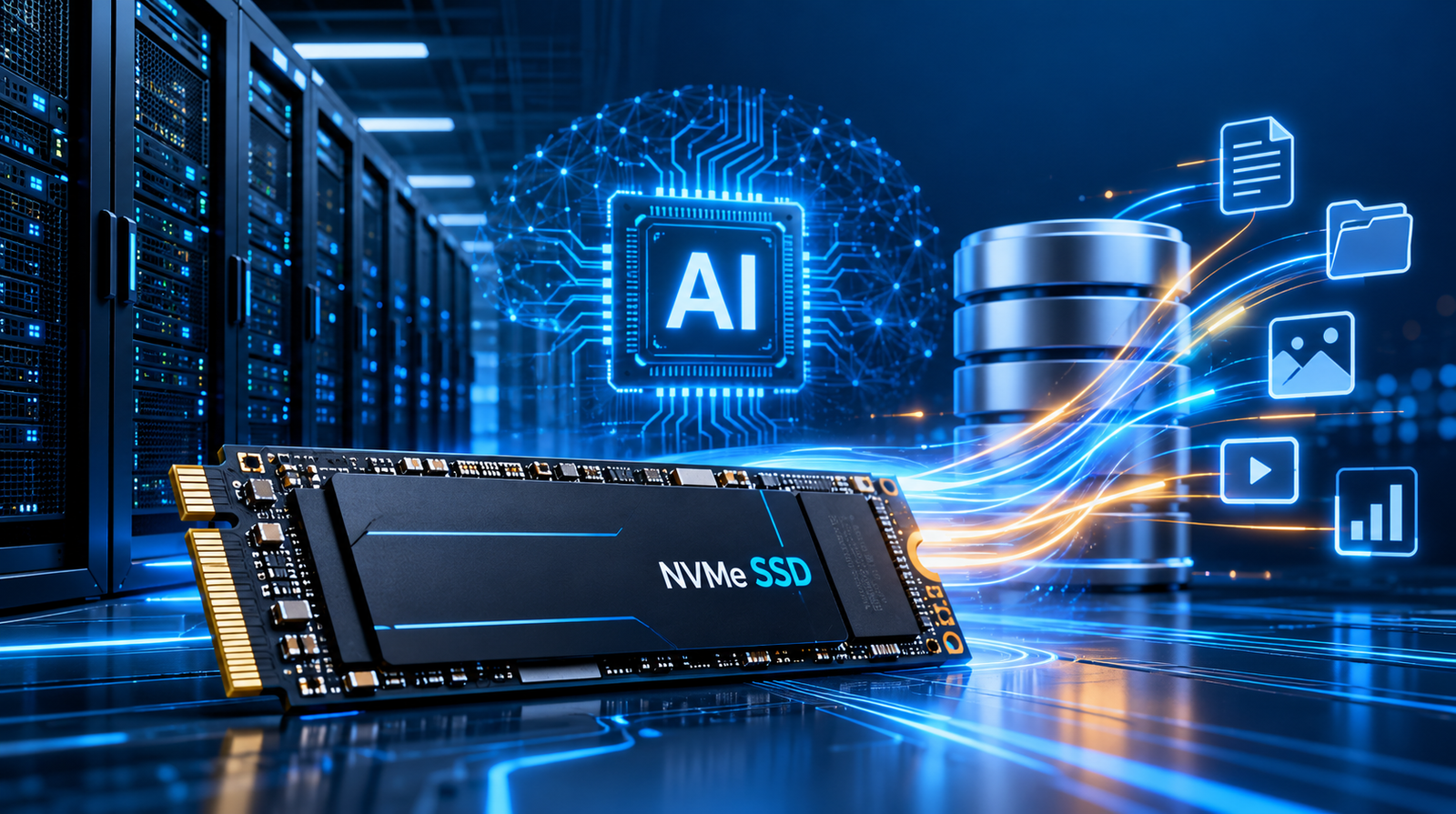
Introduction
Artificial intelligence (AI) is transforming how businesses process, store, and analyze data. From generative AI tools to autonomous systems, modern applications require faster data access and higher storage performance. As a result, traditional storage solutions are facing new challenges.
This is where AI SSDs and high-bandwidth storage come into the picture. These technologies help AI systems access large datasets, load models faster, and manage demanding workloads more efficiently.
As AI adoption continues to grow, high-performance storage is becoming an essential part of modern computing infrastructure. But what makes AI-focused storage different, and what can we expect in the coming years?
What Are AI SSDs?
AI SSDs are solid-state drives designed or optimized to support the demanding storage requirements of artificial intelligence workloads. They use flash memory to store data and provide faster access than traditional hard disk drives (HDDs).
Unlike conventional storage devices, AI-focused SSD solutions must handle large datasets, frequent read and write operations, and multiple requests simultaneously.
For example, an AI model may need to access billions of parameters and process large amounts of training data. Faster storage helps reduce the time required to transfer this information between storage, memory, and processors.
However, an SSD alone cannot eliminate every performance bottleneck. Its effectiveness also depends on the processor, memory capacity, storage interface, and overall system architecture.
Why AI Workloads Need High-Bandwidth Storage
AI applications depend on continuous data movement. If storage cannot supply data quickly enough, powerful GPUs and other accelerators may remain underutilized while waiting for the next batch of information.
High-bandwidth storage helps address this challenge in several ways.
1. Faster AI Model Training
Training AI models involves processing large datasets over multiple iterations. High-performance SSDs can supply training data more quickly, especially when several storage devices operate in parallel.
Consequently, faster data delivery can help reduce input delays and improve overall training efficiency.
2. Better Inference Performance
AI inference occurs when a trained model generates predictions, answers questions, or produces content.
Large language models may need to access model weights and other data during inference. Fast storage can improve model-loading times and support efficient access to data that does not fit entirely in memory.
However, inference speed also depends on GPU performance, memory bandwidth, model architecture, and request processing.
3. Improved Data Center Efficiency
AI data centers manage enormous volumes of information. High-bandwidth storage helps servers handle demanding workloads without relying entirely on slower storage systems.
When storage, networking, memory, and compute resources are properly balanced, organizations can improve infrastructure utilization and reduce unnecessary processing delays.
4. Faster Access to Large Datasets
AI systems frequently work with images, videos, documents, sensor readings, and other data-intensive files.
High-performance SSDs can reduce data-access delays and help applications retrieve information more efficiently. This is particularly valuable for computer vision, scientific computing, and large-scale analytics.
Key Technologies Driving AI Storage
Several technologies are shaping the future of high-bandwidth storage. Together, they help improve data transfer speeds, reduce bottlenecks, and support demanding AI workloads.
1. NVMe SSDs
Non-Volatile Memory Express (NVMe) is a storage protocol designed for high-speed, low-latency communication with solid-state storage devices.
NVMe SSDs can support many parallel input and output operations. This makes them suitable for servers and workstations that handle numerous data requests simultaneously.
As AI infrastructure evolves, NVMe storage will remain important for high-performance computing and data-intensive applications.
2. PCIe 5.0 and PCIe 6.0
Peripheral Component Interconnect Express (PCIe) provides a high-speed connection between SSDs and other computer components.
PCIe 5.0 offers up to 32 gigatransfers per second (GT/s) per lane, while PCIe 6.0 increases this to 64 GT/s per lane.
Both standards use four lanes in a typical x4 SSD configuration. Actual storage throughput depends on protocol overhead, controller performance, flash memory, and system implementation.
As a result, newer PCIe generations can provide more bandwidth for demanding storage applications, provided that the SSD and host platform support the same standard.
3. High-Density NAND Flash
NAND flash is the memory technology used in most SSDs. Improvements in flash density allow manufacturers to store more data in a smaller physical space.
Higher-capacity SSDs are particularly valuable in AI environments because training datasets, model checkpoints, and generated content can consume substantial storage capacity.
Nevertheless, greater storage density does not automatically guarantee higher speed. Performance also depends on the controller, NAND design, firmware, and workload.
4. Computational Storage
Computational storage brings certain data-processing capabilities closer to the storage device.
Instead of transferring every piece of data to the main processor, compatible systems can perform selected operations near the data.
For AI workloads, this approach may reduce unnecessary data movement and improve efficiency for suitable tasks. However, its benefits depend on application support and the type of processing involved.
High-Bandwidth Storage and GPU Performance
Graphics processing units (GPUs) are widely used to train and run modern AI models. These processors can handle enormous amounts of computation, but they also require fast access to data.
Storage performance matters because AI data must move through several layers before reaching the GPU.
A typical data path includes:
- Storage: SSDs hold datasets, model files, and checkpoints.
- System memory: RAM buffers data before processing.
- GPU memory: High-bandwidth memory (HBM) provides fast access to data used by the accelerator.
- GPU processing: The accelerator performs calculations for training or inference.
Each layer serves a different purpose.
For example, an SSD cannot replace GPU memory. Instead, it supplies data and model files that the system loads into faster memory when required.
Therefore, an effective AI infrastructure must balance storage throughput, memory bandwidth, network speed, and computing capacity.
Emerging Trends in AI SSDs and High-Bandwidth Storage
The future of AI storage will involve more than simply increasing SSD capacity. Manufacturers and infrastructure providers are also working to improve performance, scalability, and energy efficiency.
1. Faster Storage Interfaces
Newer PCIe generations provide greater potential bandwidth for compatible SSDs. As AI workloads grow, faster interfaces can help systems move more data without overwhelming existing connections.
However, real-world improvements will depend on whether the SSD controller, flash memory, host processor, and software can take advantage of the additional bandwidth.
2. Higher-Capacity Enterprise SSDs
AI infrastructure requires space for training datasets, model checkpoints, inference data, and archived information.
Higher-capacity enterprise SSDs can help organizations store more data while reducing the number of physical drives required for a given capacity.
In addition, improved storage density may simplify infrastructure management. Organizations must still consider endurance, cooling, reliability, and total cost of ownership.
3. Storage for Retrieval-Augmented Generation
Retrieval-augmented generation (RAG) allows AI applications to retrieve relevant information from external data sources before generating a response.
These systems may rely on document repositories, vector databases, and other storage services to retrieve relevant content.
Fast SSDs can improve data access for suitable workloads. However, overall RAG performance also depends on indexing, search algorithms, network latency, and database optimization.
As businesses adopt more knowledge-based AI applications, storage systems will need to support efficient access to increasingly large information collections.
4. Improved Power Efficiency
AI data centers consume significant amounts of electricity. Therefore, performance per watt is becoming an important consideration when selecting storage hardware.
Newer SSD controllers, firmware improvements, and efficient system designs may help reduce energy consumption for certain workloads.
Organizations should evaluate both active and idle power, cooling requirements, and workload performance before choosing a storage solution.
5. Smarter Storage Management
AI-assisted infrastructure management may help administrators monitor storage health, identify unusual performance patterns, and predict potential failures.
These capabilities can support more proactive maintenance and better resource allocation.
At the same time, effective monitoring still requires reliable data, appropriate policies, and human oversight.
Challenges Facing AI Storage Technology
Although AI SSDs offer important benefits, several challenges remain.
Cost and Infrastructure Upgrades
High-performance enterprise SSDs can be expensive. Organizations may also need compatible servers, newer interfaces, additional cooling, and improved networking.
Therefore, businesses must evaluate whether the expected performance improvements justify the investment.
Heat and Power Consumption
High-performance SSDs can generate significant heat under sustained workloads. Without proper cooling, thermal throttling may reduce performance.
Data centers must account for airflow, drive placement, power delivery, and cooling capacity when deploying large numbers of SSDs.
Storage Endurance
AI workloads can involve frequent data writes, particularly during training, checkpoint creation, and data processing.
Repeated write operations can contribute to flash memory wear. Enterprise SSDs should therefore be selected according to workload intensity, endurance ratings, and expected service life.
Data Movement Bottlenecks
Faster storage does not automatically make an entire AI system faster.
Network limitations, insufficient RAM, slow preprocessing pipelines, and GPU memory constraints can still reduce performance.
For this reason, organizations should evaluate the complete data path instead of focusing only on SSD specifications.
How to Choose the Right SSD for AI Workloads
Selecting an appropriate SSD requires understanding the workload and the surrounding infrastructure.
Consider these important factors before making a decision:
- Sequential read and write speeds: Useful for workloads that process large, continuous datasets.
- Random input/output performance: Important for applications involving many small or unpredictable data requests.
- Latency: Lower latency can improve responsiveness in applications with frequent storage operations.
- Capacity: Ensure the drive can accommodate datasets, model files, and temporary processing data.
- Endurance: Review drive-writes-per-day ratings and total bytes written for write-intensive workloads.
- Interface compatibility: Check whether the system supports PCIe 4.0, PCIe 5.0, or PCIe 6.0.
- Thermal management: Confirm that the drive can maintain its performance under sustained workloads.
- Total cost of ownership: Compare purchase price, power consumption, cooling, reliability, and maintenance requirements.
Most importantly, benchmark the SSD using a workload that resembles the intended AI application. This provides a more realistic picture of performance than relying on advertised speeds alone.
What Is Next for AI SSDs and High-Bandwidth Storage?
The next stage of AI infrastructure will focus on building balanced systems in which storage, memory, networking, and processors work together efficiently.
Faster interfaces will continue to expand the potential bandwidth of storage devices. Meanwhile, higher-capacity flash memory and improved storage architectures will help organizations manage growing volumes of AI data.
Computational storage may also become useful for selected workloads where processing data near the storage device offers measurable benefits.
At the same time, software optimization will remain essential. Efficient data pipelines, caching, workload scheduling, and intelligent storage management can help organizations get more value from existing hardware.
Ultimately, the goal is not simply to build faster SSDs. It is to ensure that AI systems can access the right data at the right time without wasting computing resources.
Conclusion
AI SSDs and high-bandwidth storage are becoming increasingly important as artificial intelligence workloads grow in size and complexity.
Technologies such as NVMe, PCIe 5.0, PCIe 6.0, and high-density NAND flash are helping advance storage performance and capacity. Meanwhile, computational storage and improved data management approaches offer additional opportunities to optimize demanding workloads.
However, storage performance is only one part of the equation. Memory, networking, GPU capabilities, power consumption, and software efficiency also influence overall system performance.
For businesses, engineers, and data center operators, understanding these technologies is essential for building efficient and scalable AI infrastructure.
As AI continues to evolve, high-bandwidth storage will play a critical role in connecting massive datasets with the computing power needed to turn them into useful results.
Frequently Asked Questions (FAQs)
1. What is an AI SSD?
An AI SSD is a solid-state drive designed or selected to support demanding AI workloads, including model training, inference, and large-scale data processing.
2. Why is high-bandwidth storage important for AI?
High-bandwidth storage helps deliver large datasets and model files more quickly. This can reduce data-access bottlenecks and improve the efficiency of AI infrastructure.
3. Is NVMe better than SATA for AI workloads?
NVMe SSDs generally offer higher performance and support greater parallelism than SATA SSDs. They are often a better choice for demanding AI workloads, although the best option depends on the application and budget.
4. How does PCIe 6.0 improve SSD performance?
PCIe 6.0 doubles the per-lane transfer rate of PCIe 5.0, increasing the potential bandwidth available to compatible SSDs. Actual performance depends on the drive, host system, and workload.
5. Will AI SSDs replace GPU memory?
No. SSDs provide persistent storage, while GPU memory supplies data directly to the accelerator for computation. Both technologies serve different purposes and work together in an AI system.