
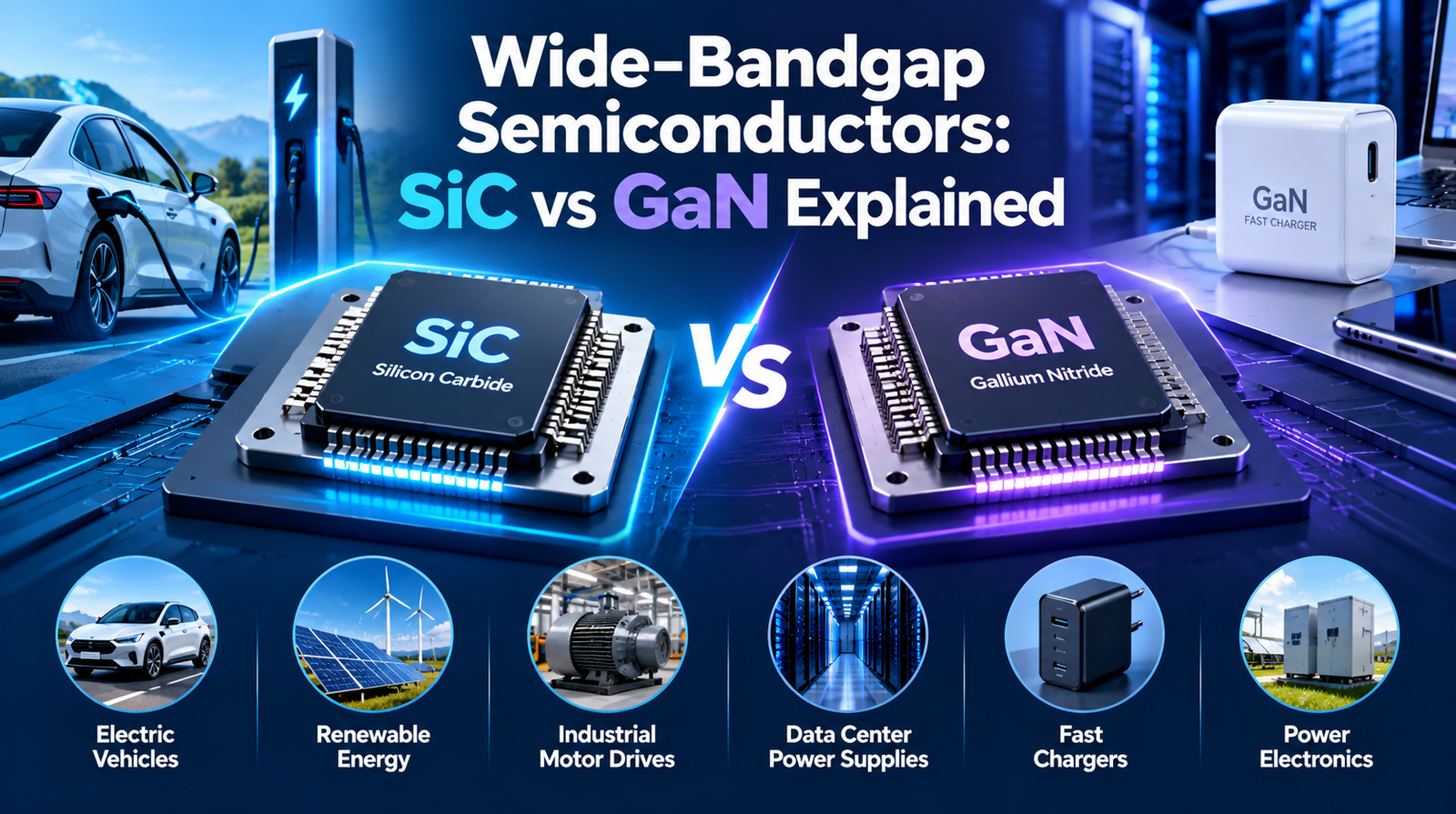
Introduction
Semiconductor technology plays a critical role in modern electronics. As electric vehicles, renewable energy systems, and high-performance computing continue to grow, manufacturers need electronic components that operate efficiently at higher voltages, frequencies, and temperatures.
Traditional silicon semiconductors have powered electronic devices for decades. However, silicon is approaching practical limits in some demanding power applications. This has increased interest in wide-bandgap semiconductors, particularly silicon carbide (SiC) and gallium nitride (GaN).
Both materials offer advantages over conventional silicon in specific applications. They can support efficient power conversion, reduce switching losses, and enable smaller electronic systems.
However, SiC and GaN are not interchangeable. Each material has different electrical characteristics, manufacturing requirements, and ideal use cases.
In this article, we explain wide-bandgap semiconductors, compare SiC vs GaN, explore their applications, and discuss how engineers can select the right technology for their designs.
What Are Wide-Bandgap Semiconductors?
Wide-bandgap semiconductors are materials with a larger energy bandgap than conventional silicon.
The bandgap is the energy difference between a material’s valence band and conduction band. It influences how the material behaves electrically and how well it can operate under different temperatures and electric-field conditions.
Silicon has a bandgap of approximately 1.12 electron volts (eV). In comparison, silicon carbide commonly has a bandgap around 3.26 eV for the 4H-SiC polytype, while gallium nitride has a bandgap of approximately 3.4 eV.
These larger bandgaps help SiC and GaN support demanding electronic applications.
Key Benefits of Wide-Bandgap Materials
1. Higher breakdown electric fields
SiC and GaN can withstand stronger electric fields than silicon. This can support power devices with lower conduction losses for suitable voltage ratings and designs.
2. Improved power efficiency
Their electrical characteristics can help reduce losses during power conversion and switching.
3. High-temperature capability
Wide-bandgap materials can support operation at higher temperatures than silicon in suitable devices. Actual operating limits depend on the component package, cooling system, and device specifications.
4. High-frequency switching
GaN devices are particularly useful for high-frequency switching applications. SiC devices also support fast switching and are widely used in demanding high-voltage power systems.
5. Smaller power systems
Higher switching frequencies and improved efficiency can reduce the size of certain passive components and cooling systems. The overall result depends on the complete circuit design.
These benefits make wide-bandgap semiconductors increasingly important in modern power electronics.
What Is Silicon Carbide (SiC)?
Silicon carbide is a compound semiconductor made from silicon and carbon.
It has a wide bandgap, a high critical electric field, and strong thermal properties. These characteristics make SiC particularly suitable for high-voltage and high-power applications.
SiC power devices are available in several forms, including MOSFETs and Schottky barrier diodes.
Key Advantages of SiC
High-voltage operation: SiC devices are widely used in applications requiring high blocking voltages, including electric vehicle traction inverters and industrial power systems.
Efficient power conversion: Properly designed SiC circuits can reduce conduction and switching losses compared with suitable silicon-based alternatives.
Strong thermal performance: SiC has high thermal conductivity, which helps transfer heat away from the semiconductor material. Effective thermal management still depends on packaging and cooling.
High-power capability: SiC is well suited to applications that need to handle substantial electrical power.
Common Applications of SiC
- Electric vehicle traction inverters.
- High-voltage EV charging equipment.
- Solar inverters.
- Energy storage systems.
- Industrial motor drives.
- Uninterruptible power supplies.
- High-voltage DC power conversion.
SiC is especially attractive when voltage handling, power density, and efficiency are major design priorities.
What Is Gallium Nitride (GaN)?
Gallium nitride is a compound semiconductor made from gallium and nitrogen.
GaN offers high electron mobility in suitable device structures, strong electric-field characteristics, and excellent high-frequency switching potential.
Many GaN power devices use a high-electron-mobility transistor (HEMT) structure. These devices can switch rapidly and support compact power-conversion designs.
Key Advantages of GaN
High-frequency switching: GaN devices can switch at high frequencies, making them useful in compact power supplies and converters.
Low switching losses: Their switching characteristics can reduce energy lost during transitions between conducting and nonconducting states.
Compact designs: Higher switching frequencies can allow smaller inductors and capacitors in suitable circuit designs.
High power density: GaN can help engineers design compact electronic systems with efficient power conversion.
Common Applications of GaN
- Fast smartphone chargers.
- Laptop power adapters.
- High-frequency DC-DC converters.
- Data-center power supplies.
- Wireless power systems.
- Selected solar power electronics.
- Radio-frequency amplifiers and communication equipment.
GaN is particularly attractive when high switching frequency, compact size, and efficient power conversion are important.
SiC vs GaN: Key Differences
Although both materials belong to the wide-bandgap semiconductor family, they serve different engineering requirements.
| Feature | Silicon Carbide (SiC) | Gallium Nitride (GaN) |
|---|---|---|
| Bandgap | Approximately 3.26 eV for 4H-SiC | Approximately 3.4 eV |
| Main strengths | High-voltage and high-power operation | High-frequency switching and compact power conversion |
| Common power devices | SiC MOSFETs and Schottky diodes | GaN HEMTs and other GaN power transistors |
| Switching capability | Fast switching with suitable designs | Particularly well suited to high-frequency switching |
| Voltage applications | Widely used in high-voltage power systems | Common in low- and medium-voltage power conversion, with higher-voltage applications also developing |
| Thermal characteristics | High thermal conductivity | Good high-temperature semiconductor potential, but device and package thermal design are critical |
| Typical applications | EV traction inverters, industrial drives, solar inverters | Fast chargers, compact power supplies, high-frequency converters |
| Main design considerations | Cost, gate driving, switching behavior, and thermal management | Gate driving, layout parasitics, switching transients, and protection |
Important: Neither material is universally better. The appropriate choice depends on voltage, current, switching frequency, efficiency targets, cooling, cost, and system architecture.
1. Electrical Performance: SiC vs GaN
Electrical performance is one of the main reasons engineers evaluate SiC and GaN for power electronics.
SiC devices are widely used in high-voltage systems because their material properties support high blocking voltages and efficient power conversion.
GaN devices are particularly attractive in applications requiring fast switching and compact circuit designs.
For example, an electric vehicle traction inverter may benefit from SiC devices because it must handle high voltage and substantial power.
A compact laptop charger may benefit from GaN because high-frequency switching can reduce the size of magnetic components.
However, device selection should be based on actual datasheet specifications and circuit-level performance rather than material properties alone.
Important parameters include:
- Breakdown voltage.
- On-resistance.
- Switching energy.
- Gate charge.
- Output capacitance.
- Maximum junction temperature.
- Thermal resistance.
- Electromagnetic interference.
These factors determine how a component performs under real operating conditions.
2. Energy Efficiency and Power Losses
Power losses directly affect the efficiency of electronic systems.
When a power transistor operates, energy can be lost through conduction, switching, gate driving, and other parasitic effects.
SiC and GaN can help reduce some of these losses compared with appropriate silicon-based designs.
How SiC Improves Efficiency
SiC power devices can provide low conduction losses and efficient switching in suitable high-voltage applications.
They are frequently used in systems where reducing conversion losses can improve vehicle range, lower cooling requirements, or reduce energy consumption.
How GaN Improves Efficiency
GaN devices can reduce switching losses in suitable high-frequency circuits.
This can help power supplies operate efficiently while using smaller magnetic components and other passive elements.
However, increasing switching frequency can also increase certain losses and electromagnetic interference if the circuit is not designed properly.
Therefore, engineers must optimize the entire power-conversion system to achieve the intended efficiency improvements.
3. SiC vs GaN in Electric Vehicles
Electric vehicles are an important application for wide-bandgap semiconductors.
Their power electronics must efficiently convert and control electrical energy between the battery, motor, and charging system.
SiC in Electric Vehicles
SiC is widely used in traction inverters, where it helps control the high-power electrical flow that drives the vehicle’s motor.
It is also used in onboard chargers and DC-DC converters.
Potential benefits include improved efficiency, reduced cooling requirements, and better power density.
GaN in Electric Vehicles
GaN can be useful in selected onboard chargers, auxiliary power supplies, DC-DC converters, and other high-frequency power-conversion stages.
Its high-frequency switching capability can help reduce component size.
However, suitability depends on the voltage rating, power level, device availability, and the requirements of the specific vehicle system.
4. Manufacturing and Cost Considerations
Manufacturing cost is another important factor when comparing SiC and GaN.
Both materials require specialized production processes, and their costs depend on wafer technology, device structure, manufacturing yield, packaging, and market demand.
SiC Manufacturing
SiC manufacturing involves growing and processing high-quality crystals, producing wafers, and fabricating power devices.
Defects, wafer processing challenges, and manufacturing complexity can influence production costs and yield.
The industry continues to work on improving wafer quality, production efficiency, and manufacturing scale.
GaN Manufacturing
GaN devices are commonly manufactured using GaN layers grown on substrates such as silicon or silicon carbide, depending on the device technology.
GaN-on-silicon can support manufacturing approaches that leverage aspects of existing silicon infrastructure, although specialized processing and integration requirements remain.
Device architecture, substrate choice, thermal design, and manufacturing yield all affect the final cost.
For engineers, the best comparison should consider total system cost rather than the semiconductor component’s purchase price alone.
A more expensive device may still provide economic benefits if it reduces cooling requirements, passive-component size, or energy losses.
5. Challenges of Using Wide-Bandgap Semiconductors
Despite their advantages, SiC and GaN introduce engineering challenges that must be addressed during circuit design.
Gate-Drive Requirements
Different SiC and GaN devices have different gate-drive voltage requirements and operating limits.
Engineers must follow manufacturer recommendations to avoid excessive gate voltage, unreliable switching, or device damage.
Electromagnetic Interference
Fast switching transitions can create high-frequency electrical noise.
Poor circuit layout can increase parasitic inductance, voltage overshoot, ringing, and electromagnetic interference.
Careful PCB layout, suitable gate-drive design, and appropriate filtering are essential.
Thermal Management
Although wide-bandgap devices can improve efficiency, they still generate heat.
Engineers must evaluate conduction losses, switching losses, package thermal resistance, and cooling requirements under realistic operating conditions.
Protection and Reliability
Power systems must handle short circuits, overloads, voltage transients, and abnormal operating conditions.
Protection requirements differ between device technologies and designs. Engineers should consider fault response, safe operating limits, and the manufacturer’s recommended operating conditions.
6. How to Choose Between SiC and GaN
Selecting the right wide-bandgap semiconductor requires evaluating the application as a complete system.
Consider these factors before making a decision.
1. Operating voltage: SiC is widely used in high-voltage power applications. GaN is particularly common in lower- and medium-voltage high-frequency converters, although the available application range continues to evolve.
2. Switching frequency: GaN is attractive for very high-frequency switching. SiC also supports fast switching and may be the better option for high-voltage, high-power systems.
3. Power requirements: Evaluate continuous current, peak current, overload conditions, and the required power rating.
4. Efficiency targets: Compare conduction losses, switching losses, gate-drive requirements, and system-level efficiency.
5. Thermal performance: Examine junction-temperature limits, package characteristics, cooling requirements, and expected operating conditions.
6. System cost: Include component price, passive components, cooling, PCB requirements, and design complexity.
7. Reliability: Evaluate device qualification, protection requirements, operating conditions, and the manufacturer’s reliability data.
By comparing these factors, engineers can select a semiconductor technology that matches their electrical and commercial requirements.
7. The Future of Wide-Bandgap Semiconductors
Demand for energy-efficient power electronics is creating opportunities for both SiC and GaN.
Electric vehicles, renewable energy, industrial automation, and data-center infrastructure all require reliable and efficient power conversion.
SiC is expected to remain important in high-voltage applications where its electrical and thermal properties provide clear benefits.
GaN is well positioned for compact, high-frequency power converters, fast charging, and other applications that benefit from rapid switching.
Manufacturers are also working to improve wafer quality, device performance, packaging, and production efficiency.
These developments could make wide-bandgap semiconductors increasingly accessible across a broader range of electronic products.
However, adoption will depend on application requirements, manufacturing costs, reliability, and competition from improved silicon technologies.
Conclusion
Wide-bandgap semiconductors are helping engineers improve power conversion, energy efficiency, and system design.
Silicon carbide and gallium nitride offer different advantages. SiC is particularly suitable for high-voltage, high-power applications such as electric vehicle traction inverters and industrial power systems. GaN is especially useful for high-frequency switching applications such as fast chargers and compact power supplies.
Neither technology is the universal winner. The right choice depends on voltage, switching frequency, efficiency, thermal management, reliability, and total system cost.
For engineers, understanding the differences between SiC and GaN is essential for designing efficient, reliable, and cost-effective power electronics.
As wide-bandgap technology continues to advance, these materials will play an increasingly important role in the next generation of electronic systems.
Frequently Asked Questions (FAQs)
1. What are wide-bandgap semiconductors?
Wide-bandgap semiconductors are materials with larger energy bandgaps than silicon. They can support demanding power-electronics applications involving high voltages, high electric fields, and efficient switching.
2. What is the difference between SiC and GaN?
SiC is widely used in high-voltage, high-power systems, while GaN is particularly attractive for high-frequency switching and compact power conversion. The best choice depends on the application’s electrical and thermal requirements.
3. Is SiC better than GaN for electric vehicles?
SiC is widely used in EV traction inverters and other high-voltage power systems. GaN can also be suitable for selected charging and auxiliary power-conversion applications. The choice depends on the system architecture and requirements.
4. Why is GaN used in fast chargers?
GaN devices can switch rapidly and efficiently, enabling smaller magnetic components in suitable power-conversion designs. This helps manufacturers develop compact chargers without sacrificing the required power output.
5. Are wide-bandgap semiconductors better than silicon?
They can provide significant advantages in demanding power applications, but they are not always the best choice. Silicon remains cost-effective and suitable for many electronic designs.
6. What are the main applications of SiC?
SiC is commonly used in electric vehicle traction inverters, solar inverters, industrial motor drives, energy storage systems, and high-voltage power converters.
7. What are the main applications of GaN?
GaN is commonly used in fast chargers, compact power supplies, high-frequency DC-DC converters, and selected radio-frequency and power-electronics applications.