
Introduction
Artificial intelligence is transforming industries, from healthcare and automotive engineering to robotics, manufacturing, and cloud computing. Behind these developments is a new generation of semiconductor technology designed to process complex AI workloads faster and more efficiently.
Traditional processors remain important, but modern AI applications often require specialized hardware capable of performing thousands of parallel mathematical operations. As AI models become more demanding, hardware manufacturers are developing new processor architectures, advanced memory systems, and innovative chip designs.
AI chips in 2026 are evolving to address several important challenges, including computing performance, memory bandwidth, power consumption, heat generation, and manufacturing costs.
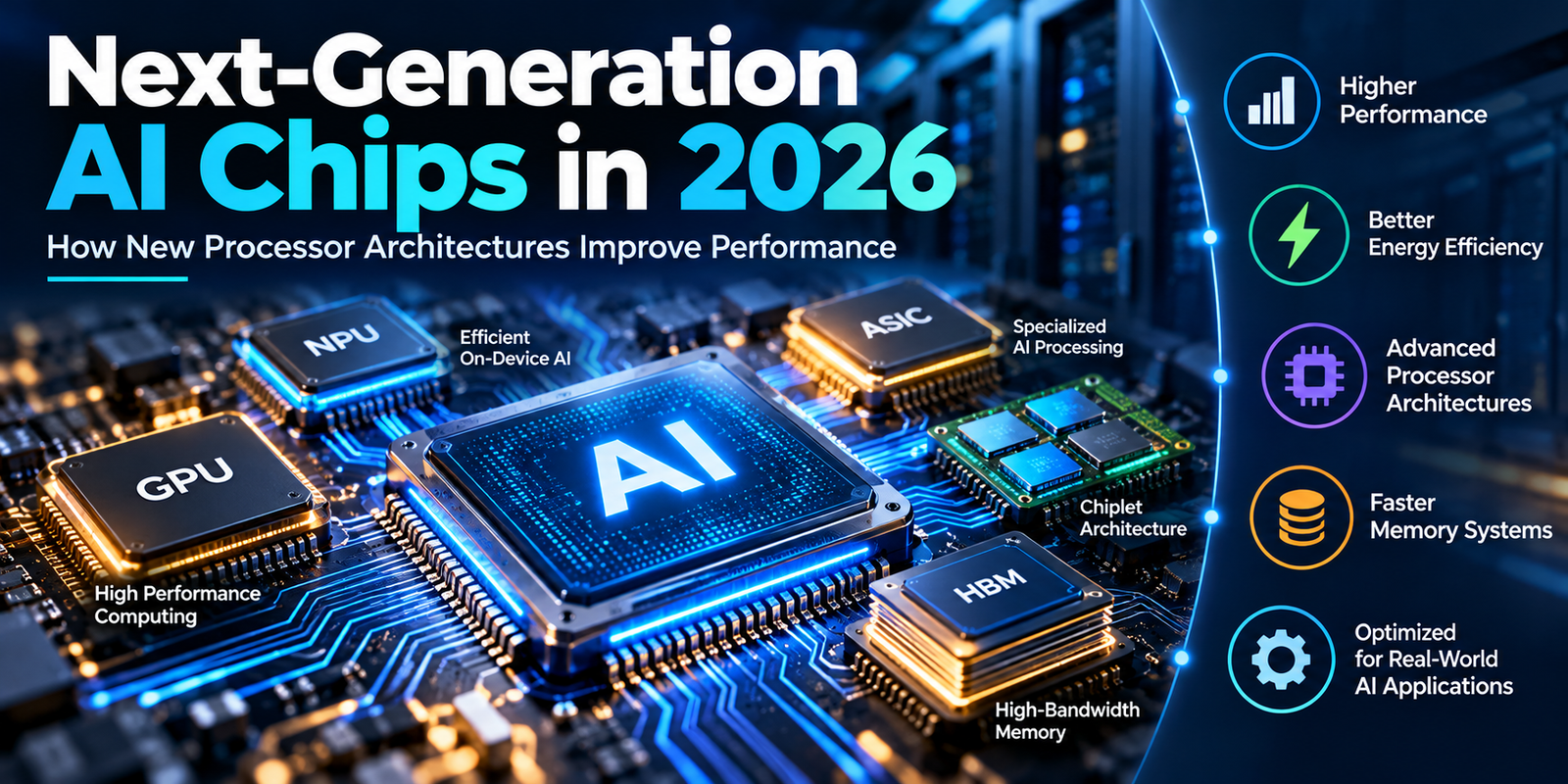
Graphics processing units (GPUs), neural processing units (NPUs), application-specific integrated circuits (ASICs), and chiplet-based architectures are helping developers build computing systems for different AI workloads.
However, improving AI performance requires more than increasing processor speed. Engineers must consider how efficiently data moves between memory and computing units, how chips communicate, and how the complete system manages power and heat.
In this article, we explore the technologies behind next-generation AI chips, explain how modern processor architectures improve performance, and examine the engineering challenges shaping AI hardware development.
1. What Are AI Chips?
AI chips are processors designed or optimized to perform the mathematical operations commonly used in artificial intelligence and machine learning.
These operations include matrix multiplication, vector processing, tensor calculations, and other computations required for training and running AI models.
Although general-purpose CPUs can execute AI workloads, specialized processors often deliver better performance for particular operations.
AI chips are used in several environments, including:
- Cloud computing and AI data centers.
- Autonomous and driver-assistance systems.
- Smartphones and personal computers.
- Industrial automation and robotics.
- Smart cameras and IoT devices.
- Medical imaging and scientific computing.
Different applications require different levels of performance, power efficiency, memory capacity, and response time.
For example, a data center training a large language model may need powerful accelerators and high-bandwidth memory. A battery-powered smart camera may prioritize low power consumption and real-time image processing.
Therefore, AI hardware designers must select processor architectures according to the requirements of the intended application.
2. Major Types of AI Processors in 2026
Several processor architectures support modern AI applications. Each has different strengths, limitations, and implementation requirements.
Graphics Processing Units (GPUs)
GPUs are widely used for AI training and inference because they can perform many computations in parallel.
Originally developed for graphics processing, modern GPUs include computing units and specialized acceleration features designed for demanding numerical workloads.
Key advantages of GPUs include:
- High parallel computing capacity.
- Support for many machine learning frameworks.
- Strong performance across different AI workloads.
- Established software development ecosystems.
- Scalability across multiple accelerators.
GPUs are particularly useful for training large neural networks, processing large datasets, and running computationally intensive AI applications.
However, high-performance GPUs can consume substantial electrical power and require sophisticated cooling systems.
Their memory capacity and communication bandwidth can also limit performance when processing very large AI models.
Neural Processing Units (NPUs)
NPUs are specialized processors designed to accelerate neural network operations.
They are increasingly used in smartphones, laptops, embedded devices, and edge computing systems.
Unlike general-purpose processors, NPUs are often optimized for specific mathematical operations used in AI inference.
Their design may include dedicated arithmetic units, efficient data movement, and support for lower-precision numerical formats.
Benefits of NPUs include:
- Efficient execution of supported AI operations.
- Reduced energy consumption for suitable workloads.
- Support for on-device AI processing.
- Reduced dependence on cloud-based computing.
- Potentially lower latency for local AI applications.
For example, a smartphone can use an NPU to process images, recognize speech, or run supported generative AI features directly on the device.
However, NPU capabilities vary considerably. Performance depends on supported operations, memory bandwidth, software compatibility, and the particular AI model being executed.
Application-Specific Integrated Circuits (ASICs)
ASICs are integrated circuits designed for specific applications or classes of workloads.
In AI computing, they can be optimized for neural network operations, inference, or other specialized computational tasks.
Because their architecture can be tailored to the intended workload, ASICs may provide advantages in performance per watt and operational efficiency.
Their potential benefits include:
- Specialized computing hardware.
- Optimized data movement.
- Predictable performance for supported workloads.
- Opportunities to reduce unnecessary circuitry.
- Greater control over hardware implementation.
However, ASIC development requires significant engineering effort and can involve substantial design, verification, and manufacturing costs.
ASICs may also be less flexible than general-purpose GPUs when workloads change or software requirements evolve.
Comparison of AI Processor Types
| Feature | GPU | NPU | AI ASIC |
|---|---|---|---|
| Primary purpose | Parallel computing and AI acceleration | Neural network acceleration | Specialized computing workloads |
| Flexibility | Generally high | Depends on supported operations | Usually optimized for defined workloads |
| Typical applications | AI training and inference | On-device AI and edge computing | Specialized AI training or inference |
| Power efficiency | Depends on workload and design | Often optimized for supported AI tasks | Can be highly efficient for targeted workloads |
| Software support | Broad ecosystem | Varies by platform | Depends on vendor and implementation |
| Development complexity | Varies by system | Usually integrated into a platform | Potentially high for custom silicon |
No processor type is best for every AI application. The right choice depends on the workload, performance targets, software requirements, power budget, and total system cost.
3. How New Processor Architectures Improve AI Performance
Next-generation AI chips are improving performance through changes in computing architecture, memory systems, and data movement.
Increasing clock speed alone is not enough to meet the requirements of modern AI workloads. Engineers must design processors that perform useful computations efficiently while reducing bottlenecks.
Parallel Processing
AI models often perform large numbers of mathematical operations that can be executed simultaneously.
Parallel processing allows a processor to distribute suitable operations across multiple computing units.
For example, a neural network may perform matrix multiplications involving thousands of values. A processor with an appropriate parallel architecture can process many of these operations simultaneously rather than executing them one at a time.
Modern AI accelerators use specialized arithmetic units to improve throughput for supported operations.
Specialized Matrix and Tensor Units
Many AI processors include specialized hardware for matrix multiplication and related tensor operations.
These units can execute supported operations more efficiently than general-purpose computing units.
They may also support lower-precision numerical formats, such as FP16, BF16, or INT8, depending on the processor.
Lower-precision calculations can reduce memory requirements and increase throughput for suitable workloads.
However, numerical precision must be selected carefully because some AI applications require greater accuracy than others.
Improved Data Movement
Moving data between memory and computing units can consume considerable time and energy.
New processor architectures attempt to reduce unnecessary data transfers through improved memory hierarchies, local storage, data reuse, and optimized interconnects.
For example, keeping frequently used model parameters or intermediate results closer to computing units can reduce the need to retrieve data repeatedly from external memory.
These improvements can increase processor utilization and reduce energy consumption.
Better Workload Scheduling
Modern AI systems must coordinate operations across computing units, memory systems, and sometimes multiple accelerators.
Efficient scheduling helps keep processors busy and minimizes idle time.
Hardware-aware software can distribute operations according to available computing resources, memory capacity, and communication requirements.
The result can be better performance without relying exclusively on more powerful hardware.
4. Advanced Memory Technologies for AI Chips
Memory is one of the most important factors affecting AI processor performance.
AI models may contain billions of parameters, and their execution requires continuous movement of model weights, input data, and intermediate results.
If memory cannot supply data quickly enough, computing units may remain underutilized.
What Is High-Bandwidth Memory?
High-bandwidth memory (HBM) is a memory technology designed to provide high data-transfer rates using a compact, vertically integrated package.
It is used in various high-performance computing and AI accelerator products.
HBM places multiple memory dies in a stacked arrangement and connects them to the processor through a wide interface.
This architecture can provide substantially greater memory bandwidth than many conventional memory configurations.
Why is HBM important for AI?
- It supplies data to computing units at high rates.
- It can support memory-intensive workloads.
- It enables compact integration of substantial memory bandwidth.
- It can reduce certain data-transfer bottlenecks.
However, HBM does not eliminate every memory limitation. Capacity, access patterns, cache behavior, and communication between processors remain important.
The Role of Cache Memory
Cache memory stores frequently accessed data closer to the processor.
By reducing the need to access slower memory, caches can improve performance for workloads with suitable data-access patterns.
Different cache levels provide different balances of capacity, latency, and physical proximity to computing units.
AI processors use cache and other local storage structures to improve data reuse and reduce unnecessary transfers.
Memory Capacity and AI Model Size
Memory capacity determines how much data a processor can hold locally.
Large AI models may exceed the memory capacity of a single accelerator. In such cases, developers may need to distribute model parameters across multiple devices or use additional memory resources.
These approaches introduce communication overhead and additional system complexity.
Consequently, AI chip design increasingly focuses on balancing computing performance with memory capacity, bandwidth, and efficient data movement.
5. Chiplet Architecture: A New Approach to AI Chip Design
As semiconductor manufacturing advances, building increasingly large monolithic chips can become challenging.
Larger dies can be difficult to manufacture economically, and certain design constraints become more significant as transistor counts increase.
Chiplet architecture offers an alternative.
Instead of placing every function on one large silicon die, engineers can combine smaller dies into a single package.
Different chiplets may provide computing cores, memory interfaces, input/output functions, or specialized accelerators.
How Do Chiplets Work?
A chiplet-based system combines multiple dies using an appropriate package and interconnect technology.
For example, an AI processor may integrate computing chiplets with memory interfaces and high-speed communication components.
Depending on the design, chiplets can be manufactured using different semiconductor processes.
This approach allows designers to select manufacturing technologies suited to individual components.
Benefits of Chiplet Architecture
1. Design flexibility
Different chiplets can be developed for specific functions.
2. Manufacturing flexibility
Designers may combine dies manufactured using different process technologies.
3. Potential cost advantages
Smaller dies can improve manufacturing yield in some circumstances, although packaging and integration costs must also be considered.
4. Scalability
Architectures can be designed to combine multiple computing components.
5. Specialized integration
Chiplets allow designers to combine computing, memory, and connectivity functions within one package.
Engineering Challenges
Chiplet-based AI processors introduce additional design considerations.
Engineers must manage communication between dies, package power delivery, thermal behavior, manufacturing yield, and system reliability.
High-speed die-to-die communication also requires careful attention to signal integrity and interconnect design.
Therefore, chiplets can improve design flexibility, but their success depends on effective system integration.
6. Advanced Semiconductor Packaging and 3D Integration
Semiconductor packaging plays an important role in modern AI hardware.
As processors require greater memory bandwidth and more computing capacity, conventional packaging approaches may not provide the integration density required by some designs.
Advanced packaging technologies help connect multiple dies and memory components within a compact physical structure.
What Is 2.5D Packaging?
In 2.5D integration, multiple dies are placed side by side and connected through an interposer or another suitable high-density interconnect structure.
This approach can support high-bandwidth communication between processors and memory components.
It is particularly relevant to high-performance computing systems where memory bandwidth and compact integration are important.
What Is 3D Integration?
Three-dimensional integration stacks dies vertically and connects them using technologies such as through-silicon vias or other vertical interconnect structures.
Depending on the design, 3D integration can shorten certain communication paths and improve integration density.
However, vertical stacking introduces additional challenges involving heat removal, manufacturing complexity, and testing.
Why Does Packaging Matter for AI?
AI chip performance depends on more than the silicon die itself.
Packaging affects:
- Communication between processor and memory.
- Signal integrity.
- Power delivery.
- Thermal management.
- Physical integration density.
- Manufacturing and assembly costs.
As a result, advanced packaging has become an important part of AI hardware engineering.
7. Power Efficiency and Thermal Management
AI chips can perform enormous numbers of calculations, but this capability comes with power and thermal challenges.
When processors consume electrical power, a substantial portion of that energy becomes heat.
If the cooling system cannot remove this heat effectively, the processor may reduce its operating frequency to remain within safe thermal limits.
This can reduce performance and affect system efficiency.
Why Is Power Efficiency Important?
Power consumption affects both operating costs and system design.
Higher power requirements may demand larger power supplies, more robust electrical distribution, and additional cooling capacity.
For data centers, these requirements can influence facility design and operating expenses.
For portable devices, excessive power consumption can reduce battery life.
How Do AI Chips Reduce Power Consumption?
Several design techniques can improve energy efficiency.
Dynamic voltage and frequency scaling: Adjusts operating voltage and frequency according to workload and system conditions.
Clock gating: Disables clock signals to inactive hardware blocks to reduce unnecessary dynamic power consumption.
Power gating: Turns off power to selected hardware blocks when supported and appropriate.
Lower-precision computation: Uses supported numerical formats that can reduce computing and memory costs for suitable workloads.
Data reuse: Keeps data closer to computing units to reduce unnecessary memory transfers.
These techniques can improve efficiency, but their effectiveness depends on the processor design and workload.
The Importance of Cooling
Cooling solutions must be designed according to processor power density, packaging, operating temperature, and system constraints.
Depending on the application, engineers may use heat sinks, fans, vapor chambers, liquid cooling, or other thermal management technologies.
For high-density AI servers, liquid cooling can help remove heat from demanding components.
For mobile and embedded devices, passive cooling and careful power management may be more appropriate.
The objective is to maintain reliable operating temperatures without consuming excessive energy or adding unnecessary system complexity.
8. Edge AI Chips: Bringing Intelligence Closer to Devices
Edge AI refers to processing AI workloads close to where data is collected rather than sending every operation to a remote cloud server.
This approach is useful for applications that require low latency, reduced network dependence, or local data processing.
Examples include industrial sensors, smart cameras, robotics, wearable devices, and connected vehicles.
Why Are Edge AI Chips Important?
Edge devices often operate under strict power, size, cost, and thermal constraints.
They may also need to respond immediately to events without depending on internet connectivity.
Specialized edge processors can help execute suitable AI models locally.
Benefits may include:
- Reduced communication latency.
- Lower dependence on cloud connectivity.
- Improved privacy for locally processed data.
- Reduced network traffic.
- Better control over real-time processing.
However, local processing does not automatically eliminate privacy or security risks. Devices still require appropriate security controls and data management practices.
Examples of Edge AI Applications
Smart cameras: Detect objects and identify events locally.
Industrial monitoring: Identify unusual equipment behavior using sensor data.
Robotics: Process visual information to support navigation and control.
Wearable devices: Analyze supported health and activity signals with suitable privacy safeguards.
Automotive electronics: Support selected driver-assistance and perception workloads.
For each application, the processor must provide sufficient performance while staying within the available energy and thermal budget.
9. Custom AI Chips vs General-Purpose Processors
As AI applications become more specialized, some companies are evaluating custom processors instead of relying entirely on general-purpose hardware.
Custom AI chips can be designed around specific workloads, potentially improving efficiency for those tasks.
However, developing custom silicon is a complex process involving architecture design, verification, manufacturing, testing, and software development.
General-Purpose AI Processors
General-purpose GPUs and other programmable accelerators support a wide range of workloads.
Their flexibility makes them useful when applications evolve or developers need to run different models on the same hardware.
They also benefit from established software ecosystems and existing commercial products.
Custom AI Accelerators
Custom accelerators can optimize hardware around a particular workload or group of operations.
Potential benefits include reduced unnecessary computation, tailored memory systems, and specialized data paths.
However, they may require more engineering effort and could be less adaptable to changing software requirements.
Comparison
| Factor | General-Purpose AI Processor | Custom AI Chip |
|---|---|---|
| Workload flexibility | Generally higher | Depends on the design |
| Development effort | Often lower when using existing products | Potentially substantial |
| Customization | Limited by the existing architecture | Can be tailored to target workloads |
| Initial investment | Depends on hardware and deployment scale | Can be high |
| Software ecosystem | Often well established | Depends on implementation |
| Efficiency | Depends on workload and processor | May improve for targeted workloads |
The appropriate option depends on the expected workload, production volume, development budget, and long-term product strategy.
10. Challenges in Developing Next-Generation AI Chips
Although AI hardware is advancing rapidly, designing and manufacturing advanced processors remains challenging.
Engineers must address several interconnected technical and commercial constraints.
Semiconductor Manufacturing Complexity
Advanced semiconductor processes require sophisticated manufacturing equipment, precise process control, and extensive testing.
Manufacturing costs and production capacity can affect how quickly new processor designs reach the market.
Thermal Constraints
Higher computing density can increase local heat generation.
Designers must manage temperature differences across the die and package while ensuring reliable operation.
Memory and Communication Bottlenecks
AI processors require fast data movement between computing units, memory, and other accelerators.
Insufficient bandwidth or inefficient communication can limit overall performance.
Software Compatibility
Hardware acceleration is useful only when software can effectively utilize it.
Compilers, runtime environments, libraries, drivers, and machine learning frameworks must support the processor’s capabilities.
Development and Verification Costs
Advanced processor development requires expertise in digital design, verification, physical implementation, packaging, and system integration.
Errors discovered late in the development cycle can cause expensive delays.
Addressing these challenges requires collaboration between semiconductor designers, software developers, packaging specialists, and system engineers.
11. What Should Businesses Consider When Choosing AI Hardware?
Businesses selecting AI hardware should begin with their application requirements.
A processor designed for a large data center may not be suitable for a battery-powered IoT device.
Similarly, a low-power edge accelerator may not provide sufficient computing capacity for training a large AI model.
Consider the following factors before making a decision.
| Evaluation Factor | Questions to Ask |
|---|---|
| Workload | Is the system intended for AI training, inference, or both? |
| Performance | What throughput and latency are required? |
| Memory | How much memory capacity and bandwidth are necessary? |
| Power consumption | What is the maximum acceptable power usage? |
| Thermal design | What cooling solutions are available? |
| Software support | Are the required frameworks and libraries supported? |
| Hardware availability | Can the processor be sourced reliably? |
| Development costs | What are the hardware, software, and engineering costs? |
| Scalability | Can the architecture support future requirements? |
| Security | What hardware security features and update mechanisms are available? |
Testing a representative workload on the intended hardware is one of the most effective ways to validate a processor choice.
Businesses should measure actual performance, energy consumption, memory usage, and operating temperature rather than relying exclusively on advertised specifications.
Conclusion
Next-generation AI chips are changing how computing systems process increasingly complex workloads.
GPUs, NPUs, ASICs, chiplet architectures, advanced memory technologies, and sophisticated packaging solutions are helping hardware designers address the growing demands of artificial intelligence.
However, processor performance depends on more than raw computing capacity. Memory bandwidth, data movement, software optimization, power delivery, and thermal management all influence the performance of the complete system.
For hardware engineers, understanding these technologies is essential when designing efficient AI infrastructure and selecting suitable processors for specific applications.
The future of AI hardware will depend on balancing computing performance with energy efficiency, manufacturing costs, software compatibility, and reliability.
At Hashing Hardware, exploring these developments provides valuable insights into the semiconductor technologies and engineering innovations shaping the next generation of computing.