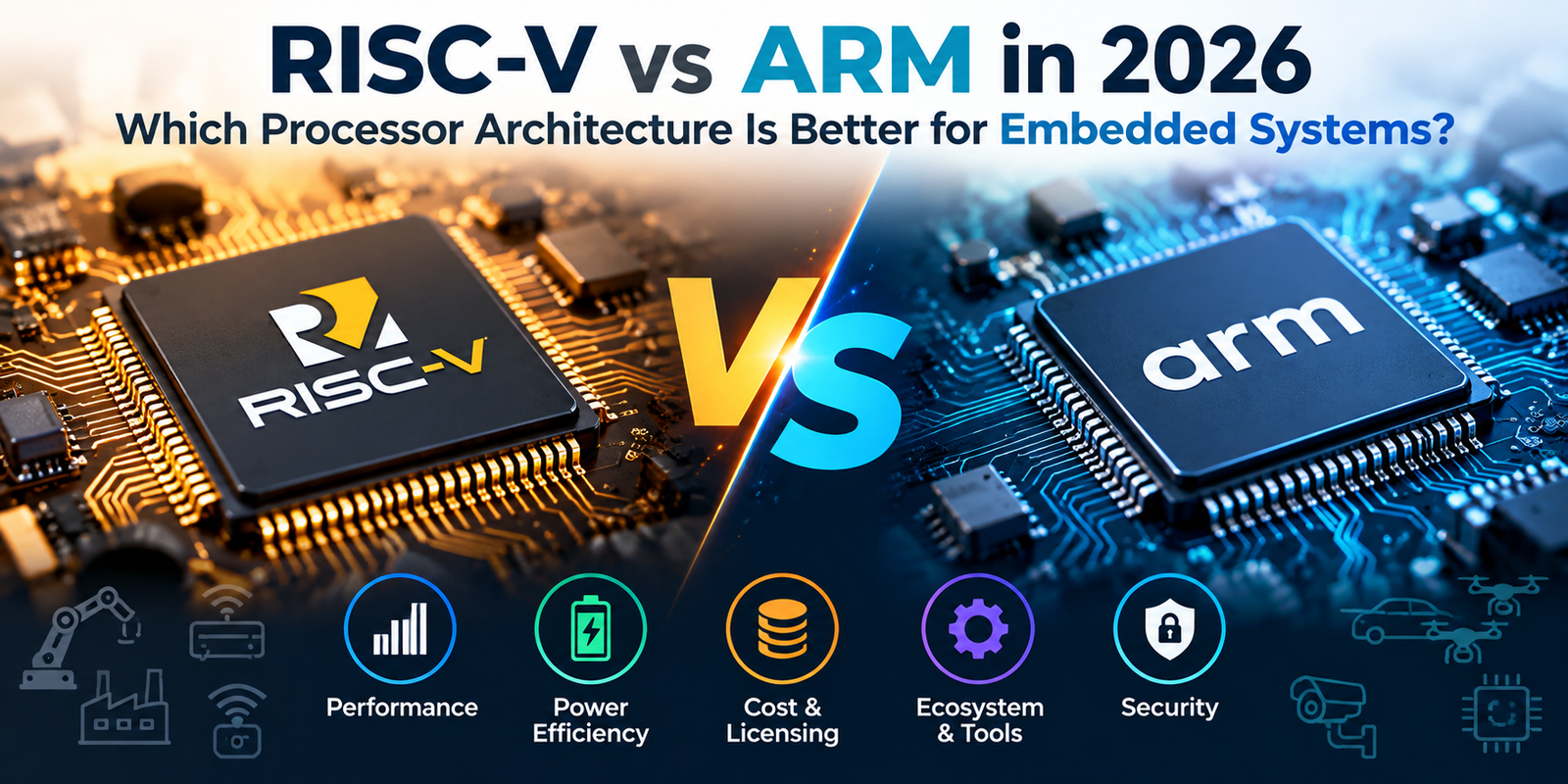
RISC-V vs ARM in 2026: Which Processor Architecture Is Better for Embedded Systems?
Focus Keyphrase: RISC-V vs ARM
SEO Title: RISC-V vs ARM in 2026: Which Is Better for Embedded Systems?
URL Slug: risc-v-vs-arm-embedded-systems-2026
Meta Description: Compare RISC-V vs ARM in 2026 for embedded systems, including performance, power efficiency, licensing, cost, and hardware design.
Excerpt: RISC-V and ARM are shaping modern embedded system design. Explore their differences in architecture, performance, power consumption, licensing, and development costs to understand which fits your project.
Introduction
Embedded systems are an essential part of modern technology. From smart home devices and industrial controllers to automotive electronics and Internet of Things (IoT) products, these systems rely on processors to perform specific tasks efficiently and reliably.
Choosing the right processor architecture is an important decision during hardware development. It affects performance, power consumption, development costs, software compatibility, and long-term product maintenance.
Two processor architectures attracting significant attention are RISC-V and ARM. Both use reduced instruction set computing principles, but they differ in licensing models, ecosystem maturity, implementation flexibility, and hardware development options.
RISC-V vs ARM has become an important comparison for hardware engineers and embedded system developers evaluating processors for new products in 2026.
ARM has an established ecosystem of processors, development tools, and commercial semiconductor products. RISC-V, on the other hand, offers an open instruction set architecture that allows organizations to develop customized processor implementations without licensing the instruction set itself.
But which architecture is more suitable for embedded systems?
The answer depends on the application’s requirements, available development resources, performance targets, power budget, and software ecosystem.
In this article, we compare RISC-V and ARM across the factors that matter most when designing embedded hardware.
1. What Is RISC-V?
RISC-V is an open-standard instruction set architecture (ISA) based on reduced instruction set computing principles.
An instruction set architecture defines the instructions a processor can execute and the rules software uses to communicate with the processor.
RISC-V was originally developed at the University of California, Berkeley, and is now maintained through the RISC-V International community.
One of its defining characteristics is that the instruction set is openly available. Companies, researchers, and developers can implement compatible processors without paying a license fee simply to use the standard ISA.
However, designing and manufacturing a RISC-V processor still involves costs related to engineering, verification, fabrication, development tools, and potentially third-party intellectual property.
Key Features of RISC-V
- Open instruction set: The ISA is available for implementation without a proprietary ISA license.
- Modular design: Implementations can support different combinations of standard instruction set extensions.
- Customization: Organizations can develop processor implementations tailored to specific workloads.
- Hardware flexibility: RISC-V can be implemented in microcontrollers, application processors, and custom silicon.
- Growing ecosystem: Development tools, operating systems, software libraries, and commercial implementations continue to evolve.
Where Is RISC-V Used?
RISC-V can be used in a variety of applications, including:
- Embedded controllers.
- IoT devices.
- Industrial automation.
- Custom accelerators and specialized processors.
- Educational and research platforms.
- Selected automotive and computing applications.
Its flexibility makes it particularly interesting for companies developing specialized hardware or seeking greater control over processor implementation.
However, software availability and production readiness vary between RISC-V platforms. Developers must evaluate the specific processor and toolchain rather than assuming every RISC-V implementation supports the same features.
2. What Is ARM?
ARM is a processor architecture family developed by Arm. Its designs are widely used in smartphones, embedded systems, automotive electronics, networking equipment, and other computing devices.
Arm provides processor IP and architecture technologies that semiconductor companies can license and incorporate into their products.
Depending on the agreement, licensing arrangements may cover processor designs, architecture rights, or other intellectual property.
ARM-based products range from low-power microcontrollers to high-performance application processors.
Key Features of ARM
- Established ecosystem: A broad range of commercial processors and development platforms are available.
- Power-efficient designs: Many ARM-based processors are designed for power-sensitive applications.
- Software support: ARM benefits from extensive compiler, operating system, and development tool support.
- Commercial processor IP: Companies can license existing processor designs rather than developing every processor component themselves.
- Wide adoption: ARM is used across consumer electronics, industrial products, automotive systems, and mobile computing.
Where Is ARM Used?
ARM-based processors are common in:
- Microcontrollers and embedded controllers.
- Smartphones and tablets.
- Automotive electronics.
- Industrial automation.
- Smart home products.
- Wearable devices.
- Networking and edge computing systems.
The availability of mature development boards, commercial silicon, and established software tools can simplify product development.
For businesses with tight development schedules, these resources can be an important consideration when selecting an embedded processor.
3. RISC-V vs ARM: Key Differences
Although both architectures follow reduced instruction set computing principles, their licensing models and implementation ecosystems differ.
The following table summarizes the main differences.
| Feature | RISC-V | ARM |
|---|---|---|
| Architecture model | Open-standard ISA | Proprietary ISA |
| ISA licensing | No license fee required to use the standard ISA | Commercial architecture licensing may be required |
| Processor implementation | Multiple open-source and commercial implementations | Multiple licensed commercial implementations |
| Customization | Flexible, with standard extensions and implementation-specific options | Depends on the licensed architecture and processor IP |
| Processor availability | Varies by vendor, platform, and application | Broad range of established commercial products |
| Software ecosystem | Growing, with support varying by platform | Mature and widely adopted |
| Development tools | Open-source and commercial tools | Extensive open-source and commercial tools |
| Development cost | Depends on implementation, engineering, and support requirements | Depends on processor selection, licensing, and development requirements |
| Power efficiency | Depends on processor implementation and workload | Depends on processor implementation and workload |
| Performance | Depends on microarchitecture and configuration | Depends on microarchitecture and configuration |
| Suitable applications | Embedded devices, custom silicon, and specialized computing | Embedded devices, consumer electronics, automotive, and computing |
Important: Neither architecture automatically guarantees better performance, lower power consumption, or lower total development costs. These outcomes depend on the actual processor implementation and project requirements.
4. Performance Comparison: RISC-V vs ARM
Processor performance is an important consideration when selecting hardware for embedded applications.
However, comparing architectures alone does not provide a complete picture of performance.
Clock frequency, pipeline design, cache architecture, memory bandwidth, instruction extensions, compiler optimization, and peripheral integration can all affect the results.
How Does ARM Perform?
ARM offers processors across a wide range of performance levels.
Some ARM Cortex-M microcontrollers are designed for low-power control applications, while Cortex-A processors support more demanding operating systems and application workloads.
This variety allows developers to select processors according to their computing requirements.
For example, an industrial controller may require predictable real-time performance, while a smart camera may need substantially greater computing capacity for image processing.
How Does RISC-V Perform?
RISC-V processors also cover a range of performance levels.
Some implementations target simple microcontrollers with limited memory and processing requirements. Others support more advanced computing workloads and operating systems.
RISC-V’s modular instruction set allows implementations to include relevant standard extensions, while certain implementations may add custom instructions.
Custom instructions can accelerate specialized workloads, but they also introduce design, verification, compiler, and software maintenance considerations.
Which Architecture Is Faster?
There is no universal performance winner.
A high-performance processor from one architecture may outperform a low-end processor from the other, but that comparison would say little about the architectures themselves.
A meaningful evaluation should compare processors with similar application requirements and measure:
- Execution time for representative workloads.
- Performance per watt.
- Memory and cache performance.
- Interrupt latency and real-time behavior.
- Compiler-generated code efficiency.
- Performance under the intended operating conditions.
For embedded applications, the best processor is the one that meets the required performance targets within the available power, memory, cost, and thermal limits.
5. Power Consumption and Energy Efficiency
Power efficiency is particularly important in embedded systems that operate on batteries or have limited thermal management.
Examples include wearable devices, wireless sensors, portable medical equipment, and remote monitoring systems.
Both ARM and RISC-V can support low-power designs. However, the architecture alone does not determine a processor’s energy consumption.
ARM for Low-Power Applications
Many ARM-based microcontrollers provide features designed for low-power operation.
Depending on the product, these features may include sleep modes, clock gating, peripheral power management, and efficient interrupt handling.
Such capabilities can help developers build systems that remain in low-power states when processing is unnecessary.
RISC-V for Low-Power Applications
RISC-V implementations can also be designed for low-power operation.
Developers can select implementations with suitable instruction extensions, power-management features, and peripheral configurations.
For custom hardware projects, this flexibility may help teams optimize the processor for a specific workload.
However, customization requires engineering resources and does not automatically produce a more efficient design.
How Should Power Efficiency Be Measured?
Engineers should measure energy consumption while executing representative workloads rather than comparing idle power alone.
Useful measurements include:
- Active power consumption.
- Sleep and standby power.
- Energy consumed per task.
- Wake-up latency.
- Performance per watt.
- Battery life under realistic operating conditions.
For example, a wireless sensor may spend most of its time sleeping and wake periodically to collect and transmit data. In this situation, sleep current and energy per measurement may matter more than peak processing performance.
The practical lesson: Choose the processor that meets the application’s performance requirements while minimizing total energy consumption.
6. Licensing and Development Costs
Licensing is one of the most important differences between RISC-V and ARM.
RISC-V’s open-standard ISA allows organizations to implement the architecture without paying a fee simply for access to the standard instruction set.
ARM operates through a commercial intellectual property model in which relevant licensing arrangements depend on the processor technology and agreement.
However, the cost comparison is more complex than simply comparing license fees.
RISC-V Cost Considerations
Potential advantages include:
- No proprietary ISA license fee for using the standard instruction set.
- Access to open-source processor implementations.
- Opportunities to customize hardware for specific applications.
- Greater flexibility in selecting certain implementation and integration options.
Potential costs include:
- Processor integration and verification.
- Software development and debugging.
- Hardware validation and security testing.
- Third-party IP and commercial tool licenses, where applicable.
- Engineering effort required for customization.
- Long-term maintenance and support.
ARM Cost Considerations
Potential advantages include:
- Access to established commercial processor IP.
- A wide selection of ready-to-use microcontrollers and application processors.
- Mature development tools and vendor support.
- Existing software and hardware resources that can reduce development effort.
Potential costs include:
- Processor or architecture licensing, where applicable.
- Commercial silicon acquisition.
- Development tools or support services, depending on the project.
- Vendor-specific integration and long-term product requirements.
Which Architecture Is More Affordable?
RISC-V may be attractive when licensing flexibility or processor customization is important.
ARM may be attractive when a suitable commercial processor already exists and can reduce development time.
For small product teams, buying an existing microcontroller may be more economical than developing a custom processor, regardless of the architecture.
For larger organizations building high-volume products or specialized silicon, the economics may be different.
The most useful comparison is total cost of ownership, including hardware, software, engineering, manufacturing, certification, support, and maintenance.
7. Software Ecosystem and Developer Support
A processor is only one part of an embedded system. Developers also need compilers, debuggers, software libraries, operating systems, drivers, and development boards.
Software support can significantly influence development time and product reliability.
ARM Software Ecosystem
ARM benefits from a mature embedded development ecosystem.
Depending on the processor, developers may have access to:
- Commercial integrated development environments.
- GNU compiler tools and other supported toolchains.
- CMSIS resources for compatible Cortex-M devices.
- Real-time operating systems.
- Vendor-provided hardware abstraction layers.
- Debugging and profiling tools.
- Extensive technical documentation.
This ecosystem can make ARM-based development convenient, especially when using established commercial microcontrollers.
RISC-V Software Ecosystem
RISC-V supports a growing collection of development tools and software platforms.
Common options include:
- GCC and LLVM-based toolchains.
- GDB debugging support.
- RTOS implementations for supported targets.
- Linux support on suitable hardware platforms.
- Open-source development boards.
- Vendor-specific SDKs and debugging tools.
However, support varies between processor implementations.
Developers should verify that their selected platform supports the required compiler features, debugging interfaces, peripheral drivers, operating system, and long-term maintenance arrangements.
Why Does Ecosystem Maturity Matter?
A mature ecosystem can reduce the time required to develop, test, debug, and maintain an embedded product.
For example, if an application depends on a particular RTOS, security library, or wireless stack, the availability of tested integrations may be more important than the theoretical flexibility of the processor architecture.
Before choosing a processor, developers should confirm that the required software components are supported and suitable for production use.
8. Security Considerations in Embedded Systems
Security is increasingly important for connected devices, industrial controllers, automotive electronics, and IoT products.
A vulnerable embedded device can expose sensitive information, disrupt operations, or provide an entry point into a larger network.
Both ARM and RISC-V can support secure embedded systems, but security depends on the processor implementation and the complete system design.
ARM Security Features
Some ARM processor families support security technologies such as TrustZone.
The exact capabilities depend on the processor profile and implementation. Compatible microcontrollers and application processors may provide hardware mechanisms to isolate trusted and untrusted software.
These mechanisms can help protect sensitive operations, credentials, and cryptographic services.
RISC-V Security Features
RISC-V implementations can incorporate security-related architectural features and platform-specific mechanisms.
Depending on the implementation, these may include privilege modes, memory protection, secure boot support, and hardware-assisted isolation.
The availability of individual features must be verified for the selected processor.
Best Practices for Both Architectures
Regardless of architecture, embedded system developers should implement:
- Secure boot and firmware integrity verification.
- Signed firmware updates.
- Memory protection and privilege separation.
- Secure storage for cryptographic keys.
- Appropriate access controls.
- Regular security updates.
- Testing for software and hardware vulnerabilities.
A secure processor cannot compensate for weak firmware, insecure communication protocols, or poor key management.
Security must be considered throughout the product lifecycle.
9. RISC-V vs ARM for Different Embedded Applications
The best architecture depends on the type of product being developed.
Different applications have different requirements for computing performance, power consumption, real-time behavior, software support, and development costs.
| Application | RISC-V Considerations | ARM Considerations |
|---|---|---|
| IoT sensors | Flexible implementations for simple, specialized devices | Broad selection of established low-power microcontrollers |
| Industrial automation | Suitable implementations are available, but verify real-time and toolchain requirements | Established options with mature vendor ecosystems |
| Wearable devices | Potential fit for custom low-power designs | Widely available low-power processor options |
| Automotive electronics | Requires evaluation of safety evidence, qualification, and ecosystem support | Established automotive processor and development ecosystems |
| AI edge devices | Suitable processors may support specialized computing and custom extensions | Broad range of processors and platforms, depending on workload |
| Custom silicon | Open ISA can provide implementation flexibility | Commercial IP licensing may suit teams using established designs |
| Linux-based embedded devices | Suitable RISC-V platforms are available, with support depending on hardware | Broad selection of mature ARM-based platforms |
These are general considerations, not guarantees that every processor in either category is suitable for a particular application.
For automotive, medical, industrial safety, or other regulated applications, engineers must also evaluate certification requirements, development processes, hardware qualification, and the availability of appropriate safety documentation.
10. How to Choose Between RISC-V and ARM in 2026
Choosing an embedded processor should begin with the product requirements rather than the popularity of a particular architecture.
Use the following steps to guide the decision.
Step 1: Define the Workload
Determine whether the device will perform simple control operations, real-time processing, signal processing, networking, or complex application workloads.
Estimate the required computing performance and memory capacity.
Step 2: Establish the Power Budget
Define acceptable active, standby, and sleep power consumption.
For battery-powered products, estimate energy consumption under realistic operating conditions.
Step 3: Check Software Requirements
Identify the required operating system, RTOS, drivers, communication protocols, libraries, and development tools.
Confirm that these components are available for the specific processor.
Step 4: Compare Hardware Availability
Evaluate commercially available processors, development boards, peripherals, documentation, and manufacturing availability.
A processor that meets technical requirements but cannot be sourced reliably may not be suitable for production.
Step 5: Estimate Total Development Costs
Consider licensing, hardware, software, engineering effort, verification, manufacturing, and long-term support.
Do not assume that an open ISA automatically produces a cheaper final product.
Step 6: Evaluate Long-Term Support
Check vendor roadmaps, software maintenance policies, security updates, product lifecycle commitments, and migration options.
This is especially important for products expected to remain in production for many years.
Step 7: Test with a Representative Prototype
Build a prototype and measure actual performance, energy consumption, memory usage, and reliability.
Where possible, compare processors using the same application and equivalent operating conditions.
This approach provides more useful evidence than relying on architecture-level assumptions.
11. What Is the Future of RISC-V and ARM?
RISC-V and ARM are likely to remain important options in embedded computing, although their adoption will vary by application and market segment.
ARM benefits from an established commercial ecosystem, a wide range of processor products, and extensive software support.
RISC-V offers an open-standard ISA and opportunities for organizations to develop or select processor implementations that suit specialized requirements.
Several factors will influence adoption over the coming years.
Increasing Demand for Custom Hardware
Companies developing specialized products may seek more control over processor design and integration.
RISC-V’s open ISA can be useful in these projects, although the engineering costs of building and validating custom silicon remain substantial.
Growth of Edge Computing
Edge devices increasingly perform data processing close to where information is collected.
This creates demand for processors that balance performance, energy consumption, connectivity, and cost.
Both ARM and RISC-V can address parts of this market through different processor implementations.
Continued Focus on Energy Efficiency
Battery-powered and thermally constrained devices need efficient computing systems.
Processor selection, firmware optimization, peripheral design, and power management will remain important regardless of architecture.
Importance of Software Compatibility
As embedded products become more complex, software availability and long-term maintenance will continue to influence hardware decisions.
An architecture’s flexibility is valuable, but practical success also depends on development tools, drivers, libraries, security support, and production-ready implementations.
Ultimately, the future of embedded computing will depend on how well each architecture’s ecosystem meets the needs of specific applications.
Conclusion
The comparison between RISC-V and ARM highlights two different approaches to processor architecture and embedded hardware development.
RISC-V provides an open-standard instruction set that offers implementation flexibility and opportunities for customization. ARM provides a mature commercial ecosystem with a broad range of processors, established development tools, and extensive software support.
Neither architecture is universally better for every embedded system.
RISC-V may be suitable for projects that value ISA licensing flexibility, specialized processor designs, or greater control over hardware implementation. ARM may be suitable for projects that benefit from established commercial silicon, mature software support, and existing development resources.
The right decision depends on performance requirements, power consumption, software compatibility, hardware availability, development costs, and long-term support.
For hardware engineers, the most effective approach is to evaluate the actual processor implementations, build representative prototypes, and measure real-world results before making a final decision.
As embedded technologies continue to evolve in 2026, understanding the differences between RISC-V and ARM will help developers make more informed hardware design decisions.
At Hashing Hardware, exploring processor architectures and their practical trade-offs helps engineers understand the technologies shaping modern embedded systems.