
Introduction
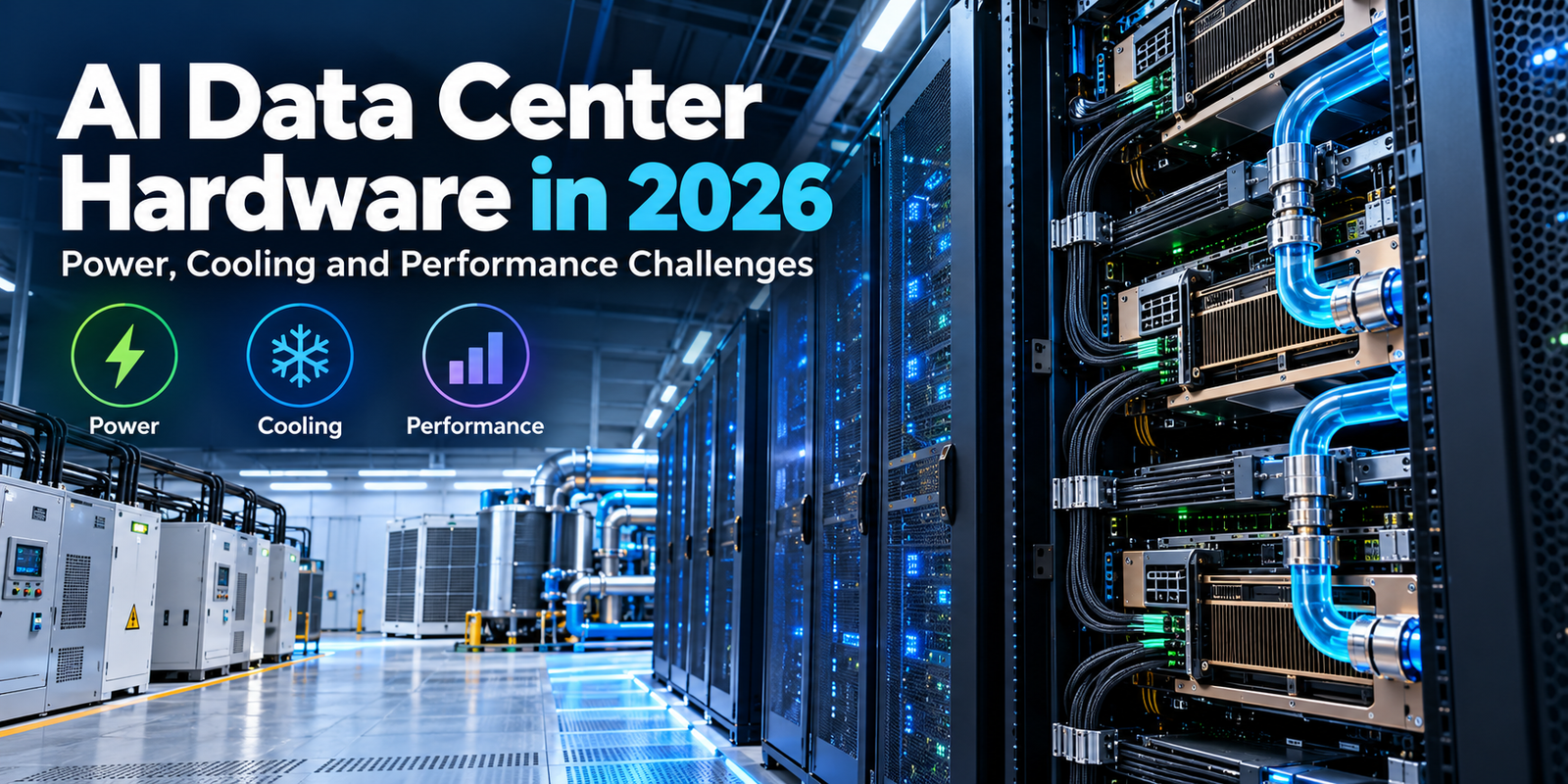
Artificial intelligence is changing how businesses build and operate data centers. From generative AI and large language models to machine learning and real-time analytics, modern AI applications require enormous computing power. As a result, AI data center hardware is becoming increasingly important for organizations that want to build reliable, scalable, and energy-efficient computing infrastructure.
Traditional data centers were primarily designed to support web applications, databases, cloud services, and enterprise software. However, AI workloads introduce different hardware requirements. High-performance GPUs, specialized AI accelerators, high-speed networking, and advanced cooling systems must work together to deliver the computing performance that modern AI applications demand.
In 2026, hardware engineers and data center operators face several challenges. These include increasing power consumption, heat generation, cooling efficiency, memory bandwidth, and hardware reliability.
Understanding these challenges helps businesses make better infrastructure decisions and build data centers that can support the next generation of AI technologies.
In this article, we explore the major hardware challenges affecting AI data centers in 2026 and the engineering solutions that can improve performance, efficiency, and reliability.
1. Why AI Data Center Hardware Is Becoming More Important
AI models require substantial computing resources for training and inference. Training involves processing large datasets to develop a model, while inference occurs when the trained model generates predictions or responses.
Both workloads place significant demands on computing hardware.
For example, generative AI applications may need to process large amounts of data, execute complex mathematical operations, and transfer information between multiple processors. These operations require more than powerful chips alone. They also depend on efficient memory systems, fast communication between servers, and reliable power delivery.
Modern AI data centers commonly use several interconnected hardware components:
- Graphics Processing Units (GPUs): Accelerate parallel computing operations used in AI training and inference.
- AI accelerators: Specialized processors designed to execute machine learning workloads efficiently.
- High-performance CPUs: Coordinate system operations, data processing, and application execution.
- High-bandwidth memory: Supplies processors with the data required for intensive computations.
- High-speed networking: Connects servers and accelerators to support distributed AI workloads.
- Power distribution systems: Deliver stable electrical power to computing equipment.
- Advanced cooling systems: Remove heat generated by high-performance components.
These components must work together efficiently. A bottleneck in power delivery, cooling, memory, or networking can reduce the performance of an otherwise powerful AI system.
Consequently, AI data center hardware design requires a system-level approach rather than a focus on individual components.
2. Power Consumption: A Major Challenge for AI Data Centers
Power consumption is one of the biggest challenges in modern AI infrastructure. As AI models become more complex, data centers need more powerful processors and larger computing clusters.
These systems require a continuous supply of electricity to operate reliably. The challenge is not limited to supplying power to GPUs. Servers, memory, networking equipment, storage devices, cooling systems, and backup infrastructure also contribute to overall energy demand.
Why Is Power Delivery Difficult?
AI workloads can create significant changes in electrical demand as processors move between different levels of activity. Data center power infrastructure must handle these changes without compromising system stability.
Several factors contribute to power-related challenges:
- High processor power requirements: AI accelerators consume substantial electricity during intensive workloads.
- Increasing rack density: More computing equipment within a rack increases its total power demand.
- Power conversion losses: Electrical energy can be lost when converting and distributing power.
- Grid limitations: Some locations lack sufficient electrical capacity to support new AI facilities.
- Backup power requirements: Data centers need reliable backup systems to maintain operations during power interruptions.
These challenges make power planning an essential part of AI data center hardware design.
How Can Data Centers Improve Power Efficiency?
Hardware engineers can improve power efficiency through several approaches.
1. Use efficient power supplies
High-efficiency power supplies reduce energy losses during electrical conversion. Selecting suitable power supplies can improve overall system efficiency and reduce unnecessary heat generation.
2. Optimize power distribution
Well-designed power distribution systems deliver electricity efficiently to servers and accelerators. Engineers can evaluate busbars, power distribution units, voltage conversion, and rack-level electrical architecture to reduce losses.
3. Monitor power consumption
Intelligent monitoring systems help operators track electricity usage across servers, racks, and cooling equipment. This information helps identify inefficient components and improve resource allocation.
4. Improve processor utilization
Keeping hardware busy with useful workloads can improve computing efficiency. However, workload scheduling must also account for memory requirements, power limits, thermal conditions, and service-level requirements.
The objective is to achieve more useful computing performance for every unit of electricity consumed.
3. Advanced Cooling Systems for High-Performance AI Hardware
Cooling is another critical challenge for AI data centers.
Powerful processors generate heat during operation. When multiple high-performance GPUs operate together, the resulting thermal load can exceed the capabilities of conventional cooling systems.
Excessive temperatures can cause processors to reduce their operating speed, a protective behavior known as thermal throttling. Persistent thermal problems can also affect hardware reliability and increase maintenance requirements.
According to industry analysis, rising rack power densities are accelerating the adoption of liquid cooling and other advanced thermal management technologies. Deloitte
Air Cooling vs. Liquid Cooling
Two major approaches used to manage server temperatures are air cooling and liquid cooling.
| Feature | Air Cooling | Liquid Cooling |
|---|---|---|
| Cooling medium | Air | Liquid coolant |
| Heat transfer | Uses airflow and heat sinks | Transfers heat through liquid-cooled components or systems |
| Hardware requirements | Fans, heat sinks, air handlers | Pumps, coolant distribution, heat exchangers, and compatible cooling hardware |
| Maintenance | Familiar maintenance procedures | Requires coolant monitoring and specialized maintenance |
| Suitable applications | Many conventional servers and moderate-density systems | High-density AI servers and demanding computing environments |
| Main consideration | Airflow capacity and temperature control | System complexity, leak management, and coolant distribution |
The best solution depends on server design, rack density, cooling capacity, operating costs, and infrastructure requirements.
What Is Direct-to-Chip Liquid Cooling?
Direct-to-chip liquid cooling removes heat from processors using cold plates attached to heat-generating components.
A typical system includes:
- Cold plates mounted on compatible processors.
- Coolant distribution pipes that carry liquid through the cooling loop.
- Pumps that maintain coolant circulation.
- A coolant distribution unit that manages heat exchange and fluid delivery.
- Heat exchangers that transfer heat away from the server cooling loop.
Because liquid can transfer heat effectively from compact components, direct-to-chip cooling is particularly useful for dense computing systems.
It can also reduce dependence on high-volume airflow for removing heat from the most demanding components.
However, engineers must carefully consider coolant flow, pressure, material compatibility, leak detection, and serviceability.
What Is Immersion Cooling?
Immersion cooling places compatible electronic equipment in a specially designed tank containing a dielectric liquid.
Depending on the technology, heat is removed through single-phase or two-phase cooling processes.
Immersion cooling can support high-density computing environments, but it requires careful planning for fluid compatibility, equipment maintenance, heat rejection, and operational procedures.
It is not automatically the best choice for every data center. Direct-to-chip cooling, immersion cooling, and hybrid systems each have different infrastructure and maintenance requirements.
Key takeaway: Effective cooling is not simply about keeping processors cold. It is about maintaining stable operating temperatures while balancing energy consumption, computing performance, reliability, and operating costs.
4. GPU Performance and Memory Bandwidth Limitations
GPUs are central to many AI data center architectures because they can execute large numbers of parallel operations.
However, adding more GPUs does not always produce a proportional increase in performance.
The actual performance of an AI system depends on several interconnected factors, including processor architecture, memory bandwidth, interconnect speed, software optimization, and workload distribution.
Why Is Memory Bandwidth Important?
AI processors need fast access to model parameters, input data, and intermediate results.
If data cannot reach the processor quickly enough, the computing units may remain underutilized while waiting for memory operations to complete.
High-bandwidth memory helps address this challenge by increasing the rate at which data can move between memory and the processor.
Engineers must also consider memory capacity. Large AI models may require more memory than a single accelerator can provide, making distributed computing or model partitioning necessary.
How Can Hardware Designers Improve GPU Utilization?
Several techniques can help improve performance:
- Select accelerators that match the intended AI workload.
- Ensure sufficient memory capacity and bandwidth.
- Optimize communication between GPUs.
- Reduce unnecessary data movement.
- Balance computing workloads across available accelerators.
- Monitor utilization, temperature, and power consumption.
- Optimize software to take advantage of the underlying hardware architecture.
For example, a system designed for training a large AI model may prioritize GPU-to-GPU communication and high-speed networking. An inference system may instead emphasize latency, throughput, memory capacity, and operating cost.
Therefore, AI data center hardware should be selected according to workload requirements rather than processor specifications alone.
5. High-Speed Networking and Data Transfer Challenges
AI computing often involves multiple servers working together to train or operate a model.
These servers must exchange large amounts of data. If networking performance is insufficient, communication overhead can limit the benefits of additional computing resources.
This is particularly important for distributed AI training, where accelerators exchange information to coordinate their computations.
Why Does Networking Matter?
AI data center networks must support:
- High data-transfer rates.
- Low communication latency.
- Reliable connections between servers.
- Efficient communication between GPUs.
- Scalable network architectures.
- Predictable performance under heavy workloads.
Modern AI infrastructure may use high-speed Ethernet, InfiniBand, and optical networking technologies, depending on its architecture and performance requirements.
Optical interconnects can support high bandwidth over longer distances than many copper-based alternatives, although cost, power consumption, reach, and integration requirements must be considered.
How Can Data Centers Reduce Networking Bottlenecks?
Hardware engineers can improve networking efficiency by selecting appropriate network interface cards, switches, cables, and interconnect technologies.
They should also consider network topology, congestion management, communication patterns, and the placement of computing resources.
For example, placing frequently communicating accelerators within an appropriately designed network architecture can help reduce communication overhead.
The objective is to keep computing resources productive instead of allowing network delays to limit performance.
6. Hardware Reliability and Thermal Management
AI data centers often run computing workloads for extended periods. Hardware failures can interrupt applications, reduce cluster availability, and increase operating costs.
As a result, reliability must be considered throughout the design and operation of AI infrastructure.
Common Hardware Reliability Challenges
Several factors can affect data center hardware reliability:
- High operating temperatures.
- Unstable power delivery.
- Component degradation.
- Cooling system failures.
- Dust and environmental contamination.
- Excessive vibration in some equipment environments.
- Network and storage failures.
- Inadequate maintenance procedures.
The effects of these issues can extend beyond individual components. For example, a cooling failure affecting one rack may require operators to reduce workloads or shut down equipment to prevent overheating.
How Can Reliability Be Improved?
Data center operators can implement preventive maintenance, hardware monitoring, redundancy, and automated alerts.
Temperature sensors, power monitoring devices, and cooling system controllers can help identify abnormal operating conditions before they cause major disruptions.
Engineers should also consider redundant power supplies, backup cooling capacity, and appropriate failover mechanisms.
Regular inspections and hardware testing are important for identifying potential problems early.
Reliability should be treated as a design requirement, not an afterthought. A high-performance system is valuable only when it can deliver consistent results under real operating conditions.
7. Energy Efficiency and Sustainable AI Infrastructure
The growing demand for AI computing has increased attention on data center energy efficiency.
Improving efficiency can help organizations manage operating costs, reduce unnecessary energy consumption, and make better use of available infrastructure.
However, energy efficiency involves more than choosing processors with lower power requirements.
It requires evaluating the entire computing environment.
What Is Performance per Watt?
Performance per watt measures how much useful computing work a system delivers relative to the electrical power it consumes.
A system that completes more work using the same amount of energy has better performance per watt.
For AI workloads, useful measurements may include inference requests per second per watt or training throughput per watt.
The most appropriate metric depends on the application.
For example, a data center running AI inference services may focus on the number of requests processed at a required latency. A training cluster may measure the amount of model training completed within a given period.
Practical Ways to Improve Energy Efficiency
1. Choose energy-efficient hardware
Compare processors, accelerators, memory systems, and power supplies based on workload-specific efficiency.
2. Improve cooling efficiency
Use appropriate cooling technologies, optimize airflow, and avoid unnecessary cooling of equipment that does not require it.
3. Monitor energy consumption
Track power use at the server and rack levels to identify inefficiencies.
4. Optimize workload scheduling
Schedule workloads according to hardware availability, performance requirements, and energy constraints.
5. Reduce idle resource consumption
Identify underutilized servers and consolidate workloads where appropriate without compromising availability or performance.
6. Improve heat management
Effective thermal management can help equipment operate within its intended temperature range while reducing avoidable cooling overhead.
These measures can help businesses build more efficient AI infrastructure while maintaining the performance required by their applications.
8. The Role of Hardware Engineering in Future AI Data Centers
AI data center design is evolving beyond individual server components. Engineers increasingly need to consider the complete infrastructure, from processor architecture to rack-level power delivery and facility cooling.
Industry developments in 2026 highlight the importance of coordinating computing, power, cooling, and networking systems. Higher-density AI deployments are encouraging the adoption of new rack architectures, advanced cooling technologies, and improved electrical distribution. Data Center Frontier
Several engineering developments are particularly important.
Higher-Density Server Designs
Modern AI servers integrate powerful accelerators, high-bandwidth memory, and high-speed interconnects into compact systems.
This approach can improve computing density, but it also increases the need for carefully engineered power and thermal management.
Advanced Power Delivery
As processor power requirements increase, conventional power distribution approaches may become less suitable for some high-density systems.
Engineers are evaluating improved power conversion, shorter power delivery paths, and higher-voltage distribution architectures to support future hardware requirements.
Such designs require careful attention to electrical safety, power conversion efficiency, transient response, and component compatibility.
Liquid Cooling Integration
Liquid cooling is becoming an important option for high-density AI infrastructure.
Future systems will need closer coordination between server manufacturers, cooling equipment suppliers, and data center operators to ensure that thermal management systems are compatible with the hardware they support.
Intelligent Infrastructure Monitoring
Monitoring systems can combine temperature, power, utilization, and equipment health data to help operators make informed decisions.
With appropriate automation, these systems can identify abnormal conditions and support more efficient workload management.
Together, these developments show why modern AI infrastructure requires collaboration between electrical engineers, thermal engineers, hardware designers, networking specialists, and data center operators.
9. How Businesses Can Choose the Right AI Data Center Hardware
Selecting AI infrastructure requires a clear understanding of business requirements.
The most expensive hardware is not necessarily the best option for every application.
Before investing in AI infrastructure, businesses should evaluate the following factors.
| Evaluation Factor | Questions to Consider |
|---|---|
| Workload requirements | Will the system support AI training, inference, or both? |
| Computing performance | What processing capacity does the application require? |
| Memory | How much memory capacity and bandwidth are needed? |
| Power availability | Can the facility support the expected electrical load? |
| Cooling | Is air cooling sufficient, or is liquid cooling necessary? |
| Networking | How much bandwidth is required between servers and accelerators? |
| Reliability | What redundancy and monitoring capabilities are required? |
| Scalability | Can the infrastructure support future workload growth? |
| Operating costs | What are the expected electricity, cooling, maintenance, and equipment costs? |
A practical approach is to begin with workload analysis, estimate the required computing capacity, and then evaluate power, cooling, networking, and facility constraints.
Businesses should also consider future expansion. Infrastructure that works for a small AI deployment may require substantial redesign when the number of accelerators increases.
Careful planning can reduce unnecessary upgrades and help organizations make better long-term hardware investments.
Conclusion
AI data centers are becoming more demanding as businesses adopt generative AI, machine learning, and large-scale computing applications.
In 2026, their success depends on more than the performance of individual processors. Power delivery, cooling efficiency, memory bandwidth, networking, and hardware reliability all influence the performance of the complete system.
Advanced cooling technologies, efficient power distribution, high-speed interconnects, and intelligent monitoring can help address these challenges.
For businesses planning new AI infrastructure, the most effective strategy is to evaluate hardware as an integrated system. Choosing the right combination of processors, memory, networking, power systems, and cooling solutions can improve performance while helping manage energy consumption and operating costs.
As AI applications continue to evolve, AI data center hardware will remain an important area of innovation for hardware engineers, infrastructure providers, and technology businesses.
At Hashing Hardware, understanding these engineering considerations provides a foundation for exploring the technologies that will shape future computing infrastructure.