
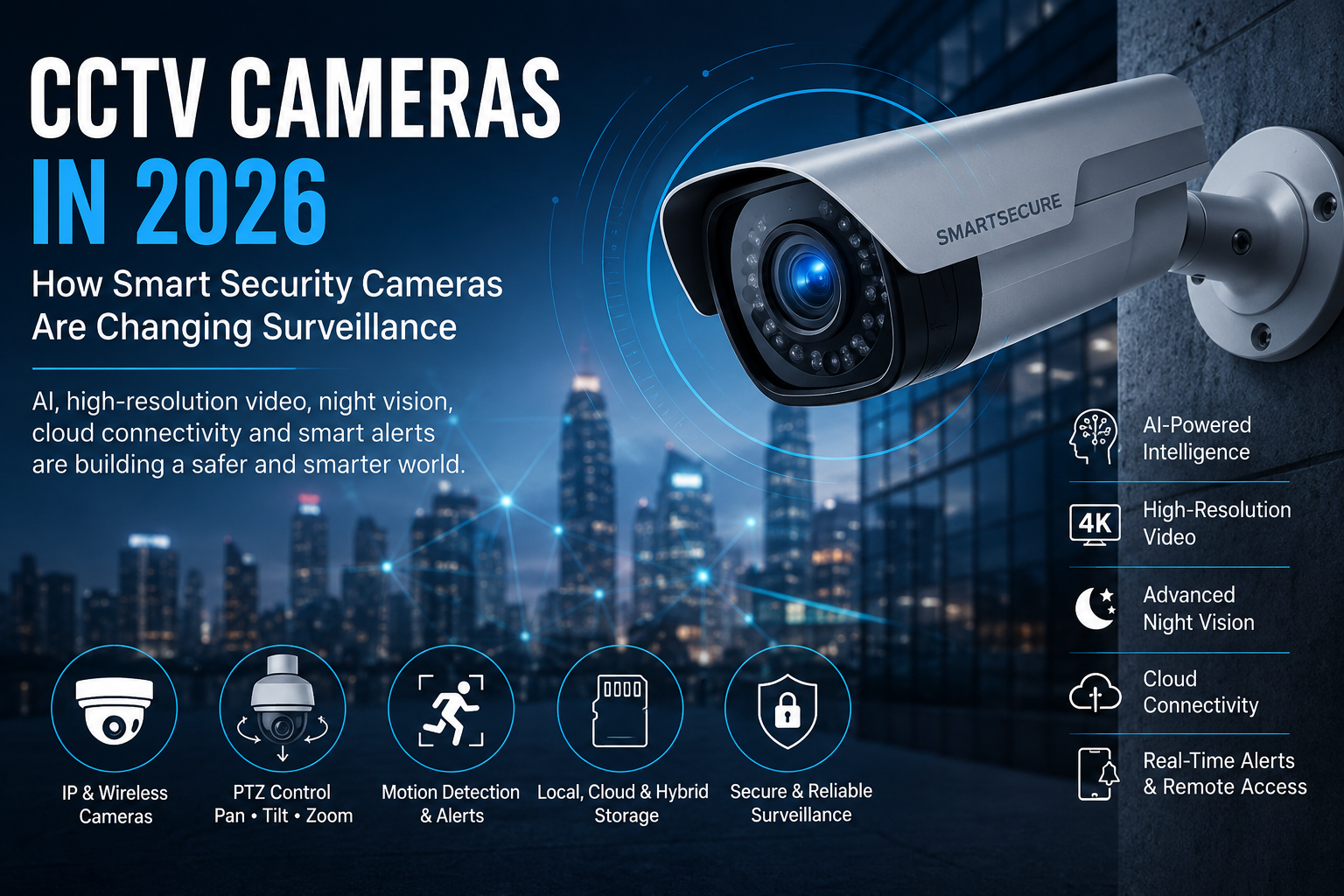
Security cameras have evolved far beyond simple video recording. Modern CCTV cameras combine high-resolution imaging, artificial intelligence, motion detection, night vision, cloud connectivity, and smart alerts to provide faster and more intelligent security.
From homes and offices to factories, retail stores, traffic systems, and public spaces, CCTV technology has become an important part of modern security infrastructure.
What Is a CCTV Camera?
CCTV stands for Closed-Circuit Television. Unlike traditional television broadcasting, CCTV systems transmit video to a limited set of monitors, recorders, or network devices.
A typical CCTV system can include cameras, cables or wireless connections, a video recorder, storage, a monitor, and networking equipment.
Modern systems increasingly use IP cameras, which connect directly to a network and can send video to computers, smartphones, or cloud platforms.
How Modern CCTV Cameras Work
A CCTV camera captures light through its lens and converts it into an electronic image using an image sensor. The camera then processes and compresses the video before sending it to a recording or monitoring system.
Depending on the camera, the footage may be stored on:
- Local memory cards
- DVR or NVR systems
- Network storage
- Cloud platforms
- Hybrid storage systems
This allows users to monitor live footage and review recorded video when required.
AI Is Making CCTV Cameras Smarter
One of the biggest developments in surveillance technology is the integration of Artificial Intelligence (AI).
Instead of simply recording everything, AI-powered cameras can analyze what they see. Depending on the system, they may detect people, vehicles, unusual movement, restricted-area entry, or other predefined events.
For example, an intelligent security camera can distinguish between a person walking through an area and harmless background movement such as moving trees.
This can reduce unnecessary alerts and make security monitoring more efficient.
High-Resolution Video and Night Vision
Image quality is another major area of CCTV development.
Modern cameras are available in resolutions such as Full HD, 2K, 4K, and higher. Higher resolution can provide more detail, which may be useful when identifying objects or examining recorded footage.
Night vision has also improved significantly. Infrared LEDs allow many cameras to capture images in low-light or dark environments, while some newer cameras use advanced sensors and low-light imaging technologies to produce more usable nighttime footage.
PTZ Cameras: Monitoring a Larger Area
PTZ cameras, or Pan-Tilt-Zoom cameras, can move horizontally and vertically while also providing optical zoom.
This allows a single camera to monitor a much larger area than a fixed camera.
PTZ systems are commonly used in locations such as:
- Parking areas
- Warehouses
- Industrial facilities
- Large buildings
- Traffic monitoring areas
- Public spaces
Some PTZ cameras can automatically follow detected movement, making them particularly useful for large surveillance environments.
Cloud-Connected CCTV
Cloud connectivity has changed the way people access security footage.
Instead of relying entirely on a local monitor, users can access compatible cameras through smartphones, tablets, or computers.
A cloud-connected system can provide features such as remote viewing, notifications, video backup, and centralized camera management.
However, cloud-based surveillance also makes data security and privacy extremely important. Strong passwords, secure networks, software updates, and appropriate access controls should be used to protect camera systems.
Wired vs Wireless CCTV Cameras
Both wired and wireless CCTV systems have advantages.
Wired cameras generally provide a stable connection and are often preferred for permanent installations. They can be suitable for businesses, factories, and large security systems.
Wireless cameras are easier to install in locations where running cables is difficult. They can also be convenient for homes and smaller installations.
The best option depends on the environment, network reliability, power availability, installation requirements, and security needs.
The Future of CCTV Technology
The future of CCTV is moving toward smarter and more automated surveillance.
AI-powered analytics, edge computing, improved image sensors, better low-light performance, cloud integration, and automated alerts are likely to continue changing how security cameras operate.
Instead of cameras simply acting as recording devices, future systems will increasingly function as intelligent security sensors capable of analyzing events in real time.
Final Thoughts
CCTV cameras have transformed from basic recording devices into sophisticated security technologies. With AI, high-resolution imaging, night vision, networking, and intelligent analytics, modern surveillance systems can provide much more than traditional video monitoring.
As technology continues to advance, the challenge will be balancing better security with privacy, cybersecurity, and responsible data management.
For businesses, homes, and industrial environments, choosing the right CCTV technology is no longer just about buying a camera. It is about building a complete and secure surveillance system.
#HashingHardware #CCTV #SecurityCamera #Surveillance #Technology #AI #SmartSecurity #IPCamera #CCTVCamera #CyberSecurity #HomeSecurity #SecurityTechnology #Engineering #FutureTech #IoT