
Introduction
The boundary between humans and machines is becoming increasingly blurred as technology advances. One of the most revolutionary developments in this field is the Brain-Computer Interface (BCI), a technology that enables direct communication between the human brain and external devices. By translating neural signals into digital commands, BCIs create a pathway for individuals to interact with computers, robotic systems, medical devices, and other technologies using only their thoughts.
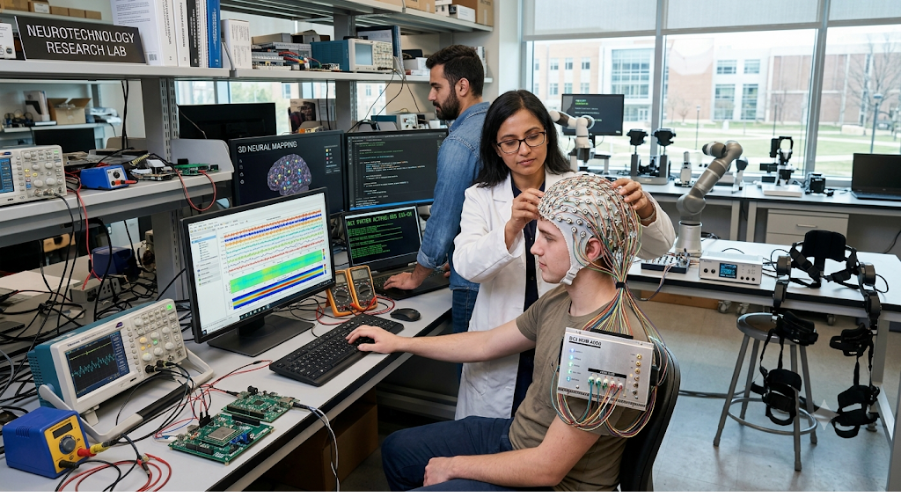
While software algorithms play a crucial role in interpreting brain activity, the foundation of every Brain-Computer Interface lies in its hardware. BCI hardware systems are responsible for capturing, amplifying, processing, and transmitting neural signals with high accuracy and reliability. These systems combine neuroscience, electronics, signal processing, and embedded engineering to create platforms capable of understanding brain activity in real time.
As research progresses, Brain-Computer Interface hardware is poised to transform healthcare, communication, robotics, education, gaming, and human augmentation technologies.
What Is a Brain-Computer Interface?
A Brain-Computer Interface is a system that establishes a direct communication pathway between the brain and an external device.
The primary objective of a BCI is to:
- Capture neural activity
- Interpret brain signals
- Convert signals into actionable commands
- Enable interaction without traditional input devices
Unlike keyboards, touchscreens, or voice commands, BCIs allow users to control systems using neural activity alone.
How Brain-Computer Interfaces Work
The operation of a BCI system generally involves several stages:
Signal Acquisition
Neural signals are captured from the brain using specialized sensors.
Signal Amplification
Weak neural signals are amplified for accurate processing.
Signal Processing
Noise and interference are removed from the acquired data.
Feature Extraction
Meaningful patterns are identified within neural signals.
Command Generation
The processed signals are translated into machine-readable instructions.
Device Control
Commands are used to control external systems such as computers, wheelchairs, robotic arms, or communication devices.
Types of Brain-Computer Interface Hardware
Invasive BCIs
Invasive systems require surgical implantation of electrodes directly into brain tissue.
Advantages
- High signal quality
- Precise neural measurements
- Superior control accuracy
Challenges
- Surgical risks
- Higher costs
- Long-term maintenance requirements
These systems are primarily used in advanced medical research and clinical applications.
Partially Invasive BCIs
Partially invasive systems place electrodes inside the skull but outside brain tissue.
Benefits
- Better signal quality than external systems
- Reduced surgical complexity
- Lower risk compared to fully invasive methods
Non-Invasive BCIs
Non-invasive BCIs capture brain activity using sensors placed on the scalp.
Advantages
- No surgery required
- Lower cost
- Easier deployment
- Safer operation
Limitations
- Lower signal resolution
- Greater susceptibility to noise
Non-invasive BCIs are currently the most widely used approach.
Core Components of BCI Hardware Systems
Neural Signal Sensors
Sensors are responsible for detecting brain activity.
Common sensor technologies include:
- Electroencephalography sensors
- Magnetic field sensors
- Optical neural sensors
- Implantable microelectrodes
The quality of signal acquisition directly impacts system performance.
Electrode Arrays
Electrodes serve as the interface between neural tissue and electronic systems.
Their functions include:
- Detecting electrical activity
- Recording neural signals
- Delivering stimulation signals in some applications
Modern electrode arrays are designed to maximize signal quality while minimizing discomfort.
Signal Amplification Circuits
Brain signals are extremely weak, often measuring only a few microvolts.
Amplification circuits:
- Increase signal strength
- Improve signal clarity
- Enable accurate processing
These circuits are essential components of every BCI system.
Analog-to-Digital Converters
Neural signals are initially captured as analog electrical signals.
Analog-to-Digital Converters (ADCs) transform these signals into digital data suitable for computational analysis.
Benefits include:
- Accurate signal representation
- High-resolution processing
- Efficient data handling
Signal Processing Hardware
Signal processing hardware removes unwanted interference and extracts useful information.
Filtering Systems
Filters eliminate:
- Electrical noise
- Motion artifacts
- Environmental interference
This improves signal reliability.
Digital Signal Processors
Dedicated processing units accelerate:
- Signal analysis
- Pattern recognition
- Neural decoding
DSP hardware is widely used in advanced BCI systems.
Embedded Processing Units
Modern BCI platforms rely on embedded processors for real-time computation.
Microcontrollers
Suitable for portable and low-power applications.
Benefits include:
- Energy efficiency
- Compact design
- Cost effectiveness
High-Performance Processors
Used for advanced neural processing tasks requiring greater computational power.
Applications include:
- Medical research
- Neural decoding
- Real-time AI analysis
Artificial Intelligence Integration
AI has become an essential component of modern Brain-Computer Interfaces.
Machine Learning Models
AI algorithms help identify patterns within neural activity.
Applications include:
- Intent recognition
- Cognitive state analysis
- Predictive control
Real-Time Neural Decoding
AI enables rapid interpretation of complex brain signals.
Benefits include:
- Faster response times
- Improved accuracy
- Enhanced user experiences
Wireless Communication Hardware
Modern BCIs increasingly support wireless operation.
Bluetooth Communication
Used for:
- Short-range connectivity
- Mobile integration
- Wearable devices
Wi-Fi Connectivity
Supports:
- Data transmission
- Cloud integration
- Remote monitoring
Low-Power Communication Protocols
Energy-efficient communication technologies extend battery life in portable systems.
Power Management Systems
Efficient power management is essential for wearable and implantable BCIs.
Battery Technologies
Modern systems utilize compact rechargeable batteries.
Requirements include:
- Long operating life
- Lightweight design
- Safe operation
Power Optimization
Advanced power management circuits reduce energy consumption while maintaining performance.
Neural Stimulation Hardware
Some BCIs not only read brain activity but also stimulate neural tissue.
Applications include:
- Medical treatments
- Neural rehabilitation
- Sensory restoration
Stimulation systems require highly precise hardware control.
Wearable BCI Hardware
Wearable BCIs have gained significant popularity due to their accessibility.
Headbands
Lightweight and easy to use.
Smart Helmets
Provide enhanced sensor coverage and signal quality.
Wearable Caps
Commonly used in research and educational environments.
Wearable systems enable practical real-world deployment.
Brain-Computer Interfaces in Healthcare
Healthcare represents one of the most important applications of BCI technology.
Assistive Communication
BCIs help individuals communicate when traditional methods are unavailable.
Motor Rehabilitation
Neural interfaces support recovery following neurological injuries.
Prosthetic Control
Users can control robotic limbs through neural activity.
Neurological Monitoring
Continuous monitoring assists in medical diagnosis and treatment.
Applications in Robotics
Brain-controlled robots are becoming increasingly sophisticated.
Applications include:
- Robotic arms
- Service robots
- Industrial automation
- Remote exploration systems
BCIs enable intuitive human-machine interaction.
Applications in Gaming and Entertainment
Gaming systems are beginning to incorporate neural interaction technologies.
Benefits include:
- Hands-free control
- Enhanced immersion
- Adaptive gameplay experiences
Future entertainment platforms may increasingly utilize brain-based inputs.
Educational and Research Applications
BCIs are valuable tools for:
- Neuroscience research
- Cognitive studies
- Human behavior analysis
- Educational experiments
Researchers use BCI hardware to better understand brain function.
Security and Privacy Considerations
Brain data is highly sensitive and requires strong protection.
Data Encryption
Protects neural information during storage and transmission.
Secure Authentication
Prevents unauthorized access to neural data.
Privacy Protection
Ensures ethical use of brain-derived information.
Security will become increasingly important as BCI adoption grows.
Challenges in BCI Hardware Development
Signal Noise
Brain signals are often weak and susceptible to interference.
Hardware Miniaturization
Devices must become smaller and more comfortable.
Power Efficiency
Long battery life remains a major design challenge.
Signal Accuracy
Improving neural decoding precision is an ongoing research focus.
Cost Reduction
Affordable systems are necessary for widespread adoption.
Emerging Technologies in BCI Hardware
Flexible Electronics
Flexible sensors improve comfort and wearability.
Nanotechnology-Based Electrodes
Enable more precise neural measurements.
AI-Optimized Signal Processing
Improves interpretation accuracy.
Wireless Implantable Systems
Reduce physical constraints on users.
High-Density Electrode Arrays
Provide richer neural data collection.
Future Trends
Consumer Brain Interfaces
BCIs may become integrated into everyday digital devices.
Neural-Augmented Computing
Users may interact directly with computers through thought.
Advanced Prosthetics
Improved neural control of artificial limbs.
Smart Healthcare Systems
Continuous brain monitoring and personalized treatment.
Human-Machine Collaboration
Enhanced cooperation between humans and intelligent machines.
Educational Importance
Studying Brain-Computer Interface hardware involves knowledge from multiple disciplines, including:
- Electronics Engineering
- Embedded Systems
- Neuroscience
- Artificial Intelligence
- Biomedical Engineering
- Signal Processing
- Wireless Communications
These interdisciplinary skills are increasingly valuable as neurotechnology continues to advance.
Conclusion
Brain-Computer Interface Hardware Systems represent one of the most groundbreaking areas of modern technology. By creating direct communication pathways between the human brain and digital systems, BCIs are transforming how humans interact with machines. Through advancements in sensors, signal processing hardware, artificial intelligence, wireless communication, and embedded computing, these systems are becoming more accurate, portable, and accessible.
Although challenges related to signal quality, miniaturization, power efficiency, and privacy remain, ongoing innovations continue to push the boundaries of what is possible. As research progresses, Brain-Computer Interface hardware is expected to play a central role in healthcare, robotics, communication, education, and human augmentation, opening new possibilities for enhancing both human capability and technological interaction.